
Construction Slurry Treatment
Rapid dewatering of bentonite and polymer drilling slurry from bored piles, diaphragm walls, and HDD operations. Converts liquid waste to stackable solids for disposal.
PAM for Construction Slurry Dewatering
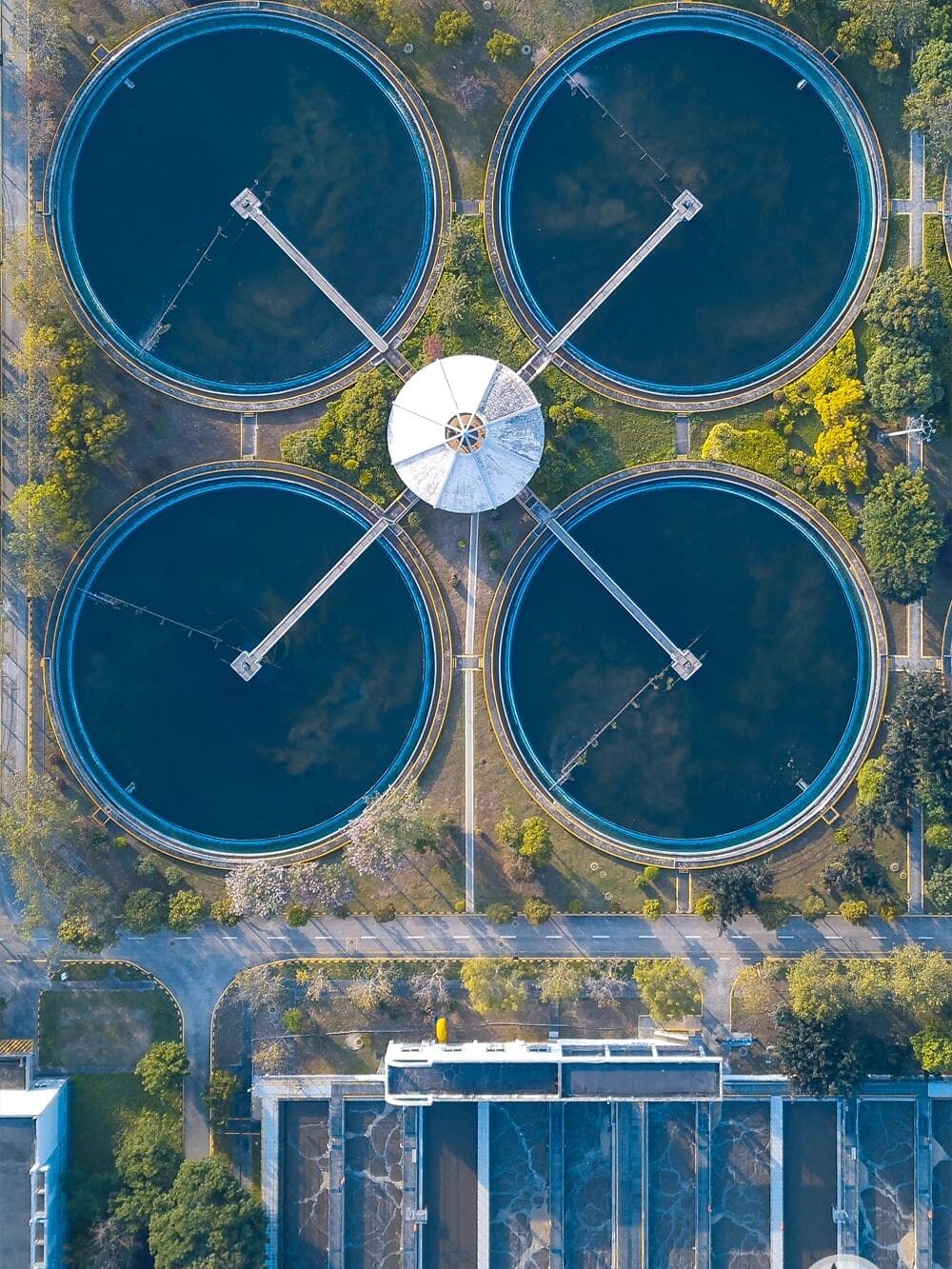
This page is about spent slurry — the bentonite and polymer drilling fluid that has done its job on bored piles, diaphragm walls and horizontal directional drilling, and now has to leave site as water you can discharge or reuse and solids you can stack and haul. The objective is destruction: break the suspension deliberately, recover the water, and get the fines into a handleable cake.
That is the opposite of what you do to slurry still in service. On a slurry shield or slurry TBM the fluid is a working material whose density and yield stress hold the excavation face, and flocculating it destroys the property you need — the separation plant there uses screens, cyclones and centrifuges to pull solids out while keeping the fluid alive. If that is your situation, our page on TBM and shield tunneling slurry covers it, including where polymer is legitimate on that circuit and where it is not. Here, the slurry is waste, so flocculating the bentonite is the goal rather than the mistake.
We supply anionic, cationic and non-ionic grades for this duty from our own plant in Xinxiang, Henan, with 100,000 tons/year of PAM capacity, and batch documentation for every consignment.
What Is Actually in the Tank
Spent slurry is described loosely on site and the differences decide the chemistry. Four streams turn up under the same name, and only one of them behaves the way most dosing advice assumes.
| Source | What dominates the solids | Dewatering difficulty |
|---|---|---|
| Bored piles in sand and gravel | Coarse cuttings plus bentonite; much of the load settles on its own | Easiest — screen and settle first, polymer for the fines only |
| Diaphragm walls, repeated panel reuse | Bentonite that has been recycled until it is loaded with sub-micron fines | Hard — the fraction left is the fraction that will not settle |
| Drilling in clay or weathered rock | Dispersed native clay, often more than the bentonite added | Hardest — plate-like colloids, strongly negative, very high water retention |
| HDD returns and bentonite plant washout | Dilute bentonite, sometimes with polymer mud additives | Moderate — thin, high volume, cheap to treat but easy to overdose |
Two practical readings come out of that table. First, the hardest slurry is not the thickest — it is the one that has been recycled longest, because every cycle removes what separates easily and concentrates what does not. Second, if your slurry is mostly native clay rather than bentonite, expect higher polymer demand and a wetter cake than any supplier's reference figures suggest, because dispersed clay holds water in a way bentonite flocs do not.
Why Polymer Alone Usually Disappoints
The most common complaint we hear on this application is that a high molecular weight anionic polymer produced a beautiful result in a jar and a disappointing one at the press. The reason is in the particles. Bentonite platelets are sub-micron, plate-shaped and carry a strong permanent negative surface charge — that charge is exactly what makes bentonite a good drilling fluid, because the platelets repel each other and stay suspended for weeks. An anionic polymer is also negative. It can bridge, but it is bridging against electrostatic repulsion it cannot overcome on its own.
The fix is a two-stage sequence, and it is worth stating in order because reversing it wastes both chemicals:
- Neutralise charge first. Lime, polyaluminium chloride, ferric chloride or a low molecular weight cationic coagulant such as polyDADMAC collapses the repulsion and lets the platelets approach each other. Bentonite-heavy slurry that resists everything else usually responds here.
- Then bridge with high molecular weight polymer. Once micro-flocs exist, anionic or non-ionic PAM aggregates them into a structure with enough size and shear strength to survive a pump and release water under pressure.
Skip stage one and you dose ever more expensive high molecular weight polymer into a suspension that will not aggregate. Skip stage two and you get micro-flocs that settle slowly and blind a filter cloth. Our polyDADMAC coagulant guide covers the charge-neutralisation side, and the difference between coagulation and bridging is set out in our PAM versus other polyelectrolytes comparison.
Grade and Dose Selection
Doses are given per tonne of dry solids where a press or centrifuge is involved, and per cubic metre where the duty is clarifying thin water. Mixing those two units is the most common source of a tenfold dosing error on site.
| Duty | Grade | Typical dose | Notes |
|---|---|---|---|
| Clarifying thin return water for reuse | Anionic, 15-22M MW, 25-30% hydrolysis | 2-8 g/m³ | After coagulant; target under 100 NTU if the water goes back to the slurry plant |
| Thickening in a settling tank or lamella clarifier | Anionic, 12-18M MW | 20-60 g/m³ of feed | Dense, fast-settling flocs matter more than floc size |
| Filter press or plate-and-frame | Cationic, 8-12M MW, 20-40% charge | 1-4 kg/t dry solids | Needs shear-resistant flocs that will not blind the cloth |
| Decanter centrifuge | Cationic, 6-10M MW, 40-60% charge | 2-6 kg/t dry solids | Lower MW deliberately — high MW flocs shear apart in the bowl |
| Geotextile dewatering tubes or bags | Cationic, 8-12M MW, 30-50% charge | 2-5 kg/t dry solids | Floc must hold under static load for days without releasing fines |
Full grade data is on our anionic polyacrylamide and cationic polyacrylamide pages. If you are converting between dose bases, the arithmetic is worked through in our PAM dosage calculation guide.
Matching Polymer to the Dewatering Equipment
The equipment decides the polymer more than the slurry does, because each machine destroys or exploits floc structure differently. This is where reference doses copied from another site most often fail.
Filter presses want flocs that hold together under rising pressure and drain through a cloth without plugging it. Too little polymer and fines migrate into the weave and blind it, so cycle times climb through the shift. Too much and the cake becomes compressible mush that seals its own surface. The diagnostic is filtrate clarity in the first minute of the cycle: cloudy means under-dosed, and a cake that will not release means over-dosed.
Decanter centrifuges are the case where a higher molecular weight actively hurts. The bowl applies sustained shear, and large fragile flocs are torn into fragments that report to the centrate instead of the cake. Lower molecular weight with higher charge density gives smaller, denser, shear-tolerant flocs and a clearer centrate — counterintuitive if you are used to buying molecular weight as a proxy for strength.
Geotextile tubes and dewatering bags are common on constrained sites and have their own failure mode. The floc has to survive static compression for days while water drains under gravity, so what matters is not initial settling speed but whether the structure holds. A polymer that gives a spectacular jar result in 30 seconds can still release fines through the fabric on day three, staining the discharge long after anyone is watching the tank.
Plain settling tanks reward dense flocs over large ones. A large, open, water-filled floc settles fast and then occupies enormous volume at the bottom, so the tank fills with sludge that is 6-8% solids and you are back to hauling water. Dosing for density rather than for a visually impressive floc is what gets the underflow up.
Reuse, Discharge and the Numbers That Get You Caught
Recovered water has two possible destinations and they impose different specifications. Sending it back to the slurry plant is forgiving on turbidity but unforgiving on chemistry. Sending it to a watercourse or sewer is the reverse.
For reuse, the constraint people miss is accumulation. Residual coagulant and hardness from lime build up over successive cycles, and bentonite hydrates poorly in hard or high-ionic-strength water — so a plant that recycles aggressively can find fresh bentonite giving progressively less yield for the same mass. If make-up bentonite consumption is drifting upward while recycling rate is stable, test the recycled water for hardness before blaming the bentonite supplier.
For discharge, three numbers cause almost all the trouble. pH — lime dosing routinely pushes recovered water above pH 10, well outside typical consent limits, and it needs neutralising before it leaves site rather than after someone samples it. Suspended solids — the fines that pass a geotextile or overflow a settling tank are exactly the fraction that stays visible in a receiving watercourse. Residual polymer — over-dosing puts unreacted polymer in the water, and while PAM at these levels is not the acute hazard some assume, free polymer is measurable and some consents address it directly.
The general principle is that dosing to the visible endpoint in the tank is not the same as dosing to the consent at the outfall, and the second one is the one you are held to.
Worked Example: Where the Money Actually Is
Modelled from typical site arithmetic rather than a delivered project, and the ratios matter more than the currency. Take a diaphragm wall job recovering only 40% of its bentonite slurry and consuming roughly 500 m³ per day of fresh make-up.
Lift recovery to 75% with correct solids separation and staged chemistry, and make-up demand falls to around 125 m³ per day. Two costs fall together: the bentonite and water you no longer buy, and the liquid waste you no longer transport. The second is usually the larger of the two, because hauling liquid waste means paying to move water by the tonne.
That is also why cake dryness deserves more attention than it usually gets. Moving spent slurry from 6% solids to 25% solids removes roughly three quarters of the mass going out the gate for the same quantity of actual soil — the dry solids are unchanged, only the water travelling with them changes. Between polymer cost and haulage cost, the second dominates by a wide margin on most sites, which means the correct optimisation target is cake dryness rather than polymer consumption. Substitute your own bentonite, water and disposal rates before building a business case on this.
Dosing Practice on Site
- Screen and settle before you dose anything. Coarse cuttings do not need polymer and consuming it on them is pure waste. Take out everything gravity and a shaker will give you first, then treat what is left.
- Jar test the actual slurry, and re-test when the ground changes. A dose established in sand will be wrong when the bore enters clay. This is the single biggest difference between construction slurry and a fixed industrial effluent — your feed changes as the job advances.
- Test coagulant and polymer as a pair, not separately. The optimum polymer dose depends on how much charge neutralisation happened upstream, so a polymer curve run without the coagulant tells you little about the plant.
- Make down properly even under site conditions. High molecular weight powder needs 30-60 minutes of gentle agitation at 0.1-0.3% to hydrate. Half-dissolved polymer is the most common cause of "the product got worse" on a construction site, and it looks identical to a quality problem.
- Dose into flow with adequate but brief mixing. Flocs formed by bridging do not reform once broken, so a long pumped run between the dosing point and the press undoes the work. Dose close to the equipment.
- Judge on cake solids and filtrate clarity, not floc appearance. Large flocs are satisfying and often over-dosed. We test every batch for molecular weight to a ±0.5M tolerance and retain samples for 24 months, so if plant behaviour shifts we can compare your drum against the retained sample and separate a product change from a ground change.
Make-down detail is in our PAM dissolving method guide, and the trial protocol is in our jar test procedure.
Standards and Reference Bodies
Construction slurry sits across geotechnical and water discharge regimes, so the relevant references come from both. We name bodies rather than quote document numbers, because slurry disposal rules are strongly local and a number quoted from memory is worse than none.
- ASTM International — test methods for bentonite slurry properties including density, viscosity, sand content and filtrate loss, which are what you measure to decide whether slurry is still in service or spent.
- American Petroleum Institute — the drilling fluid test procedures most slurry plant equipment and site practice derive from, including the standard filter press and sand content methods.
- APHA, AWWA and WEF — jointly publish Standard Methods for the Examination of Water and Wastewater, the source for the suspended solids and turbidity analyses used on recovered water.
- International Society for Soil Mechanics and Geotechnical Engineering — technical guidance on bentonite support fluid practice for diaphragm walls and bored piles.
- Your local environmental regulator — the binding constraint on pH, suspended solids and discharge consent. Confirm limits before designing the water side, not after.
Frequently Asked Questions
Why did my anionic PAM work in the jar but not at the press?
Usually because the jar test and the plant are not doing the same thing. A jar gives gentle mixing, a long quiet settling period and no pressure; a press applies shear through a pump and then sustained compression. Flocs formed by bridging do not reform once broken, so a polymer that produces large fragile flocs can look excellent in a beaker and fail in the machine. Add charge neutralisation upstream, dose closer to the equipment, and judge on filtrate clarity rather than floc size.
Do I need a coagulant as well as polymer?
For bentonite-heavy or clay-rich slurry, almost always yes. Bentonite platelets carry a strong permanent negative charge that keeps them suspended, and anionic polymer is also negative, so it is bridging against repulsion. A lime, PAC, ferric or polyDADMAC stage collapses that repulsion and typically cuts total chemical cost, because you stop compensating with expensive high molecular weight polymer.
Can I use the same polymer as the TBM separation plant next door?
The duties are opposite, so usually no. On a slurry TBM the fluid is a working material and the plant is trying to remove solids while keeping it suspendable, which is why polymer is restricted there. Here the slurry is waste and you are deliberately destroying the suspension. Same site, same word, different objective — see our TBM slurry page for that circuit.
What cake solids should I expect?
It depends far more on the solids than the polymer. Sandy cuttings press readily; recycled bentonite loaded with sub-micron fines gives a much wetter cake at the same dose; dispersed native clay is the hardest case because it holds water structurally. Expect a filter press to outperform a geotextile tube, and a geotextile tube to outperform a settling tank, at every solids type. Run the trial on your own slurry before committing to a haulage estimate.
Is residual polymer in the recovered water a problem?
At correct doses very little polymer stays free in the water — it is consumed on particle surfaces. Residual polymer is a symptom of over-dosing, and the fix is dose control rather than a different product. If you discharge to a watercourse, check what your consent says about polymer and suspended solids, and remember that lime-dosed water also needs pH correction before it leaves site.
Construction Slurry Treatment is one of several construction processes we supply polyacrylamide for. For grade selection across the full construction scope — including MOQ, samples, and quality documents — see PAM for Construction.
Recommended Products
Other Construction Solutions
Related Articles
PolyDADMAC Coagulant: Dose, Uses and PAM Pairing
What polyDADMAC does, why a coagulant is not a flocculant, charge neutralisation and overdose restabilisation, dose ranges by duty, and how it pairs with polyacrylamide.
Water TreatmentPolyacrylamide for Water Treatment: The Complete Buyer's Guide (2026)
Complete guide to polyacrylamide (PAM) for water treatment. Covers anionic, cationic, and nonionic PAM selection, dosage ranges, application scenarios, supplier selection, and cost optimization for every major water treatment sector.
Water TreatmentPolyacrylamide for Food Processing Wastewater: Dosage
Select and dose polyacrylamide for slaughterhouse, beverage, starch and dairy wastewater: dosage tables by stream, cost per m3, DAF and clarifier notes.
Water TreatmentPAM for Sand Washing: Dosage, Settling, and Water Recycling
How to use anionic PAM for sand washing wastewater treatment. Dosage vs turbidity data, grade selection, water recycling system design, and cost analysis from 130+ sand plant samples.
Water TreatmentPAM for Livestock Wastewater: Pig Farm, Poultry & Dairy
Cationic PAM selection and dosing for livestock wastewater from pig farms, poultry operations, and dairy facilities. Jar test data, system design, sludge dewatering, and cost analysis.
Technical GuidePAM Overdosing: 7 Signs You Are Wasting Polymer (and How to Fix It)
How to detect polyacrylamide overdosing in your water treatment plant. 7 field indicators, cost analysis, stepdown protocol, and prevention checklist from 200+ lab tests.
Ready to Optimize Your Construction Slurry Treatment Process?
Send us your process parameters — we'll provide a free product recommendation with dosage calculation.