Proper dissolution is the most overlooked factor in PAM performance. We get calls from customers saying their PAM "doesn't work" — and 80% of the time, the problem is improper dissolution, not the product itself. Here is the correct procedure.
Dissolution Requirements by PAM Type
Polyacrylamide dissolution requires 30-90 minutes of gentle mixing at 20-40°C and 0.1-0.3% concentration to fully hydrate polymer chains — incomplete dissolution wastes 30-50% of the polymer's flocculation capacity because undissolved granules pass through the system without bridging particles.
| PAM Type | Dissolution Time | Optimal Temp | Concentration |
|---|---|---|---|
| APAM (low MW, 6-10M) | 30-45 min | 20-40°C | 0.1-0.3% |
| APAM (high MW, 15-28M) | 60-90 min | 20-40°C | 0.1-0.2% |
| CPAM (all grades) | 45-90 min | 20-40°C | 0.1-0.3% |
| NPAM | 60-90 min | 20-40°C | 0.1-0.2% |
| Emulsion PAM | 1-5 min | 10-40°C | 0.1-0.5% |
Step-by-Step Dissolution Procedure
The standard PAM dissolution procedure involves slow powder addition into a gentle vortex (50-100 rpm) over 5-10 minutes, followed by 30-90 minutes of low-shear aging — this sequence prevents fish-eye lumps that trap dry polymer inside a hydrated shell, rendering up to 40% of the product ineffective.
- Prepare clean water — use tap water or process water at 20-40°C. Cold water (<15°C) slows dissolution significantly. Hot water (>50°C) degrades the polymer.
- Fill the aging tank — fill to 80% of target volume. Leave room for the powder and mixing.
- Start the mixer — set to low speed (50-100 rpm). You want a gentle vortex, not vigorous agitation. High shear breaks polymer chains and reduces molecular weight.
- Add powder slowly — sprinkle PAM powder into the vortex gradually over 5-10 minutes. Do not dump the entire bag at once — this causes lumping that never fully dissolves.
- Continue mixing — maintain gentle agitation for the full dissolution time (30-90 minutes depending on grade). The solution should become clear and slightly viscous.
- Check for lumps — after the dissolution time, inspect for undissolved lumps. If lumps remain, continue mixing for another 30 minutes. Persistent lumps indicate improper addition or water temperature issues.
- Dilute to working concentration — add remaining water to reach target concentration (0.1-0.3%). Mix gently for 5 minutes.
- Use within 24 hours — prepared PAM solution degrades over time. Prepare fresh solution daily for best performance.
Equipment Requirements
A properly designed PAM dissolution system uses dual aging tanks with low-shear paddle mixers (50-100 rpm), peristaltic dosing pumps, and large-bore piping (50mm+) at flow velocity below 1 m/s — high-shear equipment like centrifugal pumps can degrade polymer molecular weight by 30-60%, directly reducing flocculation performance.
Per AWWA water treatment chemical handling standards, PAM dissolution systems should be designed for continuous operation with redundancy. For continuous operation, you need at least two aging tanks — one dissolving while the other is in use. Minimum tank size: 1-2 hours of solution consumption.
- Tank material — stainless steel or polyethylene. Avoid carbon steel (PAM can corrode it).
- Mixer type — low-shear paddle mixer or slow-speed propeller. Avoid high-shear mixers (centrifugal pumps, turbine mixers).
- Mixer speed — 50-100 rpm. Faster breaks polymer chains.
- Dosing pump — peristaltic or diaphragm pump. Avoid centrifugal pumps for dosing — they shear the polymer.
- Piping — large diameter (50mm+), low velocity (<1 m/s). Avoid sharp bends and restrictions.
According to WEF process design guidelines, the aging tank should provide minimum 60 minutes retention time for high MW grades. Undersized tanks are the number one cause of incomplete dissolution in the field. Size your tanks for peak demand, not average demand.
Water Quality for Dissolution
Dissolution water quality directly controls PAM hydration efficiency — water must be 20-40°C, below 500 ppm hardness, pH 6-8, and under 0.5 ppm chlorine, because calcium ions precipitate anionic polymer chains while chlorine oxidatively cleaves them, reducing effective molecular weight by up to 50%.
The water you use for dissolution matters more than most operators realize. Per documented quality control quality control standards for chemical preparation, dissolution water should meet these criteria:
- Temperature: 20-40°C (optimal 25-35°C). Below 15°C doubles dissolution time. Above 50°C degrades polymer.
- Hardness: Below 500 ppm CaCO3. High hardness can cause APAM to precipitate with calcium ions.
- pH: 6-8 (neutral). Extreme pH during dissolution can hydrolyze the polymer prematurely.
- Chlorine: Below 0.5 ppm. Chlorine is an oxidizer that breaks polymer chains. If using chlorinated tap water, let it sit 30 minutes to off-gas chlorine before dissolving PAM.
- Iron: Below 1 ppm. Dissolved iron catalyzes polymer degradation through Fenton-type reactions.
If your process water has high hardness or iron, use softened water or RO permeate for PAM dissolution. The small extra cost of clean dissolution water pays for itself in better polymer performance and lower dosage requirements.
Common Mistakes and How to Fix Them
The five most common PAM dissolution failures — lumping, incomplete hydration, over-concentration, thermal degradation, and oxidative chain scission — collectively account for 80% of "product doesn't work" complaints, yet all are preventable through proper procedure control without changing the polymer grade.
Lumping
Cause: Adding powder too fast, or adding to still water without a vortex.
Fix: Always create a vortex before adding powder. Add slowly over 5-10 minutes. If lumps form, continue mixing — most will dissolve with time.
Poor Performance Despite Correct Dosage
Cause: Incomplete dissolution. Undissolved polymer does not flocculate.
Fix: Extend dissolution time. Check water temperature. Reduce concentration (try 0.1% instead of 0.3%).
Solution Too Viscous to Pump
Cause: Concentration too high, especially for high MW grades.
Fix: Reduce concentration to 0.1% for high MW grades (15M+ Da). Use larger diameter piping and lower pump speed.
Solution Degrading Quickly
Cause: High temperature, bacterial contamination, or oxidizing agents in water.
Fix: Use fresh water. Keep solution temperature below 40°C. Add biocide if bacterial contamination is suspected. Use within 24 hours.
Slow Dissolution in Winter
Cause: Cold water (<15°C) slows polymer hydration.
Fix: Heat water to 25-35°C before dissolving. Or switch to emulsion PAM, which dissolves in 1-5 minutes regardless of temperature.
Need PAM for your treatment system?
Free sample + jar test report. WhatsApp: +86 187-3759-0940
Emulsion PAM: Faster but Different
Emulsion polyacrylamide achieves full dissolution in 1-5 minutes versus 30-90 minutes for powder because the polymer is pre-dispersed as 1-10 micron droplets in oil phase — upon inversion with water, these micro-droplets hydrate almost instantly, eliminating the need for aging tanks while delivering equivalent flocculation performance at 20-30% higher cost per active kilogram.
Procedure for emulsion PAM:
- Add emulsion to water (not water to emulsion) under agitation
- Mix at medium speed (100-200 rpm) for 2-5 minutes
- The solution should become clear and viscous within 5 minutes
- Dilute to working concentration and use immediately
Emulsion PAM is more expensive per unit of active polymer but eliminates the need for aging tanks and long dissolution times. See our emulsion vs powder comparison for cost analysis.
Advanced Troubleshooting
Large-scale PAM dissolution systems face four critical failure modes — pipeline shear degradation beyond 50 meters, batch-to-batch inconsistency from variable aging time, surfactant-induced foaming causing pump cavitation, and seasonal temperature drops below 15°C that double required dissolution time and reduce floc formation kinetics by 20-30%.
Polymer degradation in long pipelines: If your dosing point is more than 50 meters from the aging tank, polymer chains can break from pipe friction. Solution: increase pipe diameter to reduce velocity below 0.5 m/s, eliminate sharp 90° elbows (use long-radius bends), and consider relocating the aging tank closer to the dosing point.
Inconsistent dosing from batch to batch: Usually caused by variable dissolution time. If operators rush the dissolution (30 minutes instead of 60), the solution contains undissolved polymer that does not flocculate. Solution: install a timer that locks the transfer valve until minimum dissolution time has elapsed. Automate what humans forget.
Foaming during dissolution: Some water sources contain surfactants that cause foaming when agitated. Foam traps air in the polymer solution, reducing its density and causing dosing pump cavitation. Solution: reduce mixer speed, add a small amount of defoamer (silicone-based, 1-2 ppm), or switch to a subsurface mixer that does not entrain air.
Seasonal performance variation: PAM performance drops in winter because cold water slows both dissolution and flocculation kinetics. Per AWWA cold-weather treatment guidelines, increase dissolution time by 50% when water temperature drops below 15°C. Also increase dosage by 20-30% to compensate for slower floc formation.
Scaling Up: From Jar Test to Full Plant
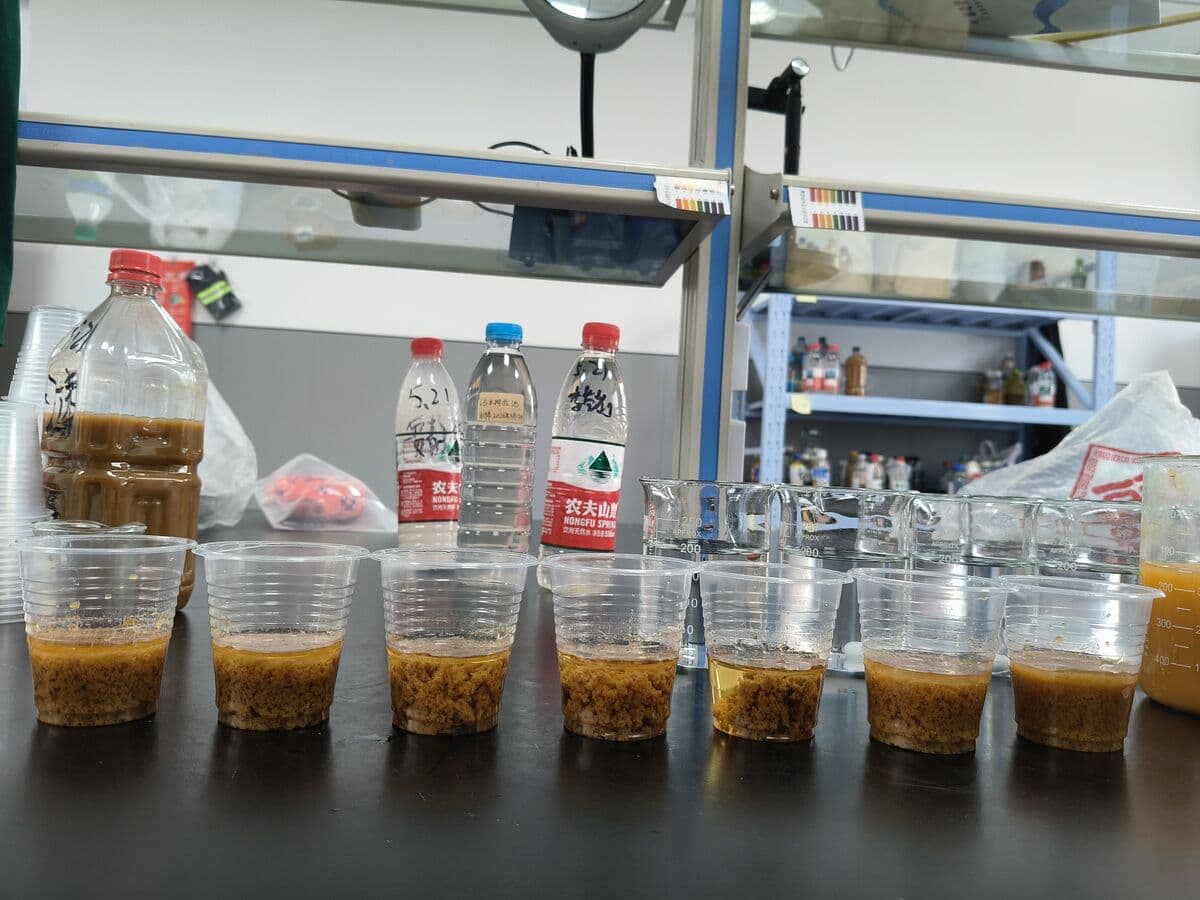
Scaling PAM dissolution from laboratory beakers to 5,000-liter aging tanks introduces mixing dead zones, uncontrolled powder addition rates, and extended solution residence times — plants that size tanks for 2-4 hours maximum retention and use screw feeders for gradual addition achieve 95%+ dissolution efficiency versus 60-70% with manual bag-dump methods.
- Mixing uniformity: In a beaker, mixing is uniform. In a large tank, dead zones form where powder accumulates and lumps. Use baffles and position the mixer off-center to eliminate dead zones.
- Powder addition rate: In a beaker, you add grams. In a plant, you add 25kg bags. Use a screw feeder or vibratory feeder for controlled, gradual addition. Never dump bags directly into the tank.
- Temperature control: Large tanks lose heat slower (good in winter) but also heat up slower. In cold climates, insulate the tank and consider a heating jacket or steam coil to maintain 25-35°C.
- Solution aging: Large batches sit longer before use. If your tank holds 8 hours of supply, the last portion used is 8 hours old and partially degraded. Size tanks for 2-4 hours maximum retention to keep solution fresh.
We offer free engineering support for dissolution system design. Send us your flow rate, PAM grade, and plant layout — we will recommend tank sizes, mixer specs, and piping configuration. This service is included with orders of 5+ tons. We have designed dissolution systems for plants treating 100 to 50,000 cubic meters per day.
Safety During Dissolution
PAM powder contains residual acrylamide monomer at ≤0.05% (a neurotoxin classified as Group 2A carcinogen by IARC), requiring N95 masks, nitrile gloves, and ventilation during handling — once dissolved to working concentration (0.1-0.3%), the acrylamide level drops below 0.15 ppm, making the solution safe for routine handling with basic PPE.
- Wear dust mask (N95 or better) when handling powder
- Wear nitrile gloves and safety glasses
- Work in ventilated area
- Wash hands thoroughly after handling
- Keep powder away from food and drinking water
Once dissolved in water at 0.1-0.3%, the solution is safe to handle with basic precautions (gloves). The acrylamide concentration in solution is extremely low (<0.15 ppm). For complete handling protocols, see our safety and SDS guide.
Spill hazard: dissolved PAM solution on floors is extremely slippery — more dangerous than the chemical toxicity itself. Clean up spills immediately with absorbent material and flush with large amounts of water. Post warning signs in the dissolution area. Per OSHA workplace safety standards, PAM preparation areas should have non-slip flooring and adequate drainage.
Storage of prepared solution: keep in covered tanks to prevent UV degradation and contamination. Do not store prepared solution for more than 48 hours — bacterial growth can occur in dilute polymer solutions, especially in warm climates. If you notice odor or discoloration in stored solution, discard it and prepare fresh.
Need Technical Support?
If you are having dissolution problems or poor performance, contact us. We provide free technical support including video calls to diagnose issues in real time. Common problems we help customers solve: lumping that will not dissolve, inconsistent flocculation performance, foaming in the aging tank, and polymer degradation during storage.
You may also find our molecular weight guide and dosage calculation guide helpful for optimizing your system. For choosing between powder and emulsion forms, see our emulsion vs powder comparison.
WhatsApp: +86 187-3759-0940 | Request a quote or sample
For more details, see our our jar test guide.
Get a Quote
Our factory in Xinxiang produces confirmed grade availability across core APAM, CPAM, NPAM, and PHPA products. MOQ 500kg, delivery 7-10 days standard. Contact us for pricing and free sample:
- WhatsApp: +86 187-3759-0940
- Email: info@chinapolyacrylamide.com
Recommended Product Grades
For the application discussed above, these are the polyacrylamide grades we ship most often:
- APAM High Molecular Weight grade
- high-charge-density CPAM
- cationic polyacrylamide emulsion — skips the dissolution step described above; inversion replaces it
- anionic polyacrylamide emulsion — same inversion procedure, anionic side
Not sure which is right for you? Try our PAM Selector tool or request a quote.