The jar test is the standard way to narrow PAM grade and dosage before full-scale use. A short lab check helps buyers and plant teams compare floc size, settling speed, and supernatant clarity on the same wastewater sample instead of choosing a grade from price alone.
This guide gives a practical jar-test workflow you can run in-house or use when reviewing a supplier recommendation. The goal is simple: match the application, wastewater conditions, and dosage range before you move into sample approval, documents, and a trial order. If you want the full selection framework behind these tests, the complete water treatment buyer's guide walks through grade choice for every major application.
Need to turn jar-test results into a supplier quote?
Start with the APAM product page for grade direction, review the MOQ and pricing guide, or check the ChinaPAM supplier profile before requesting samples. ChinaPAM's confirmed public baseline is MOQ 500 kg, free samples, 7-10 day lead time for common grades, and TDS, COA, and SDS by confirmed grade and batch.
Why Jar Testing Matters
A polyacrylamide jar test determines optimal dosage within ±10% accuracy in 30 minutes by testing 4-6 concentrations on actual wastewater samples — this prevents the two most expensive errors in PAM application: overdosing (wasting 30-60% of chemical cost) and underdosing (causing treatment failure), with typical savings of $36,000/year for a plant consuming 10 tons/month when dosage is optimized from jar test data versus operator guesswork.
- Turbidity level: 1-1,000+ NTU — a 100× range that changes optimal dosage by 10-50×
- Particle size distribution: Fine clay particles (<1 micron) need higher MW PAM than coarse silt (10-100 microns)
- pH: PAM charge changes with pH. Anionic PAM loses charge below pH 5; cationic PAM loses charge above pH 9
- Temperature: Cold water (5-10°C) needs 20-30% more PAM than warm water (25-35°C)
- Coagulant type and dosage: PAM works with coagulant, not instead of it. Wrong coagulant dose makes PAM ineffective
- Ionic strength: High-salinity water collapses anionic PAM chains, reducing bridging efficiency by 30-60%
Guessing dosage wastes money. A 30-minute jar test gives you optimal dosage with 90%+ accuracy. For a plant consuming 10 tons of PAM per month at $1,500/ton, a 20% dosage reduction from jar testing saves $3,000/month — $36,000/year.
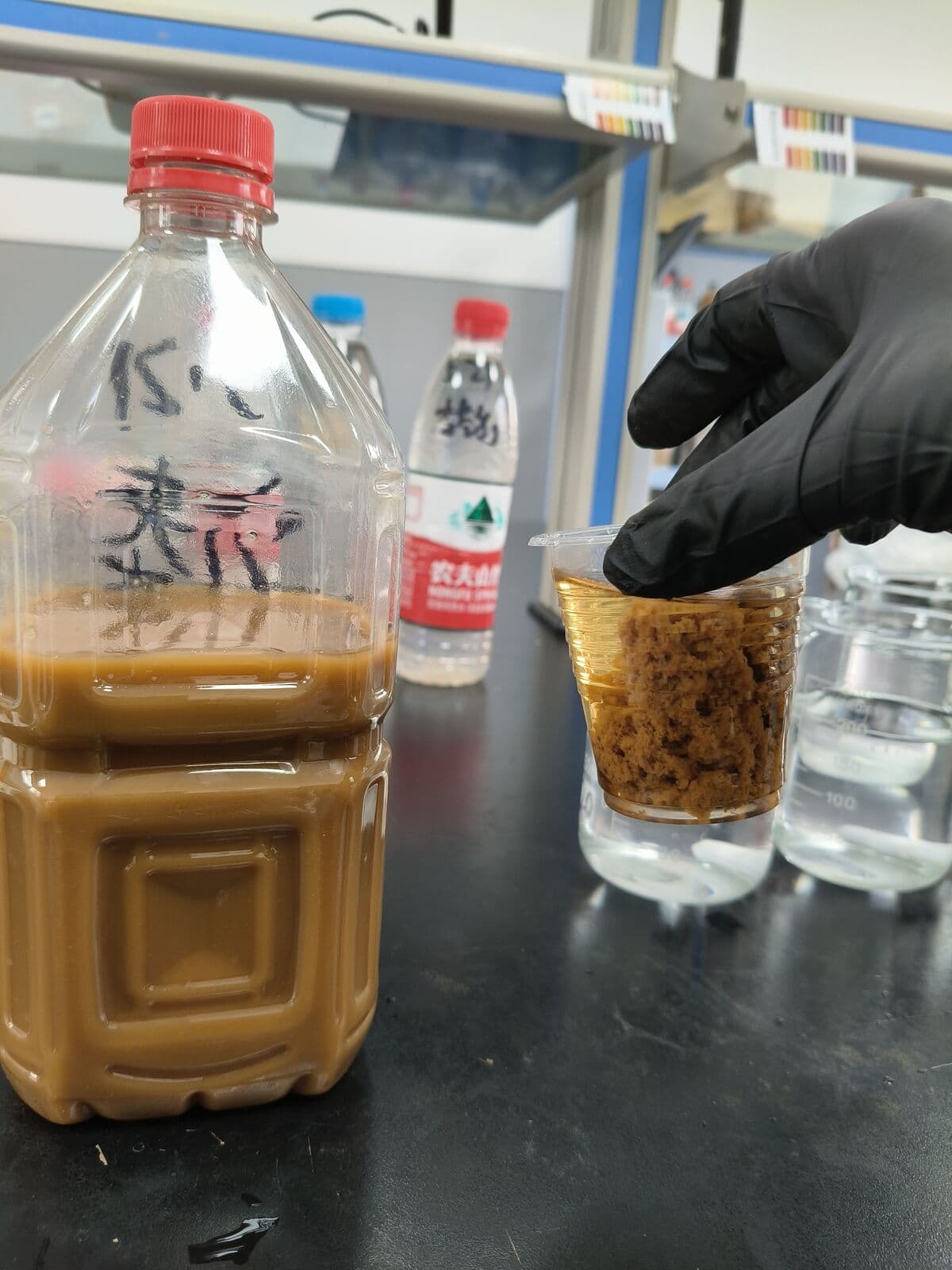
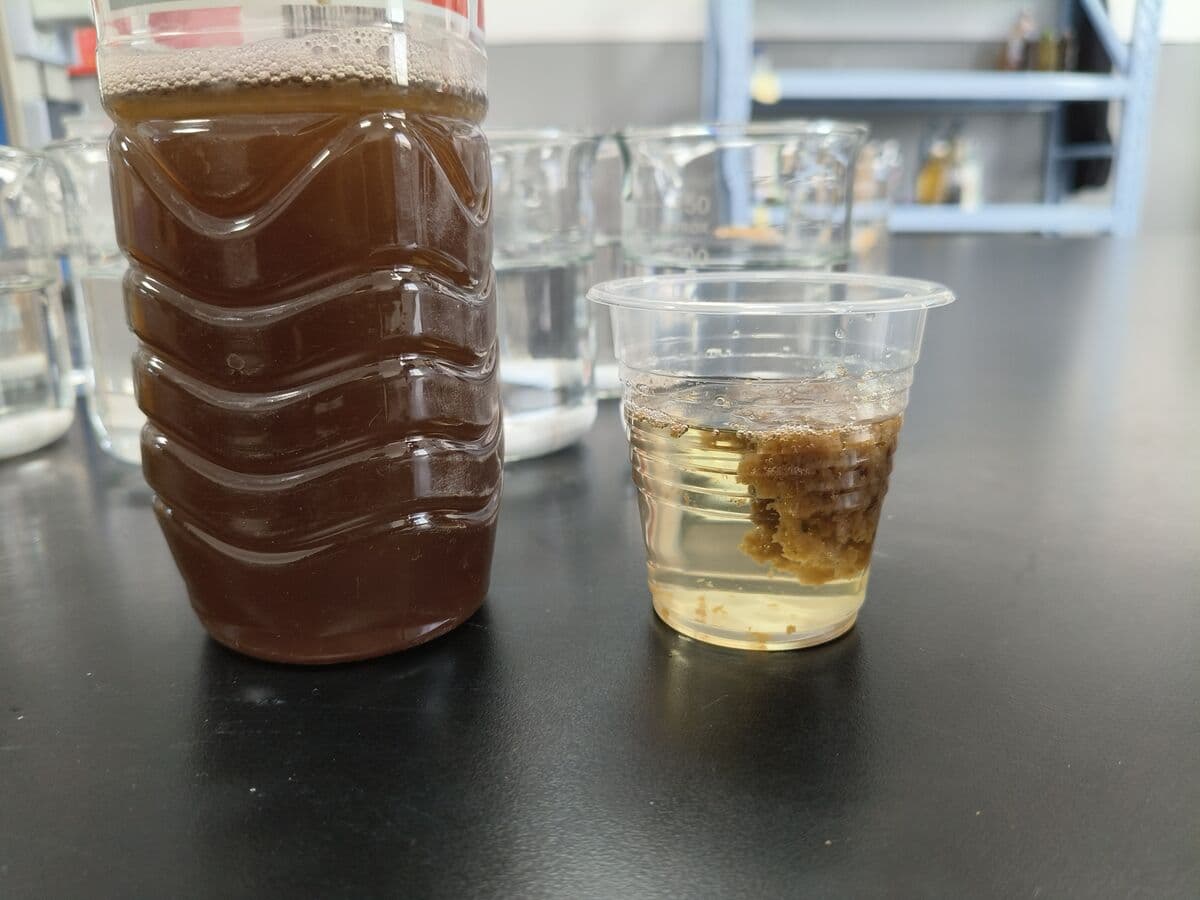
Jar-test bench in our lab: dewatered floc checked by hand for firmness, with the diluted PAM stock solution and pH strips used in the same run
Equipment Needed
A standard jar test setup requires six 1-liter clear beakers, a paddle mixer apparatus (or manual stirring capability), turbidimeter, calibrated pipettes, pH meter, and thermometer — total equipment cost under $2,000 for basic setup, with most water treatment plants and mining operations already having these items available in their on-site laboratory.
| Item | Quantity | Notes |
|---|---|---|
| 1L beakers or clear jars | 6-8 | Clear glass or plastic — you need to see the flocs |
| Jar test apparatus (paddle mixer) | 1 | Stirs all jars simultaneously at controlled speed. Can substitute with manual stirring for rough tests |
| Turbidimeter | 1 | For quantitative results. Visual comparison works for rough screening |
| Pipettes (1-10 mL) | 6-8 | One per jar to avoid cross-contamination |
| Stopwatch | 1 | Phone timer works fine |
| pH meter | 1 | Critical — pH affects PAM performance significantly |
| Thermometer | 1 | Temperature affects dissolution and flocculation rate |
Preparing the PAM Stock Solution
A 0.1% PAM stock solution (1.0g powder in 1L clean water at 20-25°C, stirred at 100-150 rpm for 60-90 minutes) provides the standard dosing concentration where 1 mL added to 1L wastewater equals exactly 1 ppm — improper preparation (high-shear mixing, cold water, or insufficient aging time) degrades polymer chains and produces misleading jar test results that underestimate PAM effectiveness by 30-50%.
- Weigh accurately: 1.0g PAM powder on a scale (±0.05g)
- Use clean water: Tap water or deionized water at 20-25°C. Do not use process water — it may contain ions that affect dissolution
- Add powder to water, not water to powder: Pour 1L of water into a beaker first, then slowly sprinkle PAM powder onto the surface while stirring gently. Adding water to powder creates lumps that never dissolve
- Stir gently: 100-150 rpm for 60-90 minutes. Do not use high-shear mixing — it breaks polymer chains
- Rest: Let solution rest for 30 minutes after stirring. This allows remaining lumps to fully hydrate
- Check: Solution should be clear and viscous (like thin syrup). If lumpy or cloudy, stir another 30 minutes. Persistent gel balls mean the powder was added too fast — see why polyacrylamide lumps before you trust the result
- Use within 4 hours: PAM solution degrades — prepare fresh for each test session
This 0.1% stock solution means 1 mL added to 1L of wastewater = 1 ppm dosage. Easy math for dosing.
Step-by-Step Jar Test Procedure
The standard jar test protocol consists of seven steps completed in 30 minutes — wastewater characterization (5 min), jar setup (2 min), dosage selection, rapid mix at 150-200 rpm (1 min), slow mix at 30-50 rpm (5 min), undisturbed settling (10 min), and supernatant turbidity measurement — producing a dosage-response curve that identifies the minimum effective PAM concentration for your specific water chemistry.
Step 1: Characterize Your Wastewater (5 minutes)
Before testing, measure baseline parameters. These determine which PAM type and dosage range to test:
- pH (determines anionic vs cationic PAM)
- Temperature (affects dissolution and flocculation rate)
- Turbidity in NTU (determines dosage range)
- Visual appearance (color, odor, particle size estimate)
Step 2: Set Up Test Jars (2 minutes)
- Fill 6 beakers with 1L of wastewater each — use the same sample batch
- If using coagulant (alum, ferric chloride), add the same dose to all jars first
- Label jars 1-6 with planned PAM dosage
Step 3: Select Dosage Range
| Application | Starting Range (ppm) | Notes |
|---|---|---|
| Drinking water (<10 NTU) | 0.25, 0.5, 0.75, 1.0, 1.5, 2.0 | buyer-required limit is 2.0 ppm |
| Municipal wastewater (10-100 NTU) | 2, 4, 6, 8, 10, 15 | After coagulant addition |
| Industrial wastewater (>100 NTU) | 5, 10, 15, 20, 30, 40 | High TSS needs higher dose |
| Mining tailings (thickener) | 10, 20, 30, 40, 50 g/ton | Expressed as g/ton ore, not ppm |
| Sludge dewatering | 3, 5, 8, 10, 12 kg/ton DS | Expressed as kg/ton dry solids |
Step 4: Rapid Mix (1 minute)
- Add PAM solution to each jar simultaneously (or as quickly as possible)
- Set mixer to 150-200 rpm
- Mix for 60 seconds — this disperses PAM throughout the sample
- Observe: small flocs (0.5-1 mm) should start forming
Step 5: Slow Mix (5 minutes)
- Reduce speed to 30-50 rpm
- Mix for 5 minutes — this grows flocs to full size
- Observe floc size: target 2-5 mm for settling, 0.5-2 mm for DAF
- Note which jars have the largest, most uniform flocs
Step 6: Settling (10 minutes)
- Stop mixer, remove paddles carefully without disturbing flocs
- Let settle for 10 minutes undisturbed
- Observe settling rate at 2, 5, and 10 minutes
- Note sludge volume at bottom (smaller = better dewatering)
Step 7: Measure and Record
- Carefully pipette supernatant from top 2 cm of each jar
- Measure turbidity (NTU) of each supernatant
- Record: dosage, turbidity, floc size, settling rate, sludge volume
- Calculate % turbidity reduction for each dosage
How to Interpret Results
Jar test results follow a characteristic U-shaped turbidity curve — turbidity decreases with increasing PAM dosage until reaching a minimum (the optimal dose), then increases again due to charge reversal or polymer overdose restabilizing particles — with the optimal operating point set at the minimum turbidity dosage plus 10-15% safety margin to account for real-world variability in feed water quality.
| Observation | Meaning | Action |
|---|---|---|
| Turbidity decreases then increases with dosage | Normal — optimum is at the minimum turbidity point | Use dosage at minimum turbidity |
| Turbidity keeps decreasing across all dosages | Optimum is above your tested range | Repeat test with higher dosages |
| No floc formation at any dosage | Wrong PAM type or coagulant needed first | Try opposite charge PAM, or add coagulant first |
| Flocs form but float instead of settling | Flocs too light — low density particles or gas | Switch to DAF system, or increase coagulant dose |
| Good flocs but slow settling | MW too low for particle size | Try higher MW PAM grade |
Need PAM for your jar testing needs?
Free sample + jar test report. WhatsApp: +86 187-3759-0940
Common Mistakes to Avoid
The seven most frequent jar test errors — using degraded PAM solution (older than 4 hours), excessive slow-mix speed (above 60 rpm breaking flocs), missing baseline turbidity measurement, testing only one PAM charge type, ignoring pH effects outside 5-9 range, cold dissolution water below 15°C, and disturbing jars during settling — collectively produce results that deviate 30-100% from true optimal dosage.
- Using old PAM solution: PAM degrades in solution within 4-8 hours. Prepare fresh for each test session
- Mixing too fast during slow mix: Above 60 rpm during slow mix breaks flocs. Use 30-50 rpm
- Not measuring baseline turbidity: You cannot calculate % reduction without a baseline
- Testing only one PAM type: If anionic PAM gives poor results, try cationic before concluding PAM does not work
- Ignoring pH: PAM performance drops sharply outside pH 5-9. Adjust pH before testing if needed
- Using cold water: PAM dissolves poorly below 15°C. Warm make-up water to 20-25°C for dissolution
- Disturbing jars during settling: Even small vibrations re-suspend flocs. Keep jars still during settling
Per AWWA standards for polymer evaluation, jar tests should be run in triplicate to confirm reproducibility. If results vary more than 15% between replicates, check your PAM solution preparation — inconsistent dissolution is the most common cause. For proper dissolution technique, see our PAM dissolving method guide.
Scaling Up from Jar Test to Full Scale
Full-scale PAM dosage typically requires 10-20% increase over jar test optimum to compensate for less controlled mixing energy, temperature differences between lab and process water, and shorter residence time in actual settling tanks — the standard approach is to start at jar test dosage plus 15%, then fine-tune downward based on actual overflow turbidity measurements over 2-4 weeks of operation.
- Mixing energy: Full-scale systems often have less controlled mixing than jar tests. Add 10-20% to jar test dosage as a starting point
- Temperature: If your process water is colder than your jar test water, add 5-10% per 5°C temperature difference
- Residence time: If your settling tank has less than 30 minutes residence time, add 10-15% to dosage
- Fine-tune on site: Start at jar test dosage + 15%, then adjust based on actual overflow turbidity. Our dosage calculation guide covers the full-scale math
How to Turn Jar-Test Results into a Supplier Brief
After the lab check, the next step is not a generic price request. A usable supplier brief should include your application, pH, solids or turbidity level, equipment type, target result, expected order quantity, destination port, and whether you need samples, OEM labels, or buyer documents before the trial order.
- State the best-performing dosage range and the conditions used in the test.
- Tell the supplier whether you are screening APAM, CPAM, NPAM, or still comparing charges.
- Request TDS, batch COA, and SDS for the grade you plan to test or buy.
- Confirm MOQ 500 kg, sample path, 7-10 day lead time for common grades, and packaging scope early.
- Keep the quote focused on grade fit and buyer documents before comparing price per ton.
This keeps the inquiry aligned with real buyer intent and avoids comparing broad supplier claims that do not match your process conditions.
Need Help with Jar Testing?
If you already have jar-test results, send the test conditions and target result first. ChinaPAM can then align the discussion around grade direction, documents, sample support, and the trial-order path:
Build a Usable PAM Inquiry
Share your application, wastewater conditions, jar-test range, and expected order scope. We can then discuss product fit, MOQ, sample support, and the document path before the first trial order.
Recommended Product Grades
For the application discussed above, these are the polyacrylamide grades we ship most often:
Not sure which is right for you? Try our PAM Selector tool or request a quote.
Related Technical Guides
- Water Treatment Chemicals Supplier — full product range
- Full-scale dosage calculation from jar test results
- Anionic vs cationic PAM — which to test first
- PAM emulsion vs powder: which form to order for jar testing
- PAM overdosing: how to detect and fix it
- How to get free PAM samples from a China manufacturer
Standards Note
According to ASTM-style laboratory practice, repeatable jar testing depends on fixed mixing speed, fixed settling time, and consistent sample volume.
Per AWWA water-treatment practice, jar-test results should be confirmed by plant trial because full-scale hydraulics differ from beaker conditions.