Magnafloc 156 Equivalent — High-Charge Anionic Polyacrylamide
ChinaPAM supplies anionic PAM powder range covering High-charge routes (Magnafloc 156 / 5250) and Medium-charge routes (Magnafloc 155 / 1011) for mining, mineral processing and industrial water treatment. Free trial samples available.
Supply Route Comparison
Published reference data and the ChinaPAM route for BASF Magnafloc 155 / 156 / 1011
| Parameter | ChinaPAM Supply Route | BASF Magnafloc 155 / 156 / 1011 |
|---|---|---|
| Type | Anionic PAM powder | Anionic PAM powder |
| Charge — Magnafloc 156 / 5250 | High anionic (our scale) | High anionic (BASF application table) |
| Charge — Magnafloc 155 / 1011 | Medium anionic range (our scale) | Medium anionic (BASF application table) |
| Molecular Weight | Selected on trial result | Not published in the held BASF source for any of these four grades |
| Grade Naming | 5250 route: CNfloc 1054 as initial supply start; 155/1011 routes: grade confirmed after trial — no specific grade pre-assigned | Magnafloc 155 / 156 / 1011 / 5250 |
| MOQ | 500 kg | Set by regional distributor |
| Lead Time | 7–10 days ex-works | Set by regional distributor |
| Trial Sample | Free 5 kg with test protocol | Via distributor request |
Specifications
| Our Grade | Contact us for grade selection |
| Positioned Against | BASF Magnafloc 155 / 156 / 1011 / 5250 |
| Type | Anionic (partially hydrolysed polyacrylamide) |
| Molecular Weight (our scale) | High MW for 156/5250 route; confirmed by trial for 155/1011 routes |
| Molecular Weight (BASF source) | Not published in the held BASF source for any of these four grades |
| Charge Density (BASF table) | High anionic — Magnafloc 156 and 5250; Medium anionic — Magnafloc 155 and 1011 |
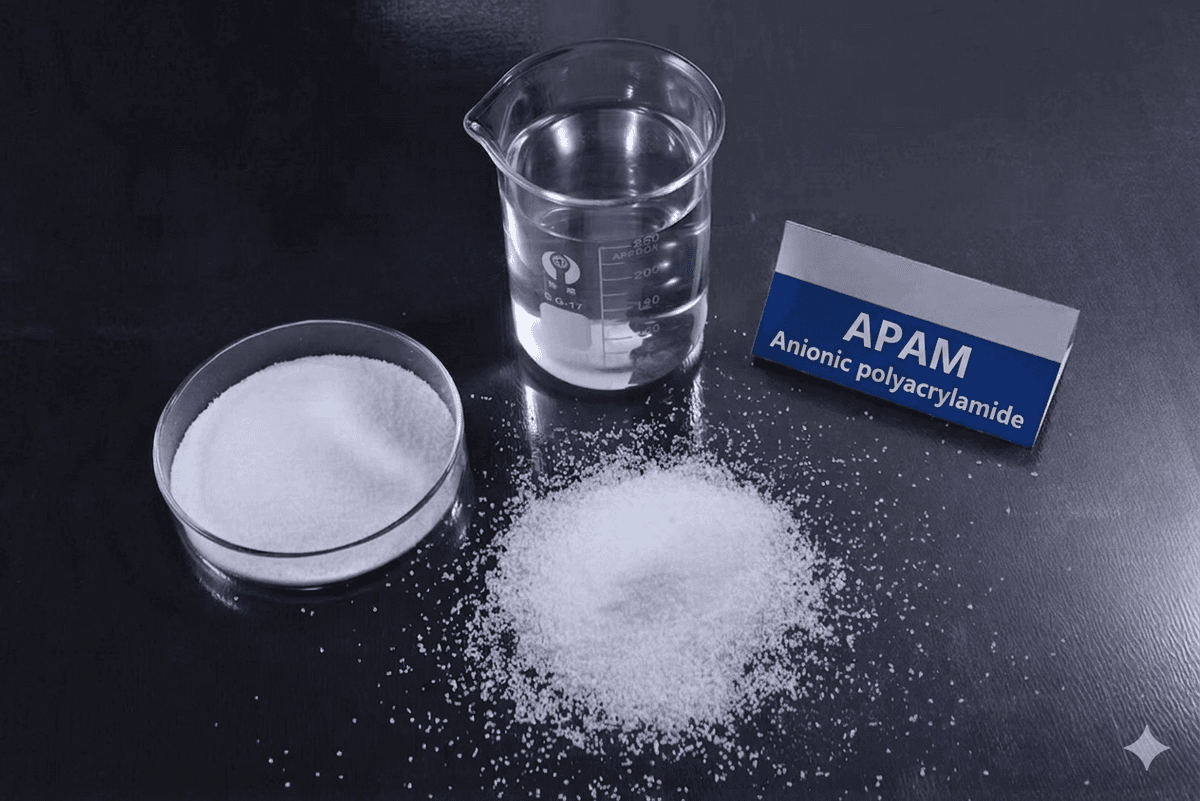
| Appearance | White granular powder |
| Packaging | 25 kg PP woven bags + PE liner |
Key Features
- Covers Magnafloc 156 and 5250 (High anionic) and 155 and 1011 (Medium anionic) as confirmed in the BASF application table
- Molecular weight not published in the held source — grade selected from settling or jar test, not assumed
- Mining, mineral processing and industrial water treatment duty from one grade line
- Drilling fluid specifications routed to the PHPA line where that fits better
- Free trial sample with settling or jar test protocol
- Contact us to confirm applicable grade-level TDS/MSDS and the relevant batch COA
Applications
- Mining and mineral processing thickeners and clarifiers
- Gold, copper and iron ore tailings settling
- Coal preparation plant water recovery
- Industrial process water clarification and reuse
- Brine clarification and phosphate slurry processing (1011 has application ticks in the BASF table)
Get a Quote for BASF Magnafloc 155 / 156 / 1011 Alternative Supply
Start with the grade name, a bag-label photo or your purchasing requirement. We can discuss current pricing and sample options now; process details can follow.
Related Articles
Water Treatment Duty and Drilling Fluid Duty Are Not the Same Problem
These grade numbers are specified into two genuinely different jobs, and the substitution decision runs differently in each. Getting this distinction right before you order matters more than which supplier you order from.
In water treatment and mineral processing you are flocculating: the polymer has to find suspended particles, adsorb onto them and bridge them into an aggregate large enough to settle or filter. Success is measured in settling rate, cake solids and supernatant clarity, and the governing variables are charge density against particle surface charge, and process water ionic strength. Magnafloc 1011 has documented mineral processing applications in the BASF table — it is not a drilling-only grade.
In drilling fluid the polymer is not flocculating anything you want to remove. It is doing three other jobs at once — building low-shear viscosity for cuttings transport, encapsulating reactive shale to stop it hydrating and dispersing, and reducing filtrate loss into the formation. Success is measured on rheology, on filtration control and on how the cuttings come up. For that duty our PHPA line is built for it and is usually the better starting point.
| Water treatment / mineral processing | Drilling fluid | |
|---|---|---|
| What the polymer does | Bridges particles into settleable flocs | Builds viscosity, encapsulates shale, controls filtrate |
| Success measured on | Settling rate, cake solids, overflow clarity | Rheology, API filtrate, cuttings integrity |
| Governing variable | Charge density vs particle surface charge | Temperature and salt stability, hydrolysis level |
| Effect of high salinity | Screens charge, collapses chain, cuts performance | Same mechanism, but managed by grade selection and hydrolysis |
| Dose driver | Solids loading | Mud volume and formation reactivity |
| Our starting product | High or medium anionic range depending on grade | PHPA oilfield grade line |
Charge and Physical Form Are Confirmed; Molecular Weight Is Not Published in the Held Source
The BASF Magnafloc application table confirms charge band and physical form for each of these four grades. Magnafloc 156 and 5250 are High anionic powder. Magnafloc 155 and 1011 are Medium anionic powder. Molecular weight is not included as a column in that table, so it cannot be drawn from this source.
Sharing a table row does not mean two products are identical. Magnafloc 156 and 5250 appear together in the High anionic row, which confirms charge band but does not establish other equivalence. Each is a distinct grade. Where the grades genuinely differ by charge band — 156 and 5250 versus 155 and 1011 — we state that clearly. The match for your specific duty is settled by test.
Magnafloc 155 — Medium Anionic, Powder
The BASF Magnafloc application table lists Magnafloc 155 as Medium anionic charge in powder form. Molecular weight is not published in the held source. Our supply route for Medium anionic powder duty is confirmed; grade selected by settling or jar test on your slurry. Contact us with the grade name and duty to confirm the applicable supply route and grade-level TDS/MSDS.
Magnafloc 1011 — Medium Anionic, Powder (mineral processing applications confirmed)
The BASF Magnafloc application table lists Magnafloc 1011 as Medium anionic charge in powder form, with application ticks against copper tailings, coal tailings, brine clarification, phosphate slurry, metal hydroxides, metal concentrates and iron tailings. It is not exclusive to drilling fluid work. Molecular weight is not published in the held source. For drilling fluid duty our PHPA oilfield grade line is typically the better starting point. Contact us with your duty and grade name to confirm the applicable supply route.
Magnafloc 5250 — High Anionic, Powder; supply screening: CNfloc 1054 (High MW / High charge)
The BASF Magnafloc application table lists Magnafloc 5250 in the same High anionic powder row as Magnafloc 156. Sharing the row confirms the charge band; it does not make the two products identical. Molecular weight is not published in the held source for 5250. For supply screening purposes, CNfloc 1054 (High molecular weight / High charge anionic, ChinaPAM grade table Sheet1!B18:D18) is our primary shortlist candidate for the Magnafloc 5250 duty position. This is a supply screening shortlist, not a confirmed equivalence — confirm by settling or jar test on your slurry before committing. Contact us to confirm applicable grade-level TDS/MSDS and the relevant batch COA.
Magnafloc 366 — High Anionic, Powder (same-type screening, no ranked route published)
The held BASF-attributed application chart identifies Magnafloc 366 as a high-anionic grade in powder form. Its pattern of suggested-duty check marks in that chart matches the pattern shown for Magnafloc 1011 and for the 156 / 5250 row. The chart records suggested applications; it does not state molecular weight for Magnafloc 366, and it does not state site performance for any grade. That makes the chart a screening input, not a substitution decision.
We traversed all 26 rows of our own anionic/cationic/nonionic powder range against this identity. Thirteen rows are anionic powder and therefore stay in the same-type screening family; the cationic rows and the nonionic row are set aside on ionic type. We do not publish a primary or backup ChinaPAM grade for Magnafloc 366 duty, because the competitor molecular weight is absent from the held source and the two houses' charge wording is not a shared numerical scale — ranking our grades against an unstated figure would be invention, not selection.
Sharing a charge descriptor or a chart position with another Magnafloc grade does not make the products identical, interchangeable, the same formulation or the same molecular weight. Site performance remains a test question. Contact us with the grade name exactly as it appears on your label, plus your duty, slurry and current dose, and we will confirm which of the same-type anionic powder grades to put into a settling or jar test and which grade-level TDS, MSDS and batch COA apply.
Dosage Guide
Polymer demand for this band is established by settling or jar test on the target slurry. Use your current Magnafloc dose rate as the starting reference and expect the optimum to move if you are on recycled or high-hardness process water. Make up at 0.1 to 0.25 percent and allow full ageing before dosing.
Frequently Asked Questions — Magnafloc 156 Equivalent — High-Charge Anionic Polyacrylamide
Why are 155, 156, 1011 and 5250 on one page instead of separate pages?
The BASF application table groups these by charge band: 156 and 5250 share the High anionic row; 155 and 1011 are separately listed as Medium anionic. Molecular weight is not published in the held source for any of them, so the honest match for each is settled by the same settling or jar test on your slurry. Where the grades genuinely differ — 156 and 5250 versus 155 and 1011 being in different charge bands — we say so. If a test shows your duty needs a different grade from ours than another of the four, we will tell you that.
Should I be on this page or the Magnafloc 336 page?
The [336 page](/products/brand-equivalents/magnafloc-336-equivalent) covers the very high molecular weight end, specified into high-rate thickeners and Bayer process settling. This page covers Magnafloc 155, 156, 1011 and 5250. If your bags read 336, start there. Where you are unsure, send both the grade name and the duty and we will place it.
Is Magnafloc 1011 only for drilling fluid?
No. The BASF application table shows mineral processing application ticks for 1011 against copper tailings, coal tailings, brine clarification, phosphate slurry, metal hydroxides, metal concentrates and iron tailings. It is a Medium anionic powder and has documented mineral processing uses. For drilling fluid work the PHPA oilfield grade is typically the better starting point, but that does not make 1011 exclusive to drilling. Send us your duty and grade name and we will advise the right route.
What do you need from me to make the match?
The grade name from your tender or delivery note, the duty and stage, the approximate solids content and particle size, the process water chemistry, and ideally a one to two litre sample. With those we can run a settling or jar comparison against our own grades rather than working from the number alone.
Is your grade a licensed copy of Magnafloc 156?
No. It is an independently manufactured anionic polyacrylamide positioned against the duty these grades are specified into. Grade descriptors follow different in-house scales, which is why we show each side on its own scale and settle the match with a test on your own slurry.
How do I make sure the trial sample is worth running?
Most trials that fail do so on procedure rather than on product, and three things account for nearly all of it. First, run the bench work at plant temperature and in plant process water, not cold and fresh — hardness and dissolved salts screen anionic charge and will change the result. Second, allow the make-up solution to age fully before dosing, because a partially hydrated polymer under-performs in a way that looks like the wrong grade. Third, run your incumbent grade side by side on the same slurry on the same day rather than comparing against a remembered dose rate, so the two results are actually comparable. Tell us the temperature, the process water chemistry and the solids loading when you request the sample and we will send the protocol set up for those conditions.
Related Products
Trademark notice. BASF Magnafloc 155 / 156 / 1011 and all other third-party product and brand names on this page are trademarks or registered trademarks of their respective owners. Henan Jinghua New Material Technology Co., Ltd. is not affiliated with, endorsed by, sponsored by or authorised by those owners, and no such relationship is implied. Those names are used here for the sole purpose of identifying the products our grades are compared against, which is necessary to describe what we supply. Our products are independently manufactured and are not licensed copies. Grade descriptors quoted for third-party products are taken from each manufacturer’s own published literature and follow that manufacturer’s own scale; we do not publish figures those manufacturers do not publish. Performance on your process should be confirmed by jar test or CST test before any change of supply.