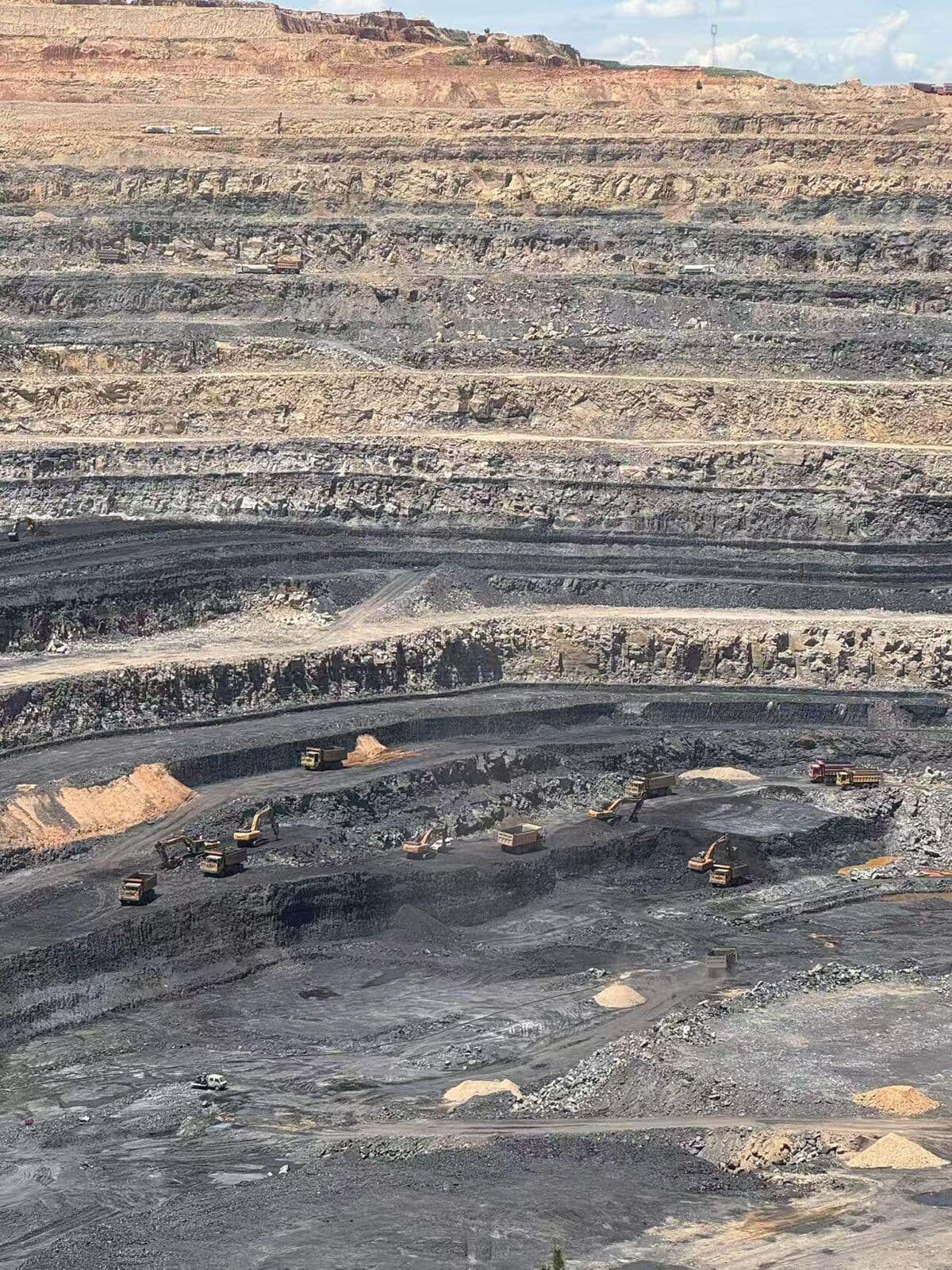
Mining operations generate massive volumes of tailings — fine mineral particles suspended in water. Without proper treatment, tailings ponds overflow, water is wasted, and environmental compliance becomes impossible. Polyacrylamide (PAM) is the industry standard for tailings clarification and water recovery, and we supply it to mining operations across South America, Africa, and Southeast Asia.
Tailings Treatment Overview
| Ore Type | Tailings Particle Size | Recommended PAM | Typical Dosage |
|---|---|---|---|
| Gold / Silver | 5-50 microns (fine) | APAM 20-28M MW | 15-40 g/ton ore |
| Copper | 10-100 microns | APAM 15-25M MW | 10-30 g/ton ore |
| Iron ore | 20-200 microns | APAM 12-18M MW | 5-15 g/ton ore |
| Phosphate | 10-50 microns | APAM 18-25M MW | 8-25 g/ton ore |
| Coal | 50-500 microns | APAM 10-15M MW | 3-10 g/ton coal |
How PAM Clarifies Tailings
Mining tailings are a mixture of fine mineral particles (clay, silica, metal oxides) suspended in water. These particles are negatively charged and repel each other — they stay suspended and settle very slowly (days or weeks without treatment).
Anionic PAM (APAM) with high molecular weight (20-28 million Da) works through polymer bridging. The long polymer chains extend into the water and physically connect multiple particles, forming large, heavy flocs that settle within hours instead of weeks.
The result: clarified water that can be recycled back to the mill, and a dense settled sludge that occupies less pond space. At our Xinxiang facility, we produce APAM specifically formulated for mining — each batch tested for molecular weight precision (±0.5M tolerance) and dissolution speed (≤90 minutes).
Water Recovery Economics
Mining operations consume enormous amounts of water — 1-3 tons of water per ton of ore processed. According to the Global Tailings Review (UNEP/ICMM/PRI, 2020), water recovery from tailings is now a baseline expectation for responsible mining operations worldwide. Recycling clarified tailings water cuts freshwater demand by 40-60%, which is critical in water-scarce regions like Peru, Chile, and parts of Africa.
Example: A 50,000 ton/day copper mine using 100,000 m³/day of water. With PAM-based tailings clarification, 60,000 m³/day is recycled. At $2/m³ freshwater cost, that is $120,000/day saved — or $36 million/year. PAM cost: ~$50,000/year. ROI: 720x in year one.
Beyond cost, water recovery improves environmental compliance. Recycled water reduces discharge volume, which means lower treatment costs and smaller environmental footprint.
Dosage by Ore Type
PAM dosage depends on tailings particle size, solids concentration, and target settling time. Finer particles (gold, silver) need higher dosage. Coarser particles (coal, iron ore) need less.
- Gold / Silver mining — 15-40 g/ton ore. Fine tailings (5-50 microns) require ultra-high MW APAM (24-28M Da). Settling time target: 2-4 hours to clear water.
- Copper mining — 10-30 g/ton ore. Medium-fine tailings (10-100 microns). APAM 15-25M MW. Settling time: 3-6 hours.
- Iron ore — 5-15 g/ton ore. Coarser tailings (20-200 microns). APAM 12-18M MW. Settling time: 4-8 hours.
- Phosphate mining — 8-25 g/ton ore. Mixed particle size. APAM 18-25M MW. Settling time: 3-6 hours.
- Coal washing — 3-10 g/ton coal. Coarse tailings (50-500 microns). APAM 10-15M MW. Settling time: 1-3 hours.
- Bauxite residue (red mud) — 100-300 g/ton solids on washer and residue duty, by far the highest polymer demand here. Very fine clay-type minerals, 18-20M MW APAM at 35-45% hydrolysis. Note that a Bayer primary settler is a different problem needing hydroxamated or starch chemistry.
These are starting points. Always run settling tests with your actual tailings to optimize dosage. Over-dosing wastes money; under-dosing leaves water turbid.
Thickener Optimization
Many mines use high-rate thickeners (HRT) or paste thickeners to concentrate tailings before disposal. PAM is critical for thickener performance — it controls settling rate and underflow density. When a thickener drifts off its normal rise rate or torque, our tailings thickener troubleshooting guide walks through the common failure modes before you change polymer.
For conventional thickeners: APAM 15-20M MW at 5-15 g/ton ore. For high-rate thickeners: APAM 20-28M MW at 10-30 g/ton ore (higher MW needed for faster settling).
Paste thickeners (producing 50-60% solids underflow) require even higher MW — 24-28M Da — to achieve the density needed for paste stacking. We supply specialized paste-grade APAM to operations in Peru, Chile, and Australia.
Environmental Compliance
Tailings ponds must meet discharge standards for suspended solids, turbidity, and sometimes specific metals. Per ICOLD (International Commission on Large Dams) tailings management guidelines, effective water management — including chemical treatment — is a core requirement for tailings storage facility (TSF) design and operation. PAM helps achieve these standards by:
- Reducing TSS (total suspended solids) from 1000+ ppm to <50 ppm in clarified water
- Improving pond stability — settled sludge is denser and less prone to resuspension
- Reducing seepage — denser settled layer acts as a natural seal
Our regulated-use APAM grades (residual monomer ≤0.05%) are suitable for operations where recycled water contacts food or drinking water sources.
Worked Example: 30,000 ton/day Gold Tailings
Modelled, not a delivered project. A 30,000 ton/day gold operation with rainy-season tailings pond overflow, 7-10 day settling and 200+ NTU recycled water is running a polymer that cannot reach the fines.
The change to test is a generic 12M MW PAM out, ultra-high MW APAM (26M Da, 30% hydrolysis) in, at around 25 g/ton ore. Same dosage, same hardware — molecular weight is the only variable.
Modelled outcome:
- Settling time: 7-10 days → 3-4 hours
- Recycled water turbidity: 200 NTU → 15 NTU
- Pond overflow incidents: eliminated
- Water recycling rate: 45% → 65%
- Freshwater cost savings: $25,000/month
The land is the part buyers underestimate: faster settling means three smaller ponds instead of five, which frees ground for expansion. Confirm the settling rate on your own tailings before sizing anything.
Need PAM for mining tailings treatment?
Free sample + jar test report. WhatsApp: +86 187-3759-0940
Our Quality Assurance for Mining
Mining-grade PAM demands tighter specs than general industrial use. Our 3-tier QC system ensures consistency:
- In-process monitoring — real-time polymerization temperature control, initiator ratio tracking
- Batch testing — every batch checked for MW (±0.5M tolerance), solid content (≥90%), dissolution time (≤90 min), and filterability
- Pre-shipment inspection — packaging integrity, moisture protection, container loading supervision
We retain samples from every batch for 24 months. If you ever have a performance issue in the field, we can trace it back to the exact production run.
Paste Thickeners: Different Requirements
Paste thickeners produce 55-70% solids underflow — dense enough to stack without a containment pond. They are increasingly required by regulators in water-scarce regions (Chile, Peru, South Africa) and for tailings storage facilities (TSF) with limited footprint. The PAM requirements are different from conventional thickeners.
Standard thickeners target 35-50% solids underflow and use APAM 15-20M MW at 5-15 g/ton ore. Paste thickeners need 55-70% solids, which requires ultra-high MW APAM (24-28M Da) at 15-35 g/ton ore — the longer polymer chains create stronger bridging that pulls more water out of the settled layer.
The critical variable is yield stress. Paste must have enough yield stress (typically 100-200 Pa) to stack without flowing, but not so much that it cannot be pumped from the thickener underflow. We work with mine operators to dial in the right MW and dosage combination through pilot-scale testing before full deployment. Our paste-grade APAM (26-28M Da) is currently in use at operations in Peru, Chile, and Western Australia.
One practical note: paste thickeners are sensitive to PAM overdose. Excess polymer at these high solids concentrations can cause the underflow to gel and block the discharge cone. Start at the low end of the dosage range and increase in 2 g/ton increments. See our dosage calculation guide for the formula.
Packaging & Shipping
Standard packaging: 25kg PE-lined kraft bags on pallets, 20 MT per 20ft container. For large mining operations consuming 500+ tons/month, we offer 750kg jumbo bags to reduce handling time on site.
From our Xinxiang factory to Qingdao port: <1 day. Standard delivery: 7-10 days from order. Urgent timing can be checked against China factory stock by grade.
We currently supply mining-grade PAM to operations in Peru, Chile, Colombia, Ghana, Zambia, Indonesia, and Australia. Our export team handles all documentation including MSDS, COA, and customs paperwork.
Pricing
Mining-grade APAM typically costs 10-15% more than standard industrial grades due to tighter MW specifications and additional testing. Current pricing:
- Standard APAM (15-20M MW): $1,800-2,200/ton FOB China
- High MW APAM (20-25M MW): $2,000-2,400/ton
- Ultra-high MW APAM (26-28M MW): $2,200-2,600/ton
Volume discounts apply for contracts above 100 tons/month. First-order MOQ is 500kg — enough for pilot trials before committing to bulk supply.
Ready to Optimize Your Tailings Treatment?
Whether you need to improve settling speed, increase water recovery, or meet environmental discharge standards — we manufacture mining-grade PAM with full traceability and technical support.
Send us your tailings analysis (particle size distribution, solids concentration, pH) and we will recommend the right grade within 24 hours. Free samples available for settling trials.
Contact us on WhatsApp at +86 187-3759-0940 or request a quote online.
Frequently Asked Questions
How do I run a settling test before ordering?
Take 1 liter of your tailings slurry at normal operating density. Prepare a 0.1% PAM solution (1g PAM dissolved in 1L water, stir 60 min). Add 0.5mL, 1mL, 2mL, 4mL of the PAM solution to four 1L cylinders of tailings. Stir gently 30 seconds, then observe settling at 5, 15, 30, 60 minutes. The dose giving clear supernatant in the shortest time is your starting point. We send a free jar-test kit with every first order — includes 5 different grades and a step-by-step procedure. See our jar test procedure guide for detailed instructions.
Can I use the same PAM for thickener feed and tailings pond?
Not optimal. Thickener feed needs high MW (20-28M) for fast settling and dense underflow. Tailings pond spigot discharge needs medium MW (12-18M) for gradual consolidation without cracking the beach. Using one grade for both is a compromise — you will either over-dose the pond or under-perform in the thickener. We recommend two grades and two dosing points. The cost difference is small; the performance difference is significant.
What happens if PAM gets into the ore processing circuit?
Small amounts of PAM in process water (from recycled tailings water) generally do not affect flotation or leaching. At concentrations above 5-10 ppm, APAM can slightly depress flotation of some sulfide minerals by adsorbing on mineral surfaces. If you are recycling clarified water back to flotation, keep PAM dosage at the minimum effective level and monitor flotation recovery. Our applications team can advise on compatible grades for your specific ore chemistry.
How should PAM be stored on a mine site?
Store in a cool, dry location away from direct sunlight. Temperature range: 5-35°C. Do not store near strong oxidizers or acids. Shelf life: 24 months in original sealed packaging. Once a bag is opened, use within 30 days. For dissolved PAM solution, use within 24-48 hours — bacterial degradation starts quickly in warm climates. See our storage guide for full details.
Get a Quote
Our factory in Xinxiang produces confirmed grade availability across core APAM, CPAM, NPAM, and PHPA products. MOQ 500kg, delivery 7-10 days standard. Contact us for pricing and free sample:
- WhatsApp: +86 187-3759-0940
- Email: info@chinapolyacrylamide.com
Recommended Product Grades
For the application discussed above, these are the polyacrylamide grades we ship most often:
See the full range of mining and mineral processing applications for equipment context and selection criteria across this industry.
Not sure which is right for you? Try our PAM Selector tool or request a quote.
If your thickener is already specified on a branded anionic grade, our FLOPAM AN 926 equivalent and FLOPAM AN 945 equivalent pages state our profile against SNF's own published descriptors, and the full FLOPAM cross-reference guide covers the rest of the range. For BASF-specified circuits: the Magnafloc 333 nonionic powder page covers circuits where a nonionic polymer is specified, the Magnafloc 338 anionic screening page covers the low-anionic band, and Magnafloc 345 has its own anchor on the Magnafloc 919 page for high-anionic duty; and for Solenis-specified plants the Praestol 2540 equivalent page and the Praestol 2640 mineral-slurry screening page. Two further anionic positions worth checking against your thickener duty are our Magnafloc 355 equivalent, which covers the same duty buyers reach for FLOPAM AN 956 SH to fill, and our Zetag 4100 DK equivalent for the lower-charge end of the anionic range where overflow clarity matters more than settling rate.