Anionic polyacrylamide (APAM) is the most widely used flocculant in mining operations worldwide — a long-chain synthetic polymer (15–25 million Da) that bridges fine mineral particles into fast-settling flocs at 10–100 g/ton dosage, achieving 85–95% water recovery in thickeners while reducing settling time from days to hours. From tailings clarification to process water recovery, APAM reduces water consumption, improves settling rates, and helps mines meet discharge regulations. We've been supplying mining operations across 30+ countries for over a decade, and this guide covers what we've learned about APAM selection, dosing, and direct sourcing from China.
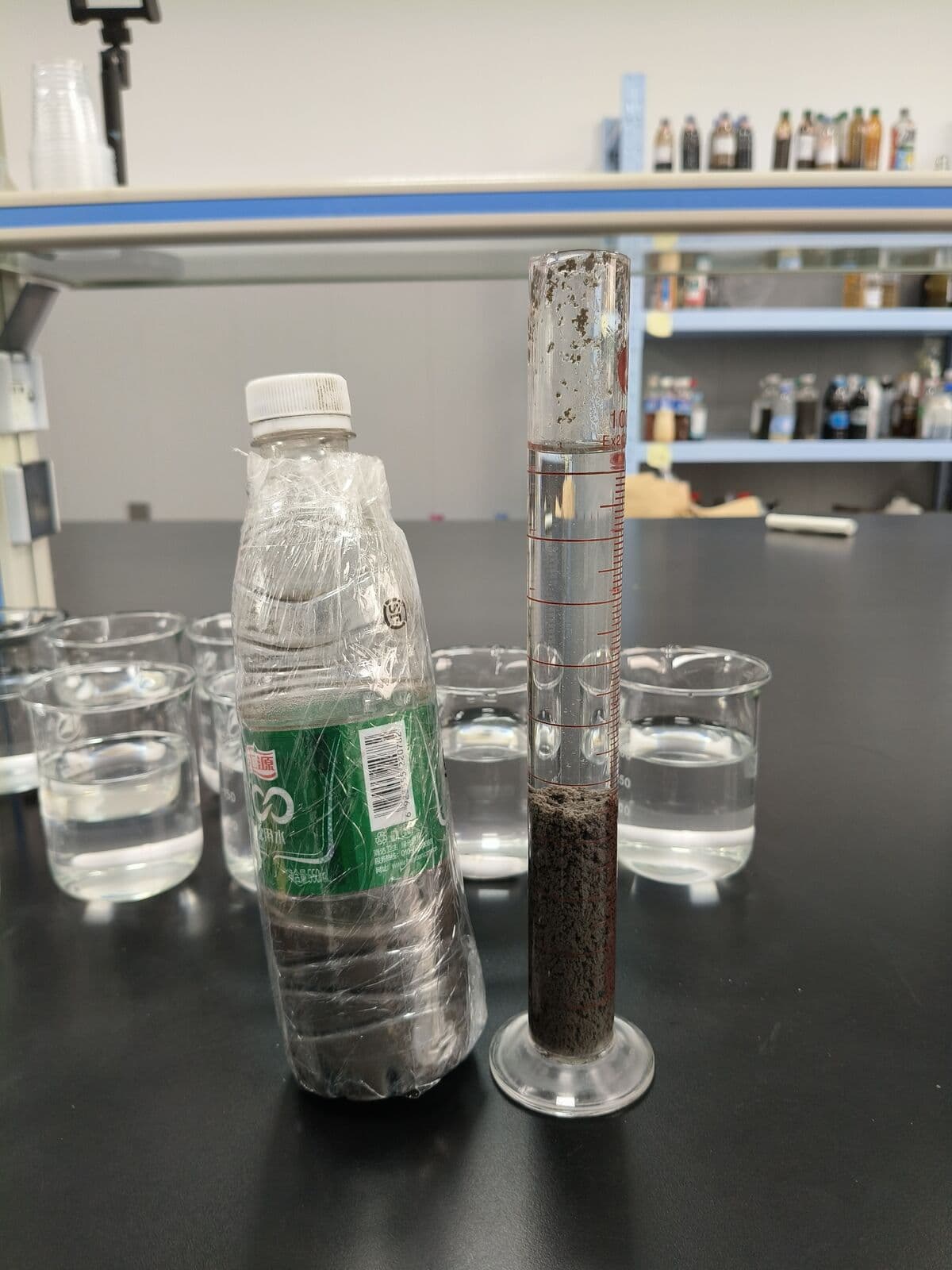
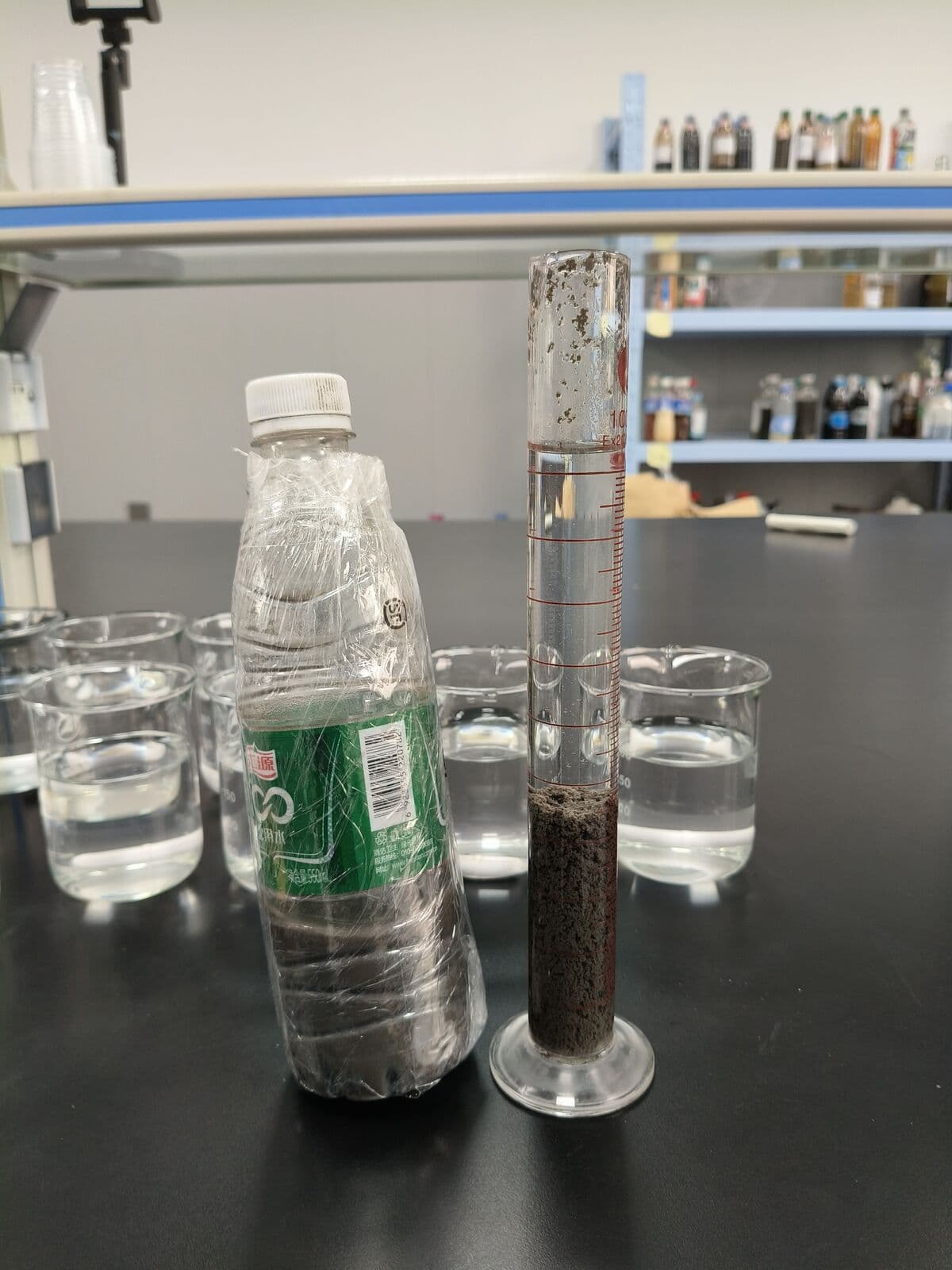
Settling test on mineral slurry: APAM selection is confirmed on the customer's own slurry before a grade is quoted
Why Mining Operations Choose APAM
APAM achieves equivalent or better clarification than inorganic flocculants (alum, ferric sulfate) at 10–50× lower dosage by weight, using a bridging mechanism where long polymer chains (15–25M Da) simultaneously adsorb onto multiple mineral particles to form large, fast-settling aggregates — reducing thickener overflow turbidity from 800–1200 NTU to 50–80 NTU.
Mining generates enormous volumes of fine-particle slurries. Tailings ponds, thickener feed, process water circuits — all contain suspended solids that must be removed efficiently. I've worked with mines that were spending $2M/year on inorganic coagulants when $200K of the right APAM would have done a better job. Here's why APAM works:
- Bridging mechanism — Long polymer chains adsorb onto multiple particles simultaneously, forming large, fast-settling aggregates
- Charge neutralization — The anionic charge interacts with positively charged mineral surfaces (iron oxides, clays)
- Selective flocculation — Can be tuned to selectively flocculate target minerals while leaving others in suspension
Compared to inorganic flocculants (alum, ferric sulfate), APAM achieves equivalent or better clarification at 10–50× lower dosage by weight, significantly reducing chemical costs. Learn more about PAM for mining tailings management and how it compares to other treatment methods.
Mining Applications by Ore Type
APAM grade selection varies by ore type: coal washing uses high MW/medium hydrolysis (30–40%) at 20–50 g/MT, phosphate requires very high MW (20M+) at 30–80 g/MT for clay-rich slimes, gold/copper CIL circuits need high hydrolysis (40–50%) at 10–30 g/MT, and iron ore thickeners use medium hydrolysis at 15–40 g/MT — with dosage driven primarily by clay content and particle size distribution.
| Mining Sector | Application | Recommended APAM Grade | Typical Dosage |
|---|---|---|---|
| Coal washing | Tailings thickening, clean water recovery | High MW, medium hydrolysis (30–40%) | 20–50 g/MT coal |
| Phosphate mining | Slime settling, beneficiation | Very high MW (20M+), low hydrolysis | 30–80 g/MT ore |
| Gold/copper | CIL/CIP circuit clarification | High MW, high hydrolysis (40–50%) | 10–30 g/MT ore |
| Iron ore | Thickener underflow, tailings dam | High MW, medium hydrolysis | 15–40 g/MT ore |
| Potash | Brine clarification | Medium MW, low hydrolysis | 5–15 g/MT brine |
APAM Technical Specifications
Mining-grade APAM performance is controlled by two parameters: molecular weight (15–25M Da for mining, with higher MW creating stronger particle bridging and faster settling) and degree of hydrolysis (10–50%, determining anionic charge density and interaction with specific mineral surfaces at different pH conditions).
Getting these two parameters right is 90% of the optimization. Everything else — dissolution, dosing point, dilution — is execution detail.
Molecular Weight
For mining applications, high molecular weight APAM (15–25 million Da) is preferred because:
- Longer polymer chains create stronger bridging between particles
- Larger flocs settle faster in thickeners (higher underflow density)
- Lower dosage required per unit of solids treated
For a deeper understanding of how molecular weight affects performance, see our molecular weight selection guide.
Degree of Hydrolysis (Anionic Degree)
Hydrolysis degree determines how many carboxylate groups are present on the polymer chain:
- Low (10–20%) — Suitable for high-pH circuits, alkaline tailings
- Medium (25–35%) — General-purpose mining grade, most common
- High (40–50%) — For fine clay-rich slurries, difficult-to-settle particles
Need PAM for mining applications?
Free sample + jar test report. WhatsApp: +86 187-3759-0940
Thickener Performance Data
Field data from a 500 MT/h coal washing plant (Shanxi Province, 2025) shows ChinaPAM APAM (18M MW, 30% hydrolysis) reduced overflow turbidity from 800–1200 NTU to 50–80 NTU, increased underflow density from 45–50% to 62–68% solids, boosted settling rate from 0.8 to 3.2 m/h, and lifted water recovery from 72% to 91%.
Performance Comparison: Before vs After APAM Optimization
Source: ChinaPAM customer case study, 500 MT/h coal washing plant, Shanxi Province, 2025.
Dosing and Preparation Guide
APAM preparation for mining requires dissolving powder at 0.1–0.3% concentration with slow agitation (30–60 RPM) for 45–90 minutes, then diluting to 0.01–0.05% working strength before injection — with high-shear mixing strictly avoided as it degrades polymer chains and can reduce flocculation efficiency by 30–50%.
Step 1: Prepare Stock Solution
Dissolve APAM powder in clean water at 0.1–0.3% concentration. Use a dedicated mixing tank with slow agitation (30–60 RPM). Allow 45–90 minutes for complete dissolution. Do not use high-shear mixing — it degrades the polymer chains. According to ICOLD recommendations on tailings management, polymer preparation systems should include redundant mixing tanks to ensure continuous supply during maintenance.
Step 2: Dilute Before Dosing
Dilute stock solution to 0.01–0.05% before adding to the process stream. This ensures even distribution and prevents localized overdosing.
Step 3: Jar Test to Optimize Dosage
Run jar tests with your actual slurry at 3–5 dosage levels. Measure settling rate and overflow clarity. The optimal dosage is the lowest dose that achieves target clarity — overdosing wastes chemical and can actually worsen performance (charge reversal). For detailed jar test procedures, refer to our jar test procedure guide.
APAM Bulk Pricing (2026)
Mining-grade APAM FOB China pricing ranges from $1,100–1,400/MT for standard 12M MW grades to $1,700–2,200/MT for ultra-high MW (20M+) custom hydrolysis grades, with 8–10% FCL discount at 20 MT and annual contract pricing available for operations consuming 50+ MT/year.
Mining-Grade APAM — FOB China
MOQ: 1 MT trial order. FCL (20MT) discount: 8–10%. Annual contract pricing available.
Ore-Specific APAM Dosage Reference
Field-validated APAM dosage rates range from 5–15 g/MT for potash brine clarification to 100–300 g/MT for bauxite red mud settling, with clay content being the primary driver — ores containing 30%+ clay minerals (bauxite, nickel laterite, kimberlite) require 3–5× more polymer per ton than coarser ores due to clay surface area consuming polymer through adsorption.
These numbers are starting points from operations we currently supply. Always run jar tests before committing to a dosage program — I've seen mines waste $100K/year by skipping this step and just copying a competitor's dosage.
| Ore Type | Process Stage | APAM Spec | Dosage (g/MT solids) | Settling Rate |
|---|---|---|---|---|
| Gold (CIL/CIP) | Tailings thickener | 18-22M MW, 25-30% hyd. | 15-30 | 3.5-5.0 m/h |
| Copper porphyry | Tailings thickener | 18-20M MW, 25-35% hyd. | 20-35 | 2.5-4.0 m/h |
| Copper concentrate | Concentrate thickener | 15-18M MW, 30-35% hyd. | 25-50 | 5-8 m/h |
| Iron ore (hematite) | Tailings thickener | 18-22M MW, 25-30% hyd. | 15-30 | 4-7 m/h |
| Iron ore (magnetite) | Concentrate dewatering | 15-18M MW, 20-25% hyd. | 20-40 | 3-5 m/h |
| Coal (raw fines) | Slimes thickener | 18-22M MW, 30-40% hyd. | 20-50 | 2-4 m/h |
| Phosphate | Slime ponds | 22-25M MW, 15-25% hyd. | 30-80 | 1.5-3 m/h |
| Bauxite (red mud) | Settler/washer | 18-20M MW, 35-45% hyd. | 100-300 | 1-2 m/h |
| Nickel laterite | CCD thickener | 18-22M MW, 30-40% hyd. | 40-100 | 1.5-3 m/h |
| Diamond (kimberlite) | Slimes treatment | 18-20M MW, 30-35% hyd. | 40-80 | 1-2 m/h |
Two practical observations from these numbers. First, ores with high clay content (bauxite red mud, nickel laterite, kimberlite slimes) need 3-5x more polymer per ton than coarser ores — clay particles have huge surface area that adsorbs polymer. Second, magnetite concentrate uses lower hydrolysis (20-25%) than hematite tailings (25-30%) because the higher pH in magnetite circuits would over-charge a high-hydrolysis polymer.
Bauxite deserves a caveat that the table cannot carry. The figures above apply to the washer train and residue thickening, where liquor has been diluted and cooled. A Bayer primary settler running full-strength caustic at 95-105°C attacks the amide backbone directly and needs hydroxamated or starch-based chemistry rather than a standard anionic grade, whatever its molecular weight. Our red mud settling guide works through which stages we can supply and which we cannot.
Water Recovery Economics
Optimized APAM flocculation in mining thickeners typically delivers 5–8× return on polymer investment through water recovery alone — a copper operation in northern Chile recovered an additional 23,100 m³/day of process water (worth $73,920/day at $3.20/m³ desalinated water cost) by switching to a properly matched 19M MW grade that lifted water recovery from 75% to 89%.
At many mines, water cost or water rights drive APAM purchasing decisions more than the polymer price itself. Here's a real example that shows the math:
Plant: 80,000 t/d ore throughput. Tailings flow: 165,000 m³/d slurry at 30% solids. Without optimized APAM, thickener underflow ran at 50% solids, recovering 75% of process water. Switching to our 19M MW, 28% hydrolysis grade lifted underflow density to 62% solids and water recovery to 89%.
- Additional water recovered: 165,000 × (0.89 - 0.75) = 23,100 m³/d
- Local industrial water cost: $3.20/m³ (desalinated, piped 180 km)
- Daily savings: $73,920
- Annual savings (350 operating days): $25.9 million
- Additional polymer cost: 65 g/MT × 80,000 MT/d × $1,650/MT = $8,580/d ($3.0M/year)
- Net benefit: $22.9M/year just on water economics
Even at mines with lower water costs (around $0.30/m³), water recovery still pays for the polymer 5-8x over. The polymer also reduces tailings dam volume, which has its own capex implications worth several million per percentage point of solids density. Per ICMM guidelines on water stewardship, maximizing process water recycling through optimized flocculation is a key performance indicator for responsible mining operations.
Seasonal Demand Patterns
Mining APAM demand follows predictable seasonal patterns: Q1 peaks as Northern Hemisphere mines restart (prices firm 3–5%), Q3 sees 15–25% higher per-ton consumption in tropical regions due to rainy season dilution, and Q4 offers the best annual contract discounts as mines lock in supply before Chinese New Year factory shutdowns (10–15 days in late January/early February).
Knowing these patterns helps with order timing and price negotiation. We've seen buyers save 8–12% just by timing their annual contract negotiations for November.
- Q1 (January-March) — Highest demand for Northern Hemisphere mines as winter freeze breaks up. Coal washing plants in China, Russia, and Mongolia stockpile ahead of spring demand. Prices firm 3-5% above annual average.
- Q2 (April-June) — Demand strong from African and Australian operations gearing up for dry season. Latin American mines (Chile, Peru) start ramping after Andean wet season. Lead times stretch 2-3 days longer than usual.
- Q3 (July-September) — Rainy season in West Africa and Southeast Asia drives higher dilution and higher polymer dosage. Indonesian nickel and gold operations consume 15-25% more APAM per ton ore.
- Q4 (October-December) — Year-end inventory building. Mines locking in 2026 supply contracts often place 100+ MT orders in November to ship before Chinese New Year disruption (late January-early February). Best discounts of the year on annual contracts signed in this window.
Around Chinese New Year (typically late January or early February), Chinese factories shut for 10-15 days. Plan orders to arrive at destination 3 weeks ahead of CNY or 4 weeks after — this avoids both the shipping crunch and the post-holiday production backlog.
FAQ: APAM for Mining
What is the difference between APAM and PHPA in mining context?
APAM (anionic polyacrylamide) is the broader category. PHPA (partially hydrolyzed polyacrylamide) is one specific manufacturing route — produced by post-hydrolysis of polyacrylamide rather than copolymerization with acrylic acid. Performance is similar; PHPA tends to have slightly more uniform charge distribution along the chain. Mining specs usually do not distinguish the two and accept either.
How do I know if my thickener can be improved by changing APAM grade?
Three quick checks. (1) If overflow turbidity exceeds 200 NTU during normal operation, you are leaving fines in the water. (2) If underflow density is below the design target (typically 55-65% solids), you are wasting thickener capacity. (3) If you cannot ramp up feed rate without losing performance, your polymer is the bottleneck. Any of these means a jar test with 2-3 alternative grades is worth a week of effort.
Does APAM work in saline or brackish water?
Standard APAM loses effectiveness above about 30,000 mg/L TDS because the high ionic strength shields the polymer's charges and collapses the chain. For saline mining environments (some Western Australia, Chilean salar operations), we supply salt-tolerant grades that incorporate AMPS or sulfonate co-monomers. These maintain 70-80% of fresh-water performance up to seawater salinity.
How long can prepared APAM solution be stored?
Stock solution at 0.3-0.5%: 24-48 hours maximum. Beyond that, viscosity drops 15-30% as residual oxygen and trace metals degrade the polymer. Diluted dosing solution (0.05%): use within 4-8 hours. For continuous operations, we recommend automated make-up systems sized for 12-24 hours of consumption rather than batch tanks for several days.
Can I use the same APAM for tailings thickener and concentrate dewatering?
Sometimes, but rarely optimal. Tailings thickeners want maximum settling rate (favors high MW). Concentrate dewatering wants strong, dense flocs that survive filtration shear (favors slightly lower MW with higher hydrolysis). Most operations we work with run two grades — but if budget is tight, a 18M MW / 30% hydrolysis is the best single-grade compromise.
Worked Example: Magnetite Concentrator Polymer Spend
Modelled, not a delivered project — this is how the dose-versus-price comparison works out on a magnetite thickener duty, and it is the calculation worth running before you renew a polymer contract.
A 16M MW APAM running at 25 g/MT is a common incumbent position. Where the ore justifies it, a 19M MW, 28% hydrolysis grade can hold the same settling rate at roughly 18 g/MT — around a 28% dose reduction, which is where the polymer line item drops by about a third. Higher MW also tends to lift underflow density by a few percentage points, and the recovered process water matters more than the polymer saving at sites trucking water from a borefield. None of that is guaranteed on your ore: run a four-week plant pilot behind the jar tests before committing to a term contract, which is what we would recommend regardless of supplier.
Shipping to Mining Regions
ChinaPAM ships mining-grade APAM to all major mining regions: Australia (18–22 days from Tianjin), South Africa (22–28 days from Qingdao), Chile/Peru (28–35 days from Shanghai), Indonesia (10–14 days), and Canada (14–18 days from Shanghai) — with full documentation including COA, MSDS, packing list, and fumigation certificate for wood pallet shipments.
- Australia — Port of Tianjin to Melbourne/Perth, 18–22 days transit
- South Africa — Port of Qingdao to Durban, 22–28 days transit
- Chile/Peru — Port of Shanghai to Callao/Valparaíso, 28–35 days transit
- Indonesia — Port of Tianjin to Jakarta, 10–14 days transit
- Canada — Port of Shanghai to Vancouver, 14–18 days transit
All shipments include: COA, MSDS, packing list, commercial invoice, and bill of lading. Fumigation certificate available for wood pallet shipments. See our coal washing application guide and sand washing guide for more mining-specific information. For gold and copper mining specifically, also check our gold mining PAM guide and copper mining PAM guide.
Get APAM Samples for Your Mine
Share your ore type and thickener specs. We'll recommend the right APAM grade and send free samples for testing.
Recommended Product Grades
For the application discussed above, these are the polyacrylamide grades we ship most often:
- APAM Medium Molecular Weight grade
- nonionic PAM (NPAM) for mineral processing
- Magnafloc 355 equivalent — anionic, coarse granulation available for manual make-up
- Zetag 4100 DK equivalent — the low-to-medium charge anionic position
See the full range of mining and mineral processing applications for equipment context and selection criteria across this industry.
Not sure which is right for you? Try our PAM Selector tool or request a quote.
Replacing a named brand? Our Superfloc A-110 equivalent guide maps Kemira’s anionic mineral processing grade to our CNfloc series with matched descriptors. On the BASF side, see the Magnafloc 155, 156 and 1011 equivalent for high molecular weight duty, the Magnafloc 336 equivalent for the very high molecular weight end, and the Magnafloc 333 nonionic page for circuits where a nonionic polymer is specified. Magnafloc 338 and Magnafloc 345 are separate grades in different charge positions and are covered separately: Magnafloc 338 is labelled low-anionic on the held BASF mining chart and has its own anionic screening page, while Magnafloc 345 is labelled high-anionic on that chart and is covered by its grade anchor on the Magnafloc 919 page. Solenis-specified circuits are covered on the Praestol 2540 equivalent page.