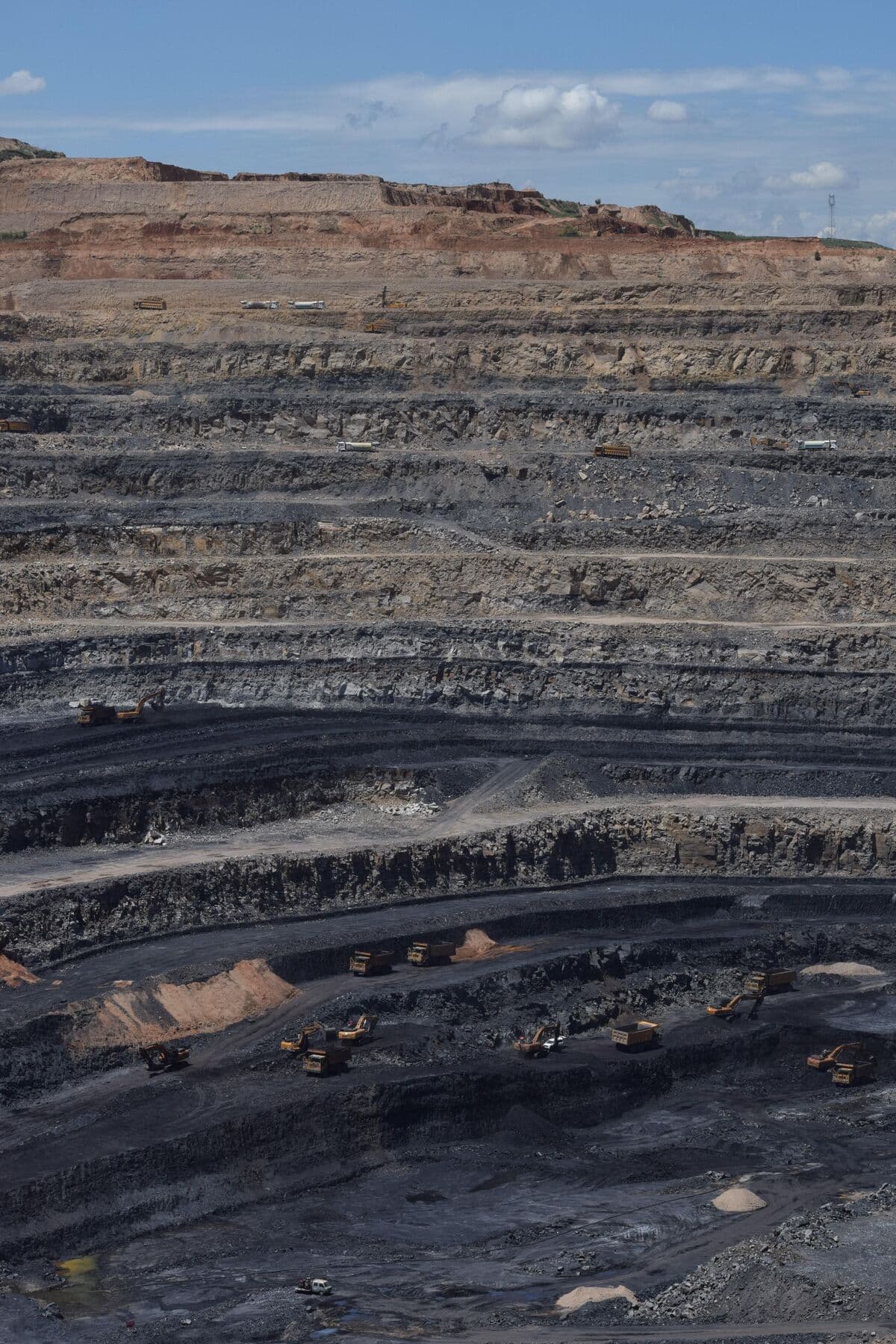
Copper mining generates some of the largest tailings volumes in the industry — a typical porphyry copper operation processing 50,000 tons of ore per day produces 2-4 tons of tailings per ton of ore. Per the International Council on Mining and Metals (ICMM) Global Tailings Review 2020, with copper grades declining globally (from 1.5% in the 1990s to 0.5-0.8% today), tailings volumes per ton of copper produced have tripled. High-MW anionic PAM is essential for thickener operation, paste tailings, and water recovery in these increasingly challenging conditions.
We supply mining-grade APAM to copper operations across Chile (Codelco, BHP, Antofagasta), Peru (Southern Copper, Cerro Verde), Indonesia (Freeport), and Zambia (First Quantum). Our factory ships 3,000+ tons annually to the copper sector, with grades formulated for the unique challenges of copper sulfide and oxide tailings.
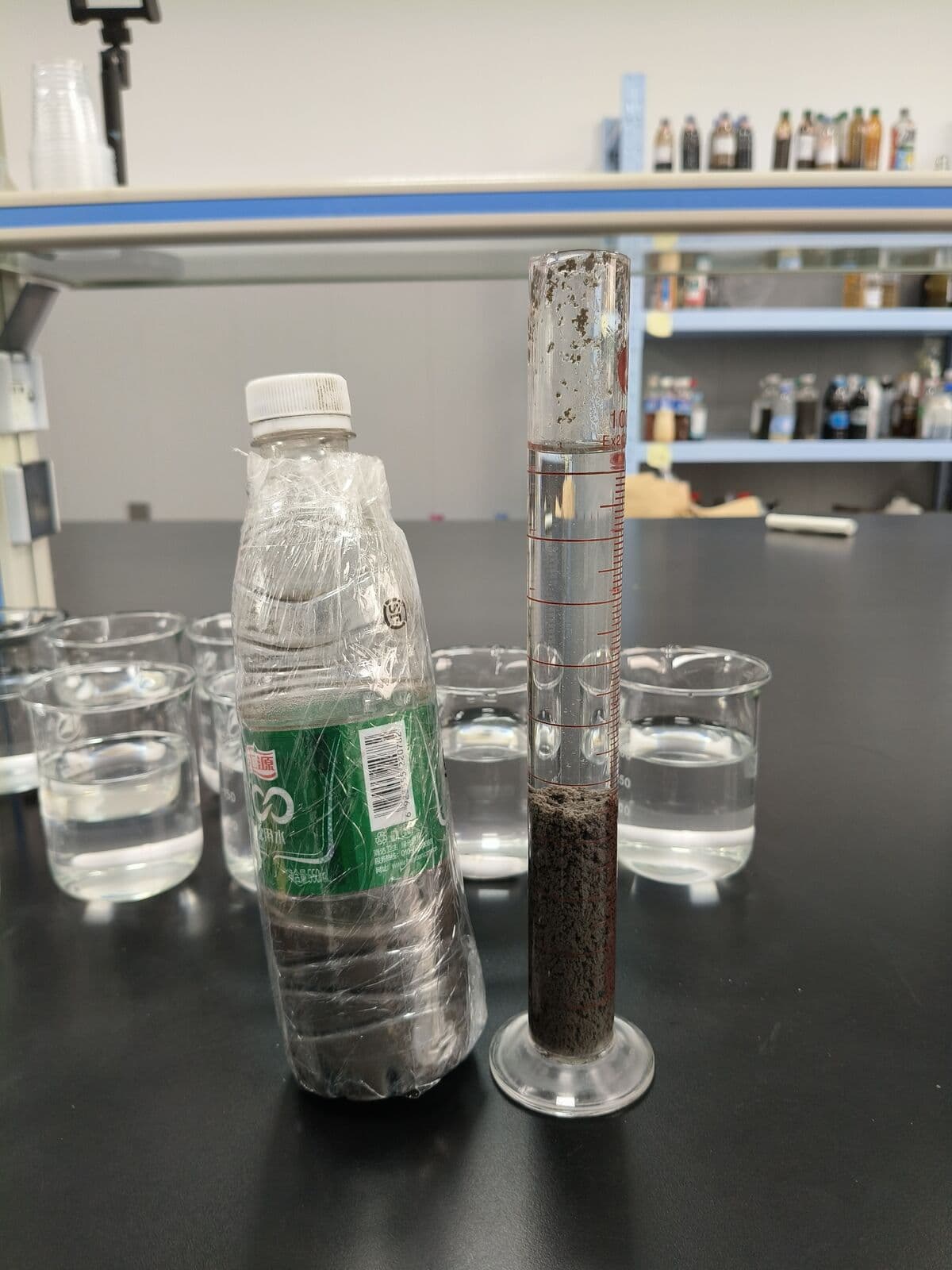
Slurry settling test: settling rate and overflow clarity are measured at several dose levels before a grade recommendation is issued
Copper Tailings: Why They Need Specialized PAM
Copper tailings present unique challenges compared to other mining tailings: See also: mining tailings treatment, molecular weight selection.
- Sulfide minerals — Pyrite (FeS₂) in copper tailings oxidizes over time, generating acid mine drainage (AMD) with pH 2-4. This degrades standard PAM and requires acid-stable formulations
- Flotation reagents — Xanthates, dithiophosphates, and frothers from flotation circuits interfere with PAM performance. Our grades are formulated to work in the presence of residual flotation chemicals
- Clay minerals — Porphyry copper deposits often contain 10-30% clay (kaolinite, smectite) that consumes flocculant and creates difficult-to-settle colloidal suspensions. Higher molecular weight grades are needed to overcome this
- Water scarcity — Major copper producing regions (Atacama Desert in Chile, coastal Peru) are among the driest on Earth. Water recovery from tailings is not optional — it is survival
PAM Applications in Copper Processing
| Application | PAM Grade | Dosage | Target Performance |
|---|---|---|---|
| Conventional thickener | APAM 18-22M MW, 25-30% hydrolysis | 20-35 g/ton ore | Overflow <50 NTU, underflow 55-65% solids |
| High-rate thickener | APAM 22-25M MW, 25-30% hydrolysis | 25-45 g/ton ore | Overflow <50 NTU, underflow 60-68% solids |
| Paste thickener (dry stacking) | APAM 22-28M MW, 28-32% hydrolysis | 30-60 g/ton ore | Underflow 65-72% solids (non-segregating paste) |
| Counter-current decantation (CCD) | APAM 15-20M MW, 20-25% hydrolysis | 15-30 g/ton ore | Overflow <100 NTU per stage |
| AMD treatment (post-lime) | APAM 20-25M MW, 30-35% hydrolysis | 15-30 ppm | Iron/copper removal 90-98%, TSS <50 mg/L |
Paste Thickening: The Future of Copper Tailings
After the Brumadinho dam disaster (2019, 270 deaths), the mining industry is rapidly moving away from conventional tailings dams toward paste thickening and dry stacking. Paste thickeners produce 65-72% solids underflow that can be stacked without a dam — eliminating catastrophic failure risk entirely.
Paste thickening requires ultra-high MW PAM (22-28M) because:
- Higher underflow density means less water between particles — PAM must create extremely strong floc structures that resist compression
- Longer polymer chains provide more bridging points per molecule, creating denser, stronger floc networks
- Higher dosage (30-60 g/ton vs 20-35 g/ton for conventional) is justified by the value of water recovered (85-95% vs 60-70%)
Our APAM-28 grade (25-28M MW) is specifically designed for paste thickeners. It produces non-segregating paste at 65-72% solids with yield stress of 50-200 Pa — suitable for conveying and stacking.
Need PAM for copper mining operations?
Free sample + jar test report. WhatsApp: +86 187-3759-0940
Water Recovery: The Economic Driver
In Chile and Peru, water is the single largest operating cost constraint for copper mines. Many operations pay $3-8/m³ for desalinated seawater pumped from the coast to mine sites at 3,000-4,000m elevation.
- Without PAM: Thickener overflow 200-500 NTU (not recyclable to flotation), water recovery 50-60%
- With PAM: Thickener overflow <50 NTU (recyclable), water recovery 85-95%
- For a 100,000 tpd operation using 0.8 m³/ton: Improving recovery from 55% to 90% saves 28,000 m³/day = 10.2 million m³/year
- At $5/m³ (desalinated seawater): Savings = $51 million/year
- PAM cost: 30 g/ton × 36.5M tons/year = 1,095 tons PAM × $1,300/ton = $1.4 million/year
- ROI: 36× return on PAM investment
AMD Treatment: PAM in Acidic, Metal-Loaded Water
Acid Mine Drainage from copper sulfide tailings is one of the longest-tail liabilities in mining. Pyrite oxidation continues for decades after a mine closes, generating water at pH 2-4 with iron, copper, zinc, manganese, and arsenic loadings in the hundreds of mg/L range. Per Society for Mining, Metallurgy & Exploration (SME) AMD handling references, the treatment train is almost always: lime neutralization → metal hydroxide precipitation → APAM flocculation → clarifier or settling pond.
PAM specifics for AMD that matter to operators:
- pH window matters — APAM works best at pH 6-9 after lime addition. Below pH 5, the polymer protonates and loses anionic charge; above pH 10, hydroxide flocs become gelatinous and PAM dose climbs sharply.
- Hydrolysis degree — for AMD post-lime, 30-35% hydrolysis grades outperform standard 25-30% by 15-20% on metal hydroxide settling. The extra carboxyl groups grab onto Fe(OH)₃ and Cu(OH)₂ surfaces more effectively.
- Order of addition — lime first, slow mix 5-10 min for hydroxide formation, then PAM at 15-30 ppm into a flocculation tank with gentle (40-60 rpm) mixing. Reverse the order and you waste 30-50% of your polymer.
- Sludge handling — AMD sludge is metal-rich and often classified as hazardous. Higher PAM dose for thicker sludge (50%+ solids) cuts disposal volume and cost. We see Chilean operations dewater AMD sludge to 55-60% with belt filter press + 8-12 g/kg DS CPAM secondary dosing.
PAM Selection by Copper Ore Type
Not every copper mine looks the same. Mineralogy drives clay content, grind size, and reagent residues — all of which change PAM grade choice. Per Cochilco (Chilean Copper Commission) industry data, ore type distribution in major producing regions varies from porphyry-dominated Chile/Peru to skarn deposits in Mexico and Indonesia. We spec PAM differently for each:
- Porphyry copper (Chile, Peru, Arizona) — large tonnage, low grade (0.4-0.8% Cu), high pyrite, 10-20% clay (sericite/illite). Use APAM 20-25M MW, 25-30% hydrolysis, 25-40 g/ton ore. Our most common copper grade.
- Skarn copper (Mexico, Indonesia, China) — higher grade (1-3% Cu), coarser grind, more carbonate gangue. APAM 18-22M MW, 20-25% hydrolysis, 18-30 g/ton. Lower hydrolysis because Ca²⁺ in solution can over-bridge.
- Sediment-hosted copper (Zambia, DRC Copperbelt) — mixed sulfide/oxide, high cobalt content, often siliceous shale gangue. APAM 22-25M MW, 25-30% hydrolysis, 30-50 g/ton. The shale fines are the troublemaker — they consume polymer.
- Heap leach SX-EW operations (Atacama, Arizona) — pregnant leach solution (PLS) clarification, raffinate solid removal. Use medium MW APAM (15-18M), 20-25% hydrolysis at 5-15 ppm. Acid stability is critical (operates at pH 1.5-2.5).
- Native/oxide copper (Michigan, parts of Africa) — less common. Standard APAM 18-22M MW works at low dose (15-25 g/ton).
Dry Stacking: Operational Detail That Decides Cost
Paste thickening + dry stacking is now the default for new copper projects in seismically active or water-scarce regions. The marketing slides make it look simple — no dam, just stack the paste. The operational reality has more nuance:
- Yield stress is the gate — paste must reach 50-200 Pa yield stress to be conveyable but not segregating. Below 50 Pa, fine particles drain out and the stack is unstable. Above 200 Pa, you blow the conveying pump. PAM dose tunes this within ±20%.
- Filter press vs paste thickener tradeoff — filter press makes 80-85% solids cake (truly dry stack) but at 5-8x the CAPEX of paste thickening. Paste thickener at 65-72% needs spreading equipment and dust control on the stack. Most projects pick paste thickener for $/ton economics, filter press for very wet climates or strict water targets.
- Underflow rheology must stay stable — copper paste sits in pipelines for 2-15 km from thickener to stack. Thixotropic behavior matters. Our 25M+ MW APAM grades produce a more shear-thinning floc structure that handles long pipeline transit better than 18-22M grades.
- Climate effects — Chilean Atacama plants get 2-4% extra evaporation off the stack surface, helping consolidation. Indonesian sites in tropical rainfall lose this benefit and need higher upfront paste density (70%+ solids).
We have shipped APAM-28 paste-thickener grade to four Chilean operations now in commercial operation, plus two Peruvian sites in commissioning. Send us a tailings sample and target underflow density and we will run a paste rheology test in our applications lab — typical turnaround 7-10 days for a full report. We can also overlay your existing flotation reagent mix in the test, which catches polymer-reagent incompatibilities before they show up at full scale and save the operations team a costly thickener trip during commissioning.
Our Quality Guarantee for Mining
Mining operations cannot tolerate batch-to-batch variation — a single bad batch can shut down a thickener for hours, costing $100,000+ in lost production. Our quality system:
- Batch tolerance: ±0.5M MW (tighter than industry standard ±1.0M)
- Three-tier QC: In-process monitoring → batch testing → pre-shipment inspection
- Retention samples: 200-500g kept for 12 months per batch
- Solid content: ≥90% (vs competitor average 88-90%)
- Dissolving time: ≤90 minutes (critical for continuous dosing systems) — see our dissolving method guide
- Free settling tests: Send us your tailings sample, we test 5-8 grades and provide dosage optimization report
FAQ
Does flotation reagent residue affect PAM performance?
Yes — xanthates and frothers can reduce PAM efficiency by 10-30%. Our mining grades are formulated with higher charge density to compensate. We recommend jar testing with your actual tailings (including flotation reagents) rather than clean ore samples.
Can I use the same PAM for thickener and AMD treatment?
Not optimal. Thickener feed is neutral pH and benefits from 25-30% hydrolysis. AMD treatment (post-lime, pH 6-7) benefits from 30-35% hydrolysis for better interaction with metal hydroxide precipitates. Using the wrong grade costs 20-30% in performance. See our mining tailings guide for detailed grade selection.
What dose adjustment do I need when going from conventional to paste thickening?
Plan for 1.5-2x the polymer dose and a step up in molecular weight. A conventional thickener running at 25 g/ton with 20M MW APAM typically needs 40-50 g/ton with 25-28M MW for stable paste at 68-72% solids. Our copper customers also report a 2-3 week tuning window during commissioning where dose drifts 15-20% above target before the rake torque and bed level controllers settle into a new operating point.
Get Copper Mining PAM Pricing
We supply mining-grade APAM from our Henan factory, backed by 100,000 tons/year documented PAM capacity. Common mining grades can be checked against China factory stock before urgent quotes. See also: APAM mining supplier guide and coal washing applications. Contact us for bulk pricing and free settling tests:
- WhatsApp: +86 187-3759-0940
- Email: info@chinapolyacrylamide.com
Recommended Product Grades
For the application discussed above, these are the polyacrylamide grades we ship most often:
- nonionic PAM (NPAM) for mineral processing
- APAM Medium Molecular Weight grade
- Magnafloc 351 equivalent — the nonionic position for low-pH leach and raffinate streams
See the full range of mining and mineral processing applications for equipment context and selection criteria across this industry.
For concentrator water balance and reclaim context, see our mine water clarification solution and our mineral tailings treatment solution.
Not sure which is right for you? Try our PAM Selector tool or request a quote.