SNF publishes charge density and molecular weight descriptors for every grade in its FLOPAM powder catalogue, which makes a real cross-reference possible. This guide maps our range against that published data grade by grade, including the grades where we have no close counterpart. This cross-reference guide identifies CNfloc equivalents for each FLOPAM grade so you can shortlist 2–3 candidates for jar testing before a full switch.
SNF FLOPAM is the most-specified polyacrylamide brand in municipal and mining applications globally. According to Grand View Research (2024), SNF holds approximately 38% of global PAM market share. Many operators specify FLOPAM by model number — FO 4490 for belt press, AN 934 for thickeners — but the actual performance depends on charge density and molecular weight, not the brand label. When those two parameters match, the flocculation mechanism is identical regardless of manufacturer.
A polyacrylamide cross-reference is the process of matching a branded flocculant grade to an equivalent product from another manufacturer based on ionic type, charge density (mol%), and molecular weight (Daltons), enabling direct substitution without system redesign. According to WEF (Water Environment Federation), polymer selection depends on these three parameters — not brand origin.
In substitution work, the safest approach is to shortlist CNfloc grades by ionic type, charge density, and molecular weight, then confirm performance by jar testing on the buyer's actual water, sludge, or slurry. Direct swaps are most likely to work when charge density and molecular weight stay close to the original FLOPAM grade.
For the model numbers named most often in tenders we publish grade-level pages that state our profile alongside SNF's own published descriptors, each on its own scale: the FLOPAM AN 934 SH equivalent for medium-charge thickener duty, the FLOPAM AN 945 equivalent where charge rather than chain length is doing the work, the FLOPAM AN 945 VHM equivalent at the top of the molecular weight ladder, the FLOPAM FO 4440 equivalent covering the FO 4350 to FO 4490 dewatering band, the FLOPAM FO 4650 equivalent, the FLOPAM FO 4190, FO 4240 and FO 4290 equivalent for the low-charge dewatering band below that, the FLOPAM FO 4550 equivalent for the three-suffix cationic route, the FLOPAM FO 4690 equivalent, the FLOPAM FO 4990 SH equivalent for the two-lane cationic screening, the FLOPAM FO 8650 equivalent and FLOPAM FO 8990 equivalent for the high-charge 8xxx series with MW gap disclosed, the FLOPAM AN 926 equivalent for raw water and tailings duty, and the FLOPAM AN 910 equivalent at the low-charge end, the FLOPAM FO 4125 SH and SSH equivalent for the very-low-charge very-high-MW selection route, the FLOPAM FO 4191 AR equivalent, the FLOPAM FO 4107 SSH equivalent for the ultra-low-charge very-high-MW two-direction screening route, the FLOPAM FO 4698 equivalent for the bare High-charge Standard-MW screening route, and the FLOPAM FO 4698 SH equivalent for the Medium-charge High-MW two-lane route — note that the bare and SH rows are at different charge and MW positions and must be kept separate, and the FLOPAM FO 4358 SH equivalent for the structured cationic Medium-charge High-MW route with a distinctive 0.69 bulk density, the FLOPAM FO 4498 SH equivalent for the Medium-charge High-MW row at 650 cps (5 g/L) with C8003 as the primary lane, and the FLOPAM FO 4498 equivalent for the bare no-suffix Standard-MW row at 350 cps where the charge position is identical to the SH row but the chain length is not. One caution worth reading before you match on a number: the suffix carries molecular weight, and in the case of FO 4440 SSH it also moves the charge band, so the number on its own does not identify the polymer. Further grade-level anionic pages include the FLOPAM AN 970 VLM equivalent for the high-charge very-low-MW two-direction screening route, the FLOPAM AN 900 SD series supply route covering the nine exact SD grades from AN 905 SD to AN 977 SD, the FLOPAM AN 900 HD series supply route, the FLOPAM AN 900 MPM / MPMU series supply route, the FLORET AN 900 PG screening route, the FLOBEADS AB screening route, the FLOSTRENGTH RSB / RSP screening route, the FLOPAM AN PWG / SEP documentation-first route, the FLOPAM AN 905 SH supply route, the FLOPAM AN 934 VHM supply route, the FLOPAM AN 995 grade-identification page, the FLOPAM AH 912 SH supply route, and the FLOPAM FO 4140 SEP documentation-first supply route, each stating its own evidence boundary. Cationic family pages cover the FLOPAM CB series, the FLOBEADS KB 6 bead series, the FLORET FO 4000 PG series, the FLOPAM FO 4000 MPM grades, the FLOPAM FO 4000 SHU series and the FLOPAM FO 4000 PWG and SEP selection route.
How FLOPAM Model Numbers Encode Specifications
FLOPAM grade names carry real information, but not in the way most cross-reference tables assume. SNF’s own powder catalogue lists every grade against two published descriptors, charge density and molecular weight, and once you line those up a clear rule emerges: the number encodes charge density, while molecular weight is carried by the suffix.
- AN series = anionic PAM. The digits track charge density: AN 905 is listed as very low, AN 910 and AN 913 as low, AN 923 / 926 / 934 as medium, AN 945 / 956 / 970 as high, and AN 977 as very high.
- Suffix carries molecular weight, from highest to lowest: VHM (ultra high), SH / SD / SHD (very high), HD (high), no suffix (standard), MPM (medium), BPM (low), VLM (very low).
- FO series = cationic PAM. The leading digit identifies the series (4 for FO 4000, 8 for FO 8000) and the middle digits track cationic charge. Molecular weight again sits in the suffix. A fourth digit of 8, as in FO 4358 or FO 4698, marks a structured or crosslinked grade.
- FA series = nonionic PAM, near-zero ionic charge, bridging mechanism only.
The practical consequence is the single most common error in FLOPAM substitution. AN 934 is not one product. SNF lists it in BPM, MPM, standard, HD, SH and VHM versions, all sharing the same medium charge density while molecular weight spans from low to ultra high. A bag marked simply “AN 934” is the standard molecular weight grade, not the highest one. If you quote a cross-reference against the number alone, you can be several molecular weight tiers away from what the plant is actually running.
Charge density in the FO range is also not strictly derivable from the digits once suffixes enter. SNF lists FO 4440 and FO 4440 SH at medium charge, but FO 4440 SSH at high charge. For that reason every mapping below is taken grade by grade from the published catalogue rather than calculated from the model number. For background on why these two parameters drive flocculation behaviour, see our charge density guide and our molecular weight selection guide.
Cationic PAM: CNfloc C-Series vs FLOPAM FO
Cationic polyacrylamide is the standard polymer for organic sludge dewatering: municipal belt presses and centrifuges, paper mill wastewater, and food processing effluent. The table below maps FLOPAM FO grades to our CNfloc C-series using SNF’s published descriptors on one side and ours on the other. Both scales are in-house scales, so they are not interchangeable units; the pairing tells you which grade to start a trial with, not that two products are identical.
| FLOPAM Grade | SNF Published Charge | SNF Published MW | Our Grade | Our Published Profile | Match Confidence |
|---|---|---|---|---|---|
| FO 4115 | Very Low | Standard | CNfloc C8008 | Low charge / Medium MW | Indicative |
| FO 4140 | Very Low | Standard | CNfloc C8008 | Low charge / Medium MW | Indicative |
| FO 4190 | Low | Standard | CNfloc C8015 | Medium charge / Medium MW | Indicative |
| FO 4240 | Low | Standard | C8008 starting route; C8001/C8015 higher-MW bracket | Low charge / Medium MW at the starting point | Trial required |
| FO 4290 | Low | Standard | CNfloc C8015 | Medium charge / Medium MW | Indicative |
| FO 4350 | Medium | Standard | CNfloc C8035 | High charge / Medium-High MW | Close |
| FO 4440 | Medium | Standard | CNfloc C8035 | High charge / Medium-High MW | Close |
| FO 4490 | Medium | Standard | CNfloc C8035 | High charge / Medium-High MW | Close |
| FO 4650 | High | Standard | CNfloc C8005 | High charge / High MW | Close |
| FO 4800 | Very High | Standard | C8005 / C8055 suffix-controlled screening routes | High/High or Very High/Very High on the ChinaPAM scale; suffix and trial decide | Screening route |
| FO 4650 SH | High | High | CNfloc C8055 | Very High charge / High MW | Close |
| FO 4800 SH | Very High | High | C8055 | Very High charge / Very High MW on the ChinaPAM scale | Screening route; MW band differs |
| FO 8650 | High | Standard | CNfloc C8005 | High charge / High MW | Close |
| FO 8990 | Very High | Standard | CNfloc C8005 | High charge / High MW | Indicative |
Where a grade you use is missing from this table, it usually means the charge and molecular weight combination has no close counterpart in our current range. We would rather tell you that than push an approximate substitute. Send us the exact grade name including suffix and we will say plainly whether we can match it.
Anionic PAM: CNfloc 1000-Series vs FLOPAM AN
Anionic PAM handles mineral slurries, tailings, coal washing water and raw water clarification. This is also where the suffix problem bites hardest, because the AN 934 number alone spans six molecular weight tiers. Each row below is tied to a specific full grade name, suffix included.
| FLOPAM Grade | SNF Published Charge | SNF Published MW | Our Grade | Our Published Profile | Match Confidence |
|---|---|---|---|---|---|
| AN 910 | Low | Standard | CNfloc 1062 | Medium charge / Medium MW | Indicative |
| AN 913 | Low | Standard | CNfloc 1062 | Medium charge / Medium MW | Indicative |
| AN 945 | High | Standard | CNfloc 1054 | High charge / High MW | Indicative |
| AN 956 | High | Standard | CNfloc 1054 | High charge / High MW | Indicative |
| AN 905 VHM | Very Low | Ultra High | CNfloc 1082 | Low charge / Very High MW | Available — adjacent charge band, jar test confirms fit |
| AN 913 VHM | Low | Ultra High | CNfloc 1082 | Low charge / Very High MW | Available — current grade confirmed at quotation |
| AN 923 VHM | Medium | Ultra High | CNfloc 1062 or CNfloc 1054V | Medium charge / Medium MW, or High charge / Very High MW | Available — two routes, trial selects |
| AN 934 VHM | Medium | Ultra High | CNfloc 1054V | High charge / Very High MW | Indicative |
| AN 945 VHM | High | Ultra High | CNfloc 635A | Very High charge / Very High MW | Indicative |
| AN 956 VHM | High | Ultra High | CNfloc 1054V | High charge / Very High MW | Available — current grade confirmed at quotation |
| AN 934 SH | Medium | Very High | CNfloc 1054 | High charge / High MW | Close |
| AN 945 SH | High | Very High | CNfloc 1001-ZJ | Very High charge / Very High MW | Close |
| AN 934 HD | Medium | High | CNfloc 1054 | High charge / High MW | Close |
Several of our anionic grades in this table sit in our oilfield line. That does not restrict them to enhanced oil recovery: frac flowback and produced water flocculation and dewatering are water treatment duties, and these grades are supplied for exactly that work alongside mineral processing.
Nonionic PAM: CNfloc 1003 and 1042 vs FLOPAM FA
Nonionic polyacrylamide works through polymer bridging without electrostatic interaction, which makes it the right choice for acidic systems, low-conductivity water, and streams where dissolved salts would destabilise a charged polymer floc. Our nonionic grades are CNfloc 1003 and CNfloc 1042, both published as low charge and low molecular weight on our scale.
| Our Grade | Our Published Charge | Our Published MW | Typical Duty |
|---|---|---|---|
| CNfloc 1003 | Low | Low | Acidic and low-conductivity streams, coal and mineral washing water |
| CNfloc 1042 | Low | Low | Sand washing, aggregate and quarry water recovery |
We are not publishing a grade-level mapping against the FLOPAM FA series here. SNF’s powder catalogue that we work from covers the AN and FO ranges in grade-by-grade detail, and we would rather leave the nonionic cross-reference open than infer one. If you are running a specific FA grade, send us the full name and the duty and we will advise directly.
Oilfield Grades: CNfloc K and 635 Series
Partially hydrolysed polyacrylamide for oilfield service overlaps the anionic specification range but carries extra qualification requirements: salt tolerance in high-salinity brine, thermal stability, and controlled hydrolysis. Our oilfield line covers this work.
| Our Grade | Our Published Charge | Our Published MW | Typical Duty |
|---|---|---|---|
| CNfloc K42 | Medium | Medium | Drilling fluid and produced water duty |
| CNfloc K62 | High | Medium | Drilling fluid, higher charge requirement |
| CNfloc 1082 | Low | Very High | High molecular weight, low charge polymer flooding duty |
| CNfloc 635B | Very High | Very High | Frac flowback flocculation and dewatering |
| CNfloc 635A | Very High | Very High | Frac flowback and produced water, highest MW tier |
| CNfloc 1001-ZJ | Very High | Very High | Drilling fluid and high charge oilfield water clarification |
Worth stating clearly, because it is often misread: these grades are not limited to enhanced oil recovery. Frac flowback and produced water flocculation and dewatering are water treatment duties, and that is a large part of what this line is supplied for. If you are treating flowback water rather than injecting polymer, these are still the grades to ask about. See our slickwater friction reducer guide and oil drilling guide for the surrounding context.
5-Step Substitution Validation Protocol
A cross-reference table gets you to candidate grades. Lab and field testing confirm performance equivalence. This is the validation protocol we provide to every customer switching from FLOPAM:
- Shortlist from this table: Select 2–3 CNfloc grades that bracket your current FLOPAM charge density ±5%.
- Jar test / beaker test: Prepare 0.1–0.2% solution using same protocol as FLOPAM. Compare floc size, settling rate, and supernatant turbidity at identical dose points.
- Sludge dewatering test: Buchner funnel or CST test. Target: cake moisture within ±2% and filtrate within ±5 NTU of FLOPAM baseline.
- Mining settling test: 500 mL cylinder at 3 dose levels (80%, 100%, 120% of current FLOPAM dose). Measure settling velocity, compression height, overflow NTU.
- Field trial at 110% dose: Run conservative dose for first week. Adjust down once steady-state confirms. Most operators converge to FLOPAM-equivalent dose within 2 weeks.
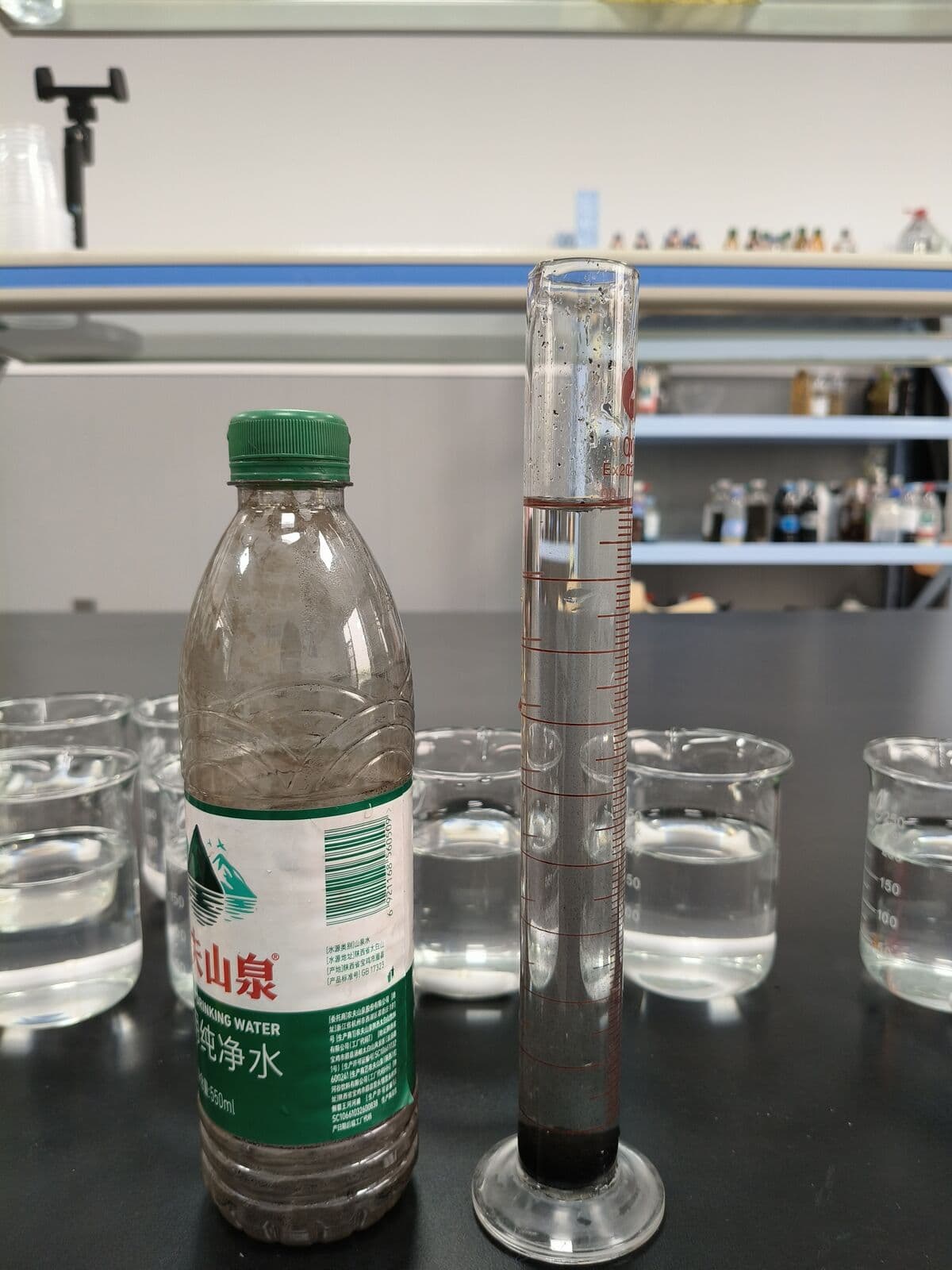
Settling cylinder test: dark solids settle to bottom with clear supernatant — the standard field validation for FLOPAM-to-CNfloc substitution
We supply a free cross-reference sample kit: 500 g each of 2–3 candidate grades for direct side-by-side jar testing. Contact us with your current FLOPAM grade number and application — we will identify the best CNfloc match.
Custom Manufacturing Based on Your TDS
If your current FLOPAM grade falls between standard CNfloc specifications — or your process requires non-standard charge density, molecular weight, or dissolution rate — we offer custom manufacturing based on your TDS (Technical Data Sheet). Send us the TDS of your current product, and our R&D team will formulate a grade that matches your exact specifications. Custom batches start at 2 MT with 15–20 days production lead time. This is particularly useful for operators with highly optimized systems where even ±3% charge deviation affects performance.
Request Free Cross-Reference Samples
Tell us your current FLOPAM grade and application. We ship 500 g samples of 2–3 matched CNfloc grades for direct comparison testing — no charge for qualified industrial buyers.
Quick Reference: FLOPAM to CNfloc Mappings
The full list, including the grades where we do not have a close counterpart. We publish those as well rather than filling the gap with an approximate answer, because an approximate flocculant match costs a plant real money in re-trials.
| SNF FLOPAM Grade | Our Candidate Grade | Type | Match Confidence |
|---|---|---|---|
| AN 910 | CNfloc 1062 | Anionic | Indicative |
| AN 913 | CNfloc 1062 | Anionic | Indicative |
| AN 945 | CNfloc 1054 | Anionic | Indicative |
| AN 956 | CNfloc 1054 | Anionic | Indicative |
| AN 934 VHM | CNfloc 1054V | Anionic | Indicative |
| AN 945 VHM | CNfloc 635A | Anionic | Indicative |
| AN 956 VHM | High-charge / very-high-MW ChinaPAM supply route | Anionic | Available — current grade confirmed at quotation |
| AN 905 VHM | Low-charge / very-high-MW ChinaPAM supply route (adjacent band, jar test required) | Anionic | Available — current grade confirmed at quotation |
| AN 913 VHM | Low-charge / very-high-MW ChinaPAM supply route | Anionic | Available — current grade confirmed at quotation |
| AN 923 VHM | Two routes: charge-matched medium or chain-length-priority very-high-MW | Anionic | Available — current grade confirmed at quotation |
| AN 934 SH | CNfloc 1054 | Anionic | Close |
| AN 945 SH | CNfloc 1001-ZJ | Anionic | Close |
| AN 934 HD | CNfloc 1054 | Anionic | Close |
| FO 4115 | CNfloc C8008 | Cationic | Indicative |
| FO 4140 | CNfloc C8008 | Cationic | Indicative |
| FO 4190 | CNfloc C8015 | Cationic | Indicative |
| FO 4240 | C8008 starting route; C8001/C8015 higher-MW bracket | Cationic | Trial required |
| FO 4290 | CNfloc C8015 | Cationic | Indicative |
| FO 4350 | CNfloc C8035 | Cationic | Close |
| FO 4440 | CNfloc C8035 | Cationic | Close |
| FO 4490 | CNfloc C8035 | Cationic | Close |
| FO 4650 | CNfloc C8005 | Cationic | Close |
| FO 4800 | C8005 / C8055 suffix-controlled routes | Cationic | Screening |
| FO 4650 SH | CNfloc C8055 | Cationic | Close |
| FO 4800 SH | C8055 screening route | Cationic | Trial required |
| FO 8650 | Selection service — MW gap disclosed, High-charge cationic powder route | Cationic | MW gap disclosed |
| FO 8990 | Two-row selection service — bare and SH suffix, MW gap disclosed | Cationic | MW gap disclosed |
| AN 934 | Contact us for grade selection | Anionic | No close match in current range |
| AN 977 SH | Very-high-charge / very-high-MW ChinaPAM supply route | Anionic | Available — current grade confirmed at quotation |
| AN 934 MPM | Contact us for grade selection | Anionic | No close match in current range |
| AN 934 BPM | Contact us for grade selection | Anionic | No close match in current range |
| FO 4650 VHM | Contact us for grade selection | Cationic | No close match in current range |
| FO 4490 VHM | Contact us for grade selection | Cationic | No close match in current range |
| FO 4190 VHM | Contact us for grade selection | Cationic | No close match in current range |
| FO 4800 SSH | C8055 starting route | Cationic | Trial required |
| FO 4698 | C8002/C8025 charge-aligned route | Cationic | Screening |
| FO 4698 SH | C8015 start; C8035 longer-chain lane | Cationic | Screening |
| FO 4358 SH | C8001/C8015 start; C8003/C8035 longer-chain lane | Cationic | Screening |
| FO 4498 SH | C8003 longer-chain primary; C8001 charge-aligned alternative | Cationic | Screening |
| FO 4498 | C8001 single published lane (bare grade, Standard MW) | Cationic | Screening |
Two reminders when reading this table. First, a grade name without a suffix is the standard molecular weight version; if your bags carry SH, VHM, HD, MPM or BPM, quote it to us because it changes the answer. Second, the descriptors on each side come from different in-house scales, so treat every row as a starting point for a jar or CST test rather than a guarantee of identical behaviour.
Frequently Asked Questions
Can I switch from FLOPAM to CNfloc without changing my dosing equipment?
Yes. Dissolution and dosing equipment is identical — same aging tanks, same mixers, same metering pumps. The only requirement is to flush the system with clean water before switching to prevent residual polymer interaction. Allow 2–3 system volumes of flush water between polymer types.
What quality documents does ChinaPAM provide for CNfloc products?
TDS, COA, and SDS documents are available by confirmed grade and batch. Solid content is ≥90%, and residual acrylamide monomer targets are confirmed on the batch COA. Regulated-use PAM requires document review before quotation. Every batch ships with Certificate of Analysis including charge density, molecular weight, solid content, and dissolution time.
What is the MOQ for a CNfloc trial to replace FLOPAM?
500 kg minimum for trial orders — enough for jar testing plus 2–4 weeks of field trial at a medium WWTP or mining thickener. Standard commercial MOQ is 1 MT per grade. We accept mixed-grade pallets in a single container for customers evaluating multiple FLOPAM replacements simultaneously.
How long does delivery take from ChinaPAM?
7–10 days production lead time plus 18–25 days sea freight to most destinations. Total 25–35 days order-to-delivery. High-runner grades (C8005, C8055, 1054, 1062) are stocked for same-week dispatch. Compare this to 4–8 week lead times from SNF European production for non-standard grades.
Is FLOPAM AN 934 the most common grade customers replace?
Yes, with one important qualification. AN 934 is the best known number in the FLOPAM anionic range and SNF lists it at medium charge density, but the number covers six molecular weight tiers from BPM through VHM. For AN 934 SH we would put forward CNfloc 1054, and for AN 934 VHM we would put forward CNfloc 1054V. Tell us which suffix you run, or send a photo of the bag label, and request both grades for parallel settling cylinder tests since ore mineralogy and particle size distribution usually decide which one wins.
FO 4490: the suffix decides the route, not the number
The FO 4490 family is the clearest example of why we ask for the complete grade string. In the SNF 2007 powder catalogue the root FO 4490 is listed at Medium charge and Standard MW; FO 4490 SH and FO 4490 SHU are listed at Medium charge and High MW; and FO 4490 SSH is listed separately at High charge and Very High MW. Three different historical MW and charge positions, one number. A purchase order written as "FO 4490" with the suffix dropped collapses all three, and a route selected for root duty can fail an SSH duty through insufficient chain length or charge — which is a problem discovered in the plant rather than on paper.
The first step is documentary; same-sludge testing then confirms the lane. A photograph of the complete bag label, or a current TDS, shows which suffix was actually delivered. Our FLOPAM FO 4490 family page sets out the three lanes we quote against those catalogue positions — C8001 and C8015 for root duty, C8003 and C8035 for the SH and SHU position, and C8005 with C8055 and C8006 as the SSH bracket. You do not have to wait for the paperwork to start the conversation: send the number you have and we can open the quotation immediately. What we will not do is lock a single route before the suffix is confirmed. If neither the bag label nor a current TDS can be obtained, we list the root and the SH/SHU and SSH candidate lanes side by side as alternatives and let the same-sludge trial decide between them. The 2007 catalogue is cited as a historical indicative source for band positions only; it is not current SNF specification or availability.
For a broader comparison of PAM manufacturers including SNF, BASF, and Kemira, see our top 10 PAM manufacturers ranking. If you run BASF Zetag or Magnafloc grades or Solenis Clarifloc, we publish dedicated cross-reference guides for those brands too. For general China PAM sourcing guidance including pricing and logistics, see the supplier guide. If you need help with dissolution procedures for these products, check our PAM dissolving method guide. For storage and shelf life considerations when stocking replacement inventory, see our shelf life and storage guide. Visit our homepage for full product catalog and technical support.
Compare a matched grade against your current FLOPAM
Send your current FLOPAM model number and the duty it runs on. We will match one or two candidates, ship 1 kg lab samples free so you can verify performance on your own feed, and quote against your real operating conditions.
Quotation based on grade, quantity and destination · info@chinapolyacrylamide.com · WhatsApp +86 187-3759-0940