Sugar mills consume enormous volumes of water and generate wastewater loaded with suspended solids, organic matter, and color. Polyacrylamide plays two distinct roles in sugar production: clarifying raw juice before crystallization, and treating mill effluent before discharge. We supply PAM to sugar mills in Brazil, India, Thailand, and Egypt.
PAM in Sugar Industry: Two Key Applications
Polyacrylamide for sugar industry serves two distinct functions: nonionic PAM (NPAM, 8-12M Da) at 2-5 ppm clarifies raw cane juice by bridging suspended fiber, wax, and colloidal impurities into settleable flocs within 30-60 minutes, while cationic PAM (CPAM) at 3-8 ppm treats mill effluent to meet BOD <30 mg/L and TSS <50 mg/L discharge standards.
| Application | PAM Type | MW | Dosage | Purpose |
|---|---|---|---|---|
| Juice clarification | NPAM or APAM | 8-12M Da | 2-5 ppm | Remove suspended solids before crystallization |
| Mill effluent treatment | CPAM | 10-15M Da | 3-8 ppm | Clarify wastewater for discharge/reuse |
| Sludge dewatering | CPAM | 10-15M Da | 4-8 kg/ton DS | Dewater clarifier sludge |
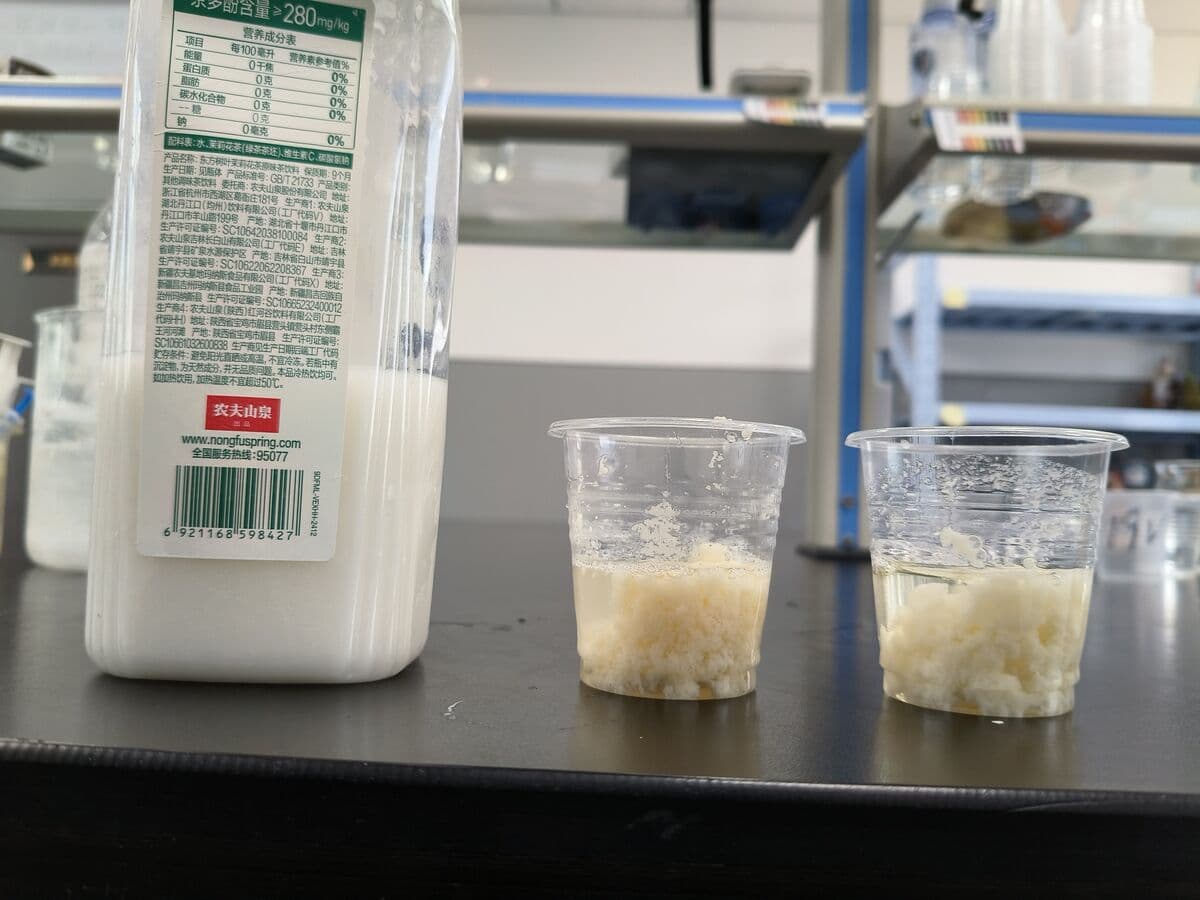
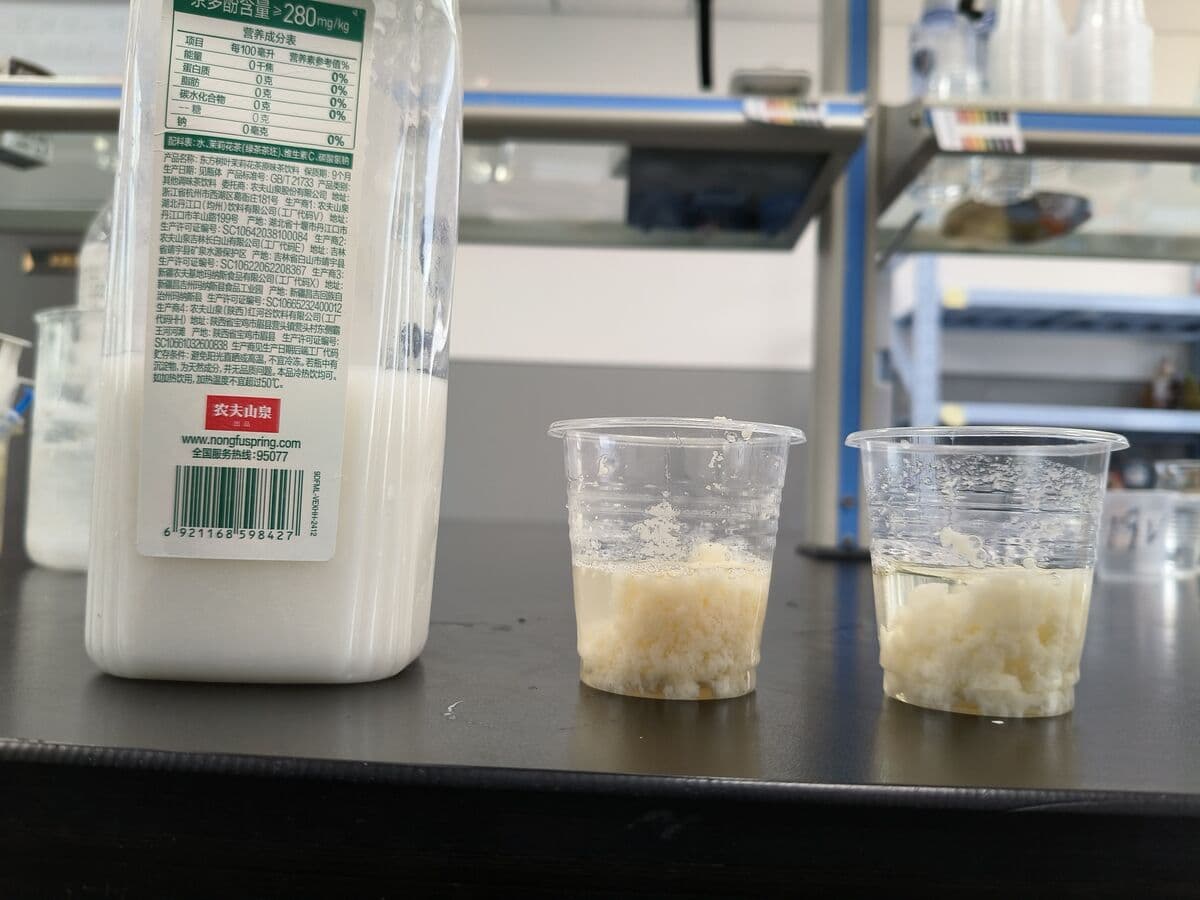
Settling test on starch-process effluent: the same clarification behaviour applies to sugar mill juice and mill effluent streams
Juice Clarification
Sugar juice clarification with PAM reduces clarifier turbidity from 200-500 NTU to below 20 NTU and cuts settling time from 2-3 hours to 30-60 minutes, using document-supported nonionic polyacrylamide at 2-5 ppm after liming to pH 7.0-7.5 and heating to 100-105°C — improving sugar recovery from mud by 5-10% compared to gravity settling alone. Raw cane juice is a mess — suspended fiber, wax, colloidal gunk, microorganisms. All of it has to come out before you can crystallize clean sugar.
The standard clarification process:
- Liming — add milk of lime to raise pH to 7.0-7.5. This precipitates phosphates and coagulates colloids.
- Heating — heat juice to 100-105°C to kill microorganisms and improve settling.
- PAM dosing — add 2-5 ppm NPAM or low-charge APAM to bridge suspended particles into large flocs.
- Settling — juice settles in a clarifier for 30-60 minutes. Clear juice overflows; sludge (mud) settles to the bottom.
- Mud filtration — clarifier mud is filtered on rotary vacuum filters to recover sugar.
Why NPAM for juice clarification? Sugar juice is a food product — it needs document-supported PAM with zero ionic charge. You don't want anything in there that could affect crystal quality or downstream processing. Our NPAM for sugar has residual monomer ≤0.05%, well below regulated-use thresholds. I've had mill operators try APAM to save money — it works for a week, then calcium-polymer scale starts building up in the evaporators. Not worth it.
Performance: PAM reduces clarifier turbidity from 200-500 NTU to <20 NTU. Settling time drops from 2-3 hours to 30-60 minutes. Sugar recovery from mud improves 5-10%.
Mill Effluent Treatment
Sugar mill effluent treatment with cationic PAM (CPAM) at 3-8 ppm removes 60-80% of suspended solids and reduces BOD load by 30-40% in the primary clarification stage, treating wastewater with typical BOD of 500-2000 mg/L and TSS of 200-1000 mg/L down to discharge-compliant levels when combined with secondary biological treatment. Sugar mill wastewater is high-organic, dark, and loaded with suspended solids from washing, cooling, and process water. Discharge standards in most countries want BOD <30 mg/L and TSS <50 mg/L — you can't get there without chemical treatment first.
PAM handles the primary clarification. The mechanism is similar to dairy wastewater treatment — both are high-organic effluents where high charge density CPAM neutralizes negatively charged organic colloids. CPAM at 3-8 ppm pulls out 60-80% of TSS, knocks 30-40% off the BOD load, and reduces color by 40-60%.
For mills with tight discharge standards, a two-stage treatment works best: PAM clarification (primary) followed by activated sludge or anaerobic digestion (secondary). The charge density of your CPAM determines how effectively it neutralizes the organic colloids — 30-50% is typical for sugar mill effluent.
Clarifier Mud Dewatering
Sugar mill clarifier mud dewatering with CPAM at 4-8 kg/ton dry solids increases cake solids from 15-20% to 25-35%, reducing disposal volume and improving sugar recovery from the filtrate — using the same sludge dewatering principles as municipal WWTPs but with the added benefit of recovering trapped sucrose. The sludge from juice clarifiers — called "mud" in sugar — is 5-15% solids and still has sugar trapped in it.
Properly conditioned mud dewaters to 25-35% solids, compared to 15-20% without polymer. This reduces the volume of mud to handle and improves sugar recovery from the filtrate.
Dosage Optimization for Sugar Mills
PAM dosage optimization for sugar mills requires seasonal jar testing because juice composition varies with cane variety, soil conditions, and harvest timing — with optimal doses typically falling at 2-4 ppm for juice clarification and 4-6 ppm for effluent treatment, where overdosing causes clarifier foaming and underdosing leaves turbidity above 20 NTU. Sugar mill wastewater composition shifts throughout the season. Early-season cane is different from late-season. Different varieties, different soil conditions, different weather — it all changes the juice. Jar testing at the start of each crushing season is non-negotiable:
- Collect fresh juice or effluent samples at normal operating conditions
- Test NPAM at 1, 2, 3, 5, 8 ppm for juice clarification
- Test CPAM at 2, 4, 6, 8, 10 ppm for effluent treatment
- Measure settling time, supernatant turbidity, and color at each dose
- Select the minimum dose achieving target clarity
Typical optimal doses: 2-4 ppm for juice clarification, 4-6 ppm for effluent treatment. Over-dosing wastes chemical and can cause foaming in the clarifier. For the math behind scaling jar test results to full-scale dosing systems, see our dosage calculation guide.
Need PAM for sugar juice clarification?
Free sample + jar test report. WhatsApp: +86 187-3759-0940
Our Sugar-Grade PAM
Sugar-grade polyacrylamide specifications require regulated-use document review, residual acrylamide monomer ≤0.05%, molecular weight of 8-12 million Da for juice clarification (deliberately lower than mining grades to produce small dense flocs that don't trap sugar), and solid content ≥90% for consistent dissolution performance in high-temperature mill environments.
At our Xinxiang factory, we produce PAM specifically for sugar industry applications:
- NPAM for juice clarification: 8-12M MW, 0% ionic charge, low-residual-monomer target confirmed by COA
- CPAM for effluent treatment: 10-15M MW, 30-50% charge density
- CPAM for mud dewatering: 10-15M MW, 40-60% charge density
All grades: solid content ≥90% and dissolution time ≤90 minutes, supported by TDS, SDS, and batch COA review. The molecular weight for sugar applications is deliberately lower (8-15M) than mining grades (18-28M) because juice clarification needs small, dense flocs that do not trap sugar — not the large, open flocs used in tailings settling.
For sugar and starch buyers, our export team handles standard shipment documents, SDS, COA, and buyer-required document review before order. Any food-processing document must be confirmed by exact grade and batch before quotation.
Packaging and Delivery
Standard packaging: 25kg PE-lined kraft bags on pallets. 20 MT per 20ft container. For large mills consuming 50+ tons per crushing season, we offer volume pricing and scheduled delivery to match your production calendar.
From our Xinxiang factory to Qingdao port: <1 day. Standard delivery: 7-10 days. Urgent timing can be checked against China factory stock by grade. Proper storage conditions are critical in tropical climates — keep bags sealed and below 35°C to maintain full 24-month shelf life.
Economics: PAM Cost vs Sugar Recovery
PAM economics in sugar production deliver 100-200× ROI: at $0.004-0.008 per ton of cane processed (2-4 ppm dosage, $2,000/ton PAM), improved clarification recovers 0.1-0.3% more sugar from mud — worth $8,000/day for a 10,000 ton/day mill at $400/ton sugar price, against $40-80/day PAM cost. The numbers on this are almost embarrassing. A mill processing 10,000 tons of cane per day spends $40-80/day on PAM for juice clarification.
What does it get back? Better clarification means less sugar trapped in mud. Even a 0.2% improvement in sugar recovery — on 10,000 tons of cane at 10% sugar content and $400/ton sugar price — is worth $8,000/day. That's 100-200× return on the PAM investment. I've never seen a mill question the cost once they see the recovery numbers.
For effluent treatment, the economics are driven by regulatory compliance. Discharge fines for exceeding BOD/COD limits can be $10,000-50,000 per violation. PAM-based effluent treatment costs $0.01-0.03 per cubic meter — cheap insurance against fines and production shutdowns.
Cane Sugar vs Beet Sugar: Different PAM Requirements
Cane sugar clarification uses NPAM at 2-4 ppm and pH 7.0-7.5 to handle wax, fiber, and soil impurities, while beet sugar uses low-charge APAM (5-15% hydrolysis) at 1-3 ppm and pH 8.5-9.5 to flocculate pectin and protein colloids — requiring different polymer grades due to fundamentally different juice chemistry and impurity profiles per ICUMSA guidelines.
| Parameter | Cane Sugar | Beet Sugar |
|---|---|---|
| Juice pH after liming | 7.0-7.5 | 8.5-9.5 |
| Clarification temperature | 95-105°C | 80-90°C |
| PAM type | NPAM (preferred) | APAM (low charge, 5-15%) |
| PAM dosage | 2-4 ppm | 1-3 ppm |
| Main impurities | Wax, fiber, soil | Pectin, protein, colloids |
For beet sugar, low-charge APAM (5-15% hydrolysis) works because the higher pH provides natural charge interaction with beet juice colloids. For cane sugar, NPAM remains the standard because cane juice has more diverse impurities that respond better to charge-neutral bridging.
We supply both cane and beet sugar grades. Most of our sugar customers are in tropical cane-producing regions (Brazil, India, Thailand, Indonesia, Egypt), but we also supply beet sugar factories in Turkey and Central Asia.
Common Problems in Sugar Mill PAM Use
The most common PAM problems in sugar mills are clarifier foaming (from overdosing or premature addition before liming completes), slow settling (from undissolved polymer lumps or juice temperature below 60°C), and off-season degradation (from storing PAM in hot tropical warehouses above 35°C for months between crushing seasons).
Foaming in the clarifier: Nine times out of ten, this is overdosing. Cut back 20-30% and make sure pH is stable at 7.0-7.5 before you add PAM. Foam traps air in flocs — they float instead of settle. I've seen operators panic and add more PAM thinking it'll fix the foam. It makes it worse.
Slow settling despite correct dosage: Check your dissolution quality first. Lumps don't flocculate. Then check juice temperature — below 60°C, flocculation kinetics slow way down. Keep juice at 95-100°C during clarification.
Color in clarified juice: PAM removes suspended solids but not dissolved color bodies. If color is a problem, you need activated carbon or ion exchange after clarification. PAM is not a decolorizer.
PAM degrading in storage during off-season: Sugar mills run 4-6 months, then sit idle. PAM stored in a hot warehouse for 6 months loses performance. We tell our customers: order fresh stock at the start of each season. The $200 you save carrying old inventory costs you $2,000 in poor clarification performance.
Frequently Asked Questions
Is PAM safe for regulated-use sugar production?
It can be evaluated for sugar production only after grade, dosage, residual monomer data, and buyer-required documents are reviewed. Do not treat the phrase "sugar-grade" as a substitute for local regulatory approval or the buyer's own quality system.
Can I use anionic PAM instead of nonionic for juice clarification?
Not recommended. APAM introduces anionic charge that can interact with calcium ions from liming, forming calcium-polymer complexes that increase scale buildup in evaporators. NPAM is charge-neutral and does not interfere with downstream processes. Per ICUMSA (International Commission for Uniform Methods of Sugar Analysis) guidelines, nonionic flocculants are preferred for juice clarification.
How much PAM does a typical sugar mill use per season?
A mill processing 5,000-10,000 tons of cane per day uses 10-40 kg of PAM per day for juice clarification. Over a 120-150 day crushing season, that is 1.2-6 tons total. Add another 2-5 tons for effluent treatment and mud dewatering. Total: 3-11 tons per season for a medium-large mill.
What is the shelf life of sugar-grade PAM in tropical climates?
In proper storage (sealed bags, below 35°C, dry conditions): 24 months. In typical tropical warehouse conditions (35-45°C, high humidity): 12-15 months. We recommend ordering fresh stock at the start of each crushing season rather than carrying inventory through the hot off-season months.
Ready to Optimize Your Sugar Mill Treatment?
Send us your juice analysis or effluent data and we will recommend the right PAM grade and dosage. Free samples available for jar testing before your crushing season starts.
WhatsApp: +86 187-3759-0940 | Request a quote
Get a Quote
Our factory in Xinxiang produces confirmed grade availability across core APAM, CPAM, NPAM, and PHPA products. MOQ 500kg, delivery 7-10 days standard. Contact us for pricing and free sample:
- WhatsApp: +86 187-3759-0940
- Email: info@chinapolyacrylamide.com
Recommended Product Grades
For the application discussed above, these are the polyacrylamide grades we ship most often:
Not sure which is right for you? Try our PAM Selector tool or request a quote.
Standards Note
According to ICUMSA sugar-analysis practice, clarification performance should be judged by turbidity, color, settling behavior, and process impact.
Per FAO food-processing guidance, chemical use in food-adjacent processes should be reviewed against local regulation and buyer quality systems.