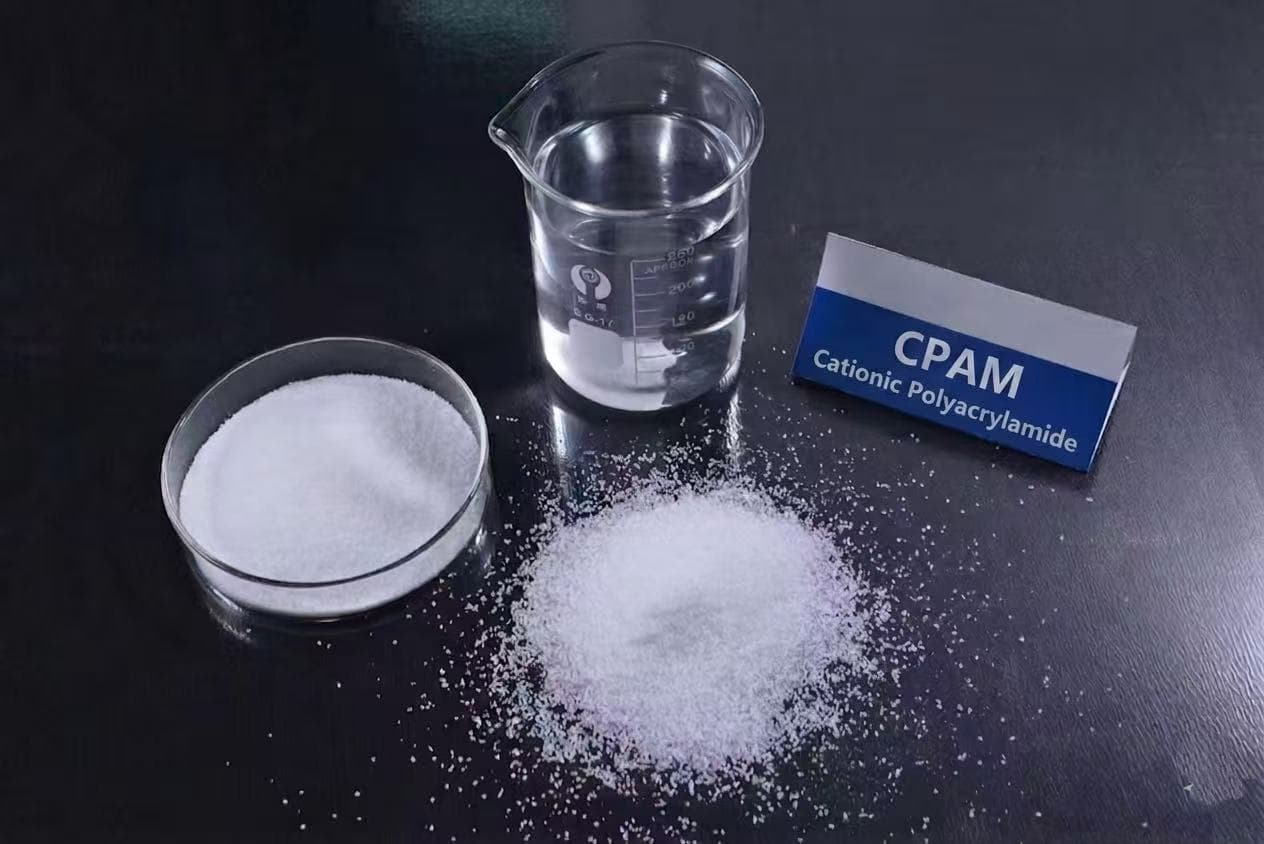
Cationic polyacrylamide (CPAM) is a positively charged water-soluble polymer (5–14M Da, 10–80% charge density) that neutralizes negatively charged organic particles in sludge, enabling mechanical dewatering to reduce cake moisture from 85% to 72–78% — the dominant flocculant for municipal sludge dewatering, industrial wastewater treatment, and paper manufacturing worldwide. This guide covers charge density selection, bulk pricing, and how to source CPAM directly from a ChinaPAM factory supply base with 100,000 tons/year documented PAM capacity.
What Is Cationic Polyacrylamide?
Cationic polyacrylamide (CPAM) is a water-soluble synthetic polymer produced by copolymerizing acrylamide with cationic monomers (DMDAAC or AETAC), carrying a positive ionic charge that neutralizes negatively charged suspended particles — bacteria, organic colloids, and fine solids — causing them to aggregate into large, settleable flocs at dosages of 3–15 g/m³. For a comparison with anionic types, see our anionic vs cationic PAM guide.
The ratio of cationic monomer determines the charge density, which is the most critical specification for application matching. Get this wrong and you're either wasting money (overdosing) or getting poor results (underdosing). I've seen plants cut their polymer cost 30% just by switching to the correct charge density — same supplier, same MW, just the right charge for their sludge.
Key Specifications
CPAM performance is defined by five parameters: molecular weight (5–12M Da, controlling bridging strength), charge density (10–80 mol%, matching sludge organic content), solid content (≥90%, determining shipping economics), dissolution time (30–60 min, affecting dosing system design), and residual monomer (≤0.1%, critical for drinking water compliance).
| Parameter | Typical Range | Effect on Performance |
|---|---|---|
| Molecular Weight | 5–12 million Da | Higher MW = stronger bridging, larger flocs |
| Charge Density | 10–80 mol% | Higher charge = better for high-organic sludge |
| Solid Content | ≥ 90% | Higher solid = less shipping cost per active kg |
| Dissolution Time | 30–60 min | Affects dosing system design |
| Residual Monomer | ≤ 0.1% | Safety compliance for drinking water applications |
Choosing the Right Charge Density
CPAM charge density selection follows the VSS/TSS ratio of your sludge: low charge (10–20%) for inorganic sludge with VSS/TSS below 0.5, medium charge (30–50%) for municipal WWTP sludge with VSS/TSS 0.5–0.6, and high charge (60–80%) for activated sludge and high-organic industrial waste with VSS/TSS above 0.6 — with overdosing wasting 20–40% of chemical cost and underdosing producing wet, unhandleable cake.
This is the single most important variable. Matching charge to your sludge type prevents overdosing (wasted cost) and underdosing (poor dewatering). Here's the quick reference:
| Charge Density | Best For | Typical Dosage |
|---|---|---|
| Low (10–20%) | Inorganic sludge, low-organic wastewater | 3–5 g/m³ |
| Medium (30–50%) | Municipal WWTP sludge, food processing | 5–10 g/m³ |
| High (60–80%) | Activated sludge, high-organic industrial waste | 8–15 g/m³ |
Rule of thumb: If your sludge has high organic content (VSS/TSS ratio > 0.6), start with medium-to-high charge density. For predominantly inorganic sludge (mining tailings, quarry runoff), low charge density is usually sufficient. Learn more about charge density selection.
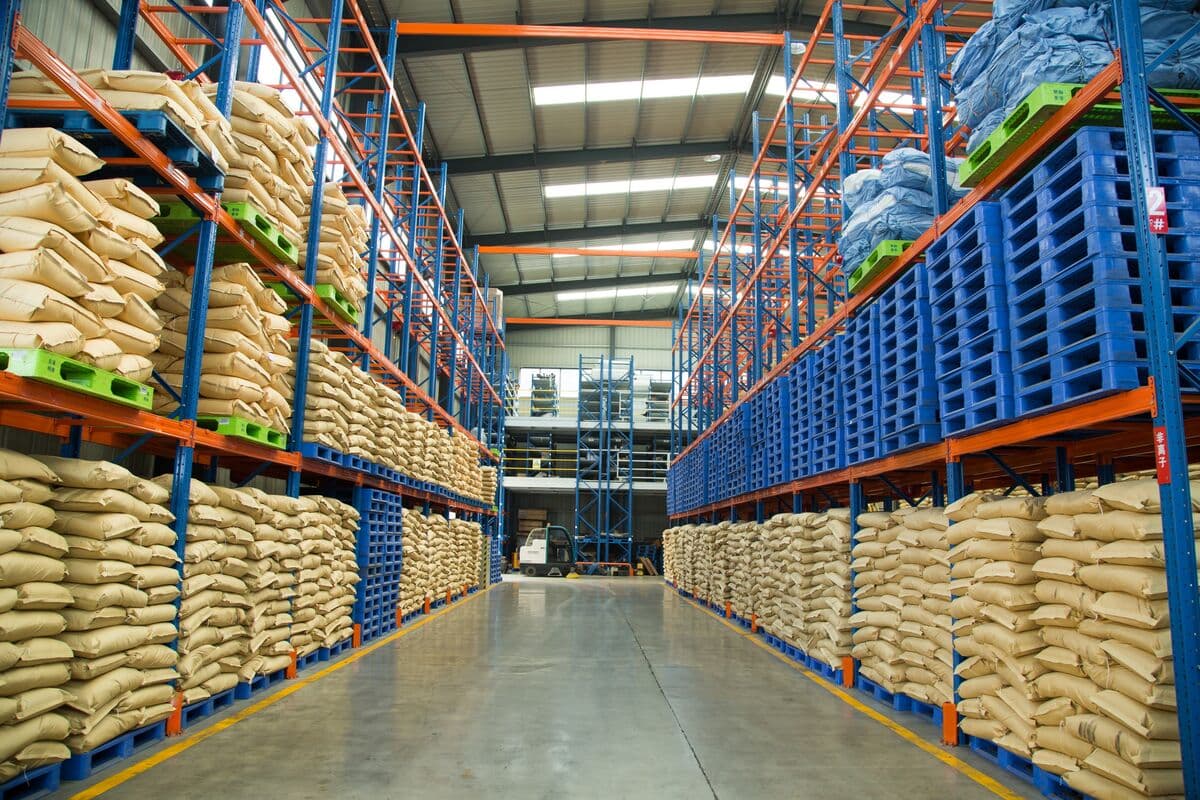
CPAM bulk storage: 25kg kraft bags on pallets, standard export packaging
Primary Applications
CPAM serves four primary markets: municipal sludge dewatering (reducing cake moisture from 85% to 75–78%, cutting disposal costs 30–40%), industrial wastewater clarification ($0.05–0.15/m³ treatment cost), paper manufacturing retention/drainage (200–500 g/MT paper), and oil sludge treatment (60–80% charge for emulsion breaking).
1. Municipal Sludge Dewatering
CPAM is the dominant flocculant in belt filter press and centrifuge dewatering systems. Per WEF guidelines on biosolids management, polymer conditioning is the most cost-effective method for achieving target cake solids. A well-matched CPAM can reduce sludge cake moisture content from 85% to 75–78%, cutting disposal costs by 30–40%. Read our detailed municipal sludge dewatering guide for optimization tips.
2. Industrial Wastewater Treatment
Paper mills, textile plants, and food processing facilities use CPAM to clarify process water and dewater production sludge. Typical treatment cost: $0.05–0.15 per m³ of wastewater treated.
3. Paper Manufacturing
In papermaking, CPAM acts as a retention and drainage aid, improving filler and fiber retention on the wire. This reduces raw material loss and improves paper formation. Dosage: 200–500 g/MT of paper produced. See our PAM in paper manufacturing article for details.
4. Oil Sludge Treatment
Oilfield produced water and refinery sludge require high-charge CPAM (60–80%) to break oil-water emulsions and separate suspended solids. For more on oilfield applications, see PAM for oil drilling.
Need PAM for sludge dewatering?
Free sample + jar test report. WhatsApp: +86 187-3759-0940
Bulk Pricing (2026)
CPAM FOB China pricing ranges from $1,400–1,700/MT for low-charge grades (10–20%) to $2,600–3,200/MT for high-charge/high-MW specialty grades, with FCL (20MT+) discounts of 8–12% and annual contract (100MT+) discounts of 15–20% — pricing driven primarily by cationic monomer content, which accounts for 40–60% of raw material cost.
CPAM FOB China Price Guide
FCL (20MT+) discounts: 8–12% off listed price. Annual contract (100MT+): 15–20% off.
Packaging Options
CPAM bulk packaging options include 25 kg kraft bags (40 bags/pallet, standard export), 500 kg jumbo bags (FIBC, for operations with bulk handling equipment), and custom-labeled bags for OEM/private label distributors — all GHS-compliant with product name, batch number, production date, net weight, and safety information.
- 25 kg kraft bags — Standard export packaging, 40 bags/pallet
- 500 kg jumbo bags — For large-volume buyers with bulk handling equipment
- Custom labeling — OEM/private label available for distributors
All packaging includes: product name, batch number, production date, net weight, and safety information (GHS compliant).
Quality Testing Before Shipment
Every CPAM batch undergoes five-parameter testing before shipment: molecular weight (Ubbelohde viscometry), charge density (colloidal titration with PVSK), solid content (gravimetric at 105°C), residual acrylamide monomer (HPLC, ≤0.1%), and dissolution rate (visual at 0.1% solution) — with Certificate of Analysis provided per batch and third-party SGS inspection available on request.
Every batch of CPAM from ChinaPAM is tested for:
- Molecular weight (viscosity method, Ubbelohde viscometer)
- Charge density (colloidal titration)
- Solid content (gravimetric, 105°C drying)
- Residual acrylamide monomer (HPLC, ≤0.1%)
- Dissolution rate (visual inspection at 0.1% solution)
Certificate of Analysis (COA) is provided with every shipment. Third-party SGS inspection available on request. According to EPA polymer use guidelines, residual monomer content must be documented and controlled for any water-contact application.
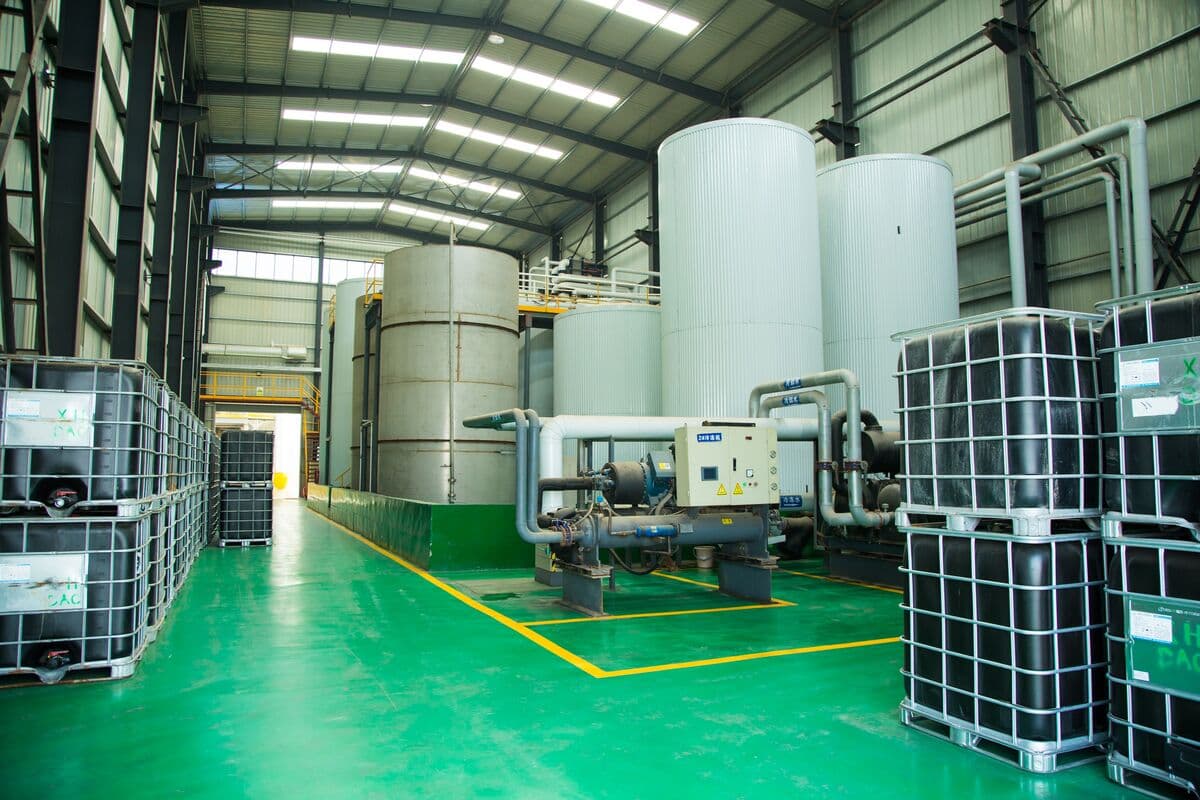
CPAM production facility: storage tanks and processing equipment
Equipment Compatibility: Matching CPAM to Your Dewatering System
CPAM grade must match dewatering equipment shear characteristics: belt presses need medium MW/medium charge (10–12M Da, 40–55%) for compressible flocs, centrifuges require high charge/high MW (11–13M Da, 60–75%) for shear-resistant flocs at 2000–3500 G, plate-and-frame presses tolerate lower charge (30–50%, 8–10M Da), and screw presses need the highest MW (12–14M Da, 60–80%) for compression-resistant flocs.
Using the wrong CPAM grade for your equipment is one of the most common reasons buyers see disappointing results. Run centrifuge-grade CPAM on a belt press and it works, but you are paying roughly 30% more than the duty requires. Run belt-press grade on a centrifuge and it does not work at all — the flocs shatter at 3000 G.
Belt Filter Press
Belt presses apply moderate shear during the gravity drainage zone and higher shear in the wedge and pressure zones. They favor flocs that are large but compressible — meaning medium-to-high MW (10-12M Da) with medium-to-high charge (40-60%). If flocs are too soft, they squeeze through the belt; if they are too rigid, they crack and release water back into the cake.
- Recommended grade: 10-12M MW, 40-55% charge density
- Typical dosage: 5-12 g/kg dry solids
- Expected cake moisture: 75-80%
- Polymer make-up concentration: 0.2-0.4%
Centrifuge (Decanter)
Decanter centrifuges apply the most aggressive shear of any common dewatering equipment — typically 2000-3500 G. This destroys weak flocs. Centrifuge dewatering needs strong, shear-resistant flocs, which means higher charge density (60-80%) and slightly higher MW (11-13M Da). Dosage runs 20-40% higher than belt press for the same sludge.
- Recommended grade: 11-13M MW, 60-75% charge density
- Typical dosage: 8-15 g/kg dry solids
- Expected cake moisture: 72-78%
- Polymer make-up concentration: 0.15-0.3%
Plate-and-Frame (Filter Press)
Plate-and-frame presses apply low shear during fill and high static pressure during squeeze. They tolerate a wider range of CPAM grades and often operate well with lower-charge polymers (30-50%) at moderate MW (8-10M Da). Final cake moisture is typically the lowest of all equipment types but cycle times are longer.
- Recommended grade: 8-10M MW, 30-50% charge density
- Typical dosage: 4-8 g/kg dry solids
- Expected cake moisture: 65-72%
- Polymer make-up concentration: 0.2-0.5%
Screw Press
Screw presses apply continuous low-rotation pressure with high mechanical squeeze. They benefit from very high MW polymers that form coarse, durable flocs that hold up under prolonged compression. High charge density (60-80%) plus high MW (12-14M Da) is typical.
- Recommended grade: 12-14M MW, 60-80% charge density
- Typical dosage: 10-18 g/kg dry solids
- Expected cake moisture: 70-76%
- Polymer make-up concentration: 0.2-0.4%
Troubleshooting Common CPAM Issues
The seven most common CPAM performance issues — from pinpoint flocs (underdosing/low charge) to rising consumption over months (moisture degradation) — are diagnosable through systematic jar testing and sludge characterization, with most problems resolved by adjusting charge density, dosage, or dissolution procedure rather than switching suppliers.
| Symptom | Likely Cause | Fix |
|---|---|---|
| Pinpoint flocs, no aggregation | Underdosing or charge too low | Increase dose 20%, retest. If no improvement, switch to higher charge density |
| Flocs disperse on agitation | Charge reversal (overdosing) | Reduce dose 30%, run jar test to find true optimum |
| Slow dissolution, gel lumps | Powder added too fast or solution too concentrated | Use eductor or vibrating feeder; max 0.3% solution strength; let solution age 30-60 min |
| Filtrate cloudy at belt press | MW too low for shear conditions | Move to 12M+ MW grade; verify polymer not being sheared in mixing |
| Wet cake, soft flocs | Flocs too fragile for centrifuge G-force | Move to higher charge (60-80%) and higher MW grade |
| Dosage doubled overnight | Sludge composition shift (rain event, seasonal change) | Run jar test with current sludge; adjust grade if VSS/TSS shifted >10% |
| Polymer consumption rising over months | Stored powder past shelf life or moisture absorbed | Check moisture content; powder shelf life is 24 months sealed, 6 months opened |
Frequently Asked Questions
How do I know if my sludge needs medium or high charge CPAM?
Run a quick VSS/TSS test on your sludge sample. If VSS (volatile suspended solids) is over 60% of TSS, you have organic-rich sludge and should start with high charge (55-70%). If VSS is under 50%, medium charge (30-50%) usually performs equally well at lower cost. Anything in between needs a jar test with two grades side by side.
What is the shelf life of CPAM powder?
24 months in sealed bags stored below 30°C with humidity under 60%. Once a bag is opened, expect 6 months of usable life — moisture absorption from air slowly degrades the polymer's MW. Centrifuge users notice this fastest because they need the highest MW. Belt press users often run open bags 9-12 months without issues.
Can I mix CPAM and APAM in the same plant?
Yes, but never in the same dosing line. Cationic and anionic polymers neutralize each other on contact, forming insoluble complexes that clog pumps and lines. Plants using both (some industrial WWTPs do) keep separate make-up tanks, separate pumps, and dose at different points in the process — for example, APAM at primary clarifier and CPAM at sludge thickening.
Why does my CPAM dosage spike during summer?
Three reasons typically combine. First, biological activity increases at higher temperatures, raising VSS and EPS production — both of which bind cationic polymer. Second, dissolved oxygen drops in some plants, shifting the microbial community toward filamentous bacteria that resist dewatering. Third, summer storm events bring more silt and grit. Plan for 15-25% higher CPAM consumption from June through September in temperate climates.
What is the difference between CPAM made with DMDAAC vs AETAC?
DMDAAC-based CPAM is generally cheaper and more shear-stable, with charge density typically 20-50%. AETAC-based CPAM achieves higher charge density (up to 80%) with better hydrolytic stability at high pH (above 8.5). Most municipal sludge dewatering uses DMDAAC; high-pH industrial sludge or paper mill applications often spec AETAC. We produce both — let us know your pH range and we will match accordingly.
Worked Example: Centrifuge Grade Selection on Industrial Park Sludge
Modelled, not a delivered project. This is the shape of the problem when a centrifuge is stuck on wet cake, and it is worth walking through because the fix is a sampling exercise rather than a capital one.
Starting point: a 50% charge CPAM at 10M MW, dosing 14 g/kg DS, cake moisture stuck at 80-82%. On mixed industrial-park sludge that combination is usually under-charged for the duty. The way to find out is to test three charge densities — 60%, 70% and 80% — at a constant 12M MW, and let the centrate tell you which one is right. Where 70% charge wins, expect cake moisture toward 75%, dosage nearer 11 g/kg DS, and a large drop in centrate solids. The money is in disposal, not polymer: drier cake means fewer truckloads, which at typical tipping fees is a five-figure annual difference. Confirm on one machine before rolling it across the plant. We send 200-500 g samples of each grade free for exactly this.
How to Order CPAM in Bulk
Bulk CPAM ordering follows a 5-step process: share application details (sludge type, equipment, current flocculant) → receive grade recommendation matched to your process → request free 200–500g samples for jar testing → confirm order specs (quantity, packaging, Incoterms) → production and shipment with 7–15 day lead time and COA before loading.
- Share your application details — sludge type, dewatering equipment, current flocculant (if any)
- Receive product recommendation — we match charge density and MW to your process
- Request free samples — 200–500g for jar testing at no cost
- Confirm order specs — quantity, packaging, shipping terms
- Production and shipment — 7–15 day lead time, COA before loading
Get CPAM Pricing Now
Tell us your charge density requirement and monthly volume. We'll send a factory-direct quote within 24 hours.
Recommended Product Grades
For the application discussed above, these are the polyacrylamide grades we ship most often:
- high-charge-density CPAM
- medium-charge-density CPAM
- FLOPAM FO 4132, FO 4350 and FO 4400 — if your contract names an SNF grade code
- FLOPAM DW 533 equivalent — drinking water duty, where approval decides sourcing before price does
Not sure which is right for you? Try our PAM Selector tool or request a quote.