Polyacrylamide charge density is one of the most misunderstood parameters in the industry. Suppliers often say "high charge" or "low charge" without giving actual numbers. Here is what charge density means, how it affects performance, and how to choose the right level for your application.
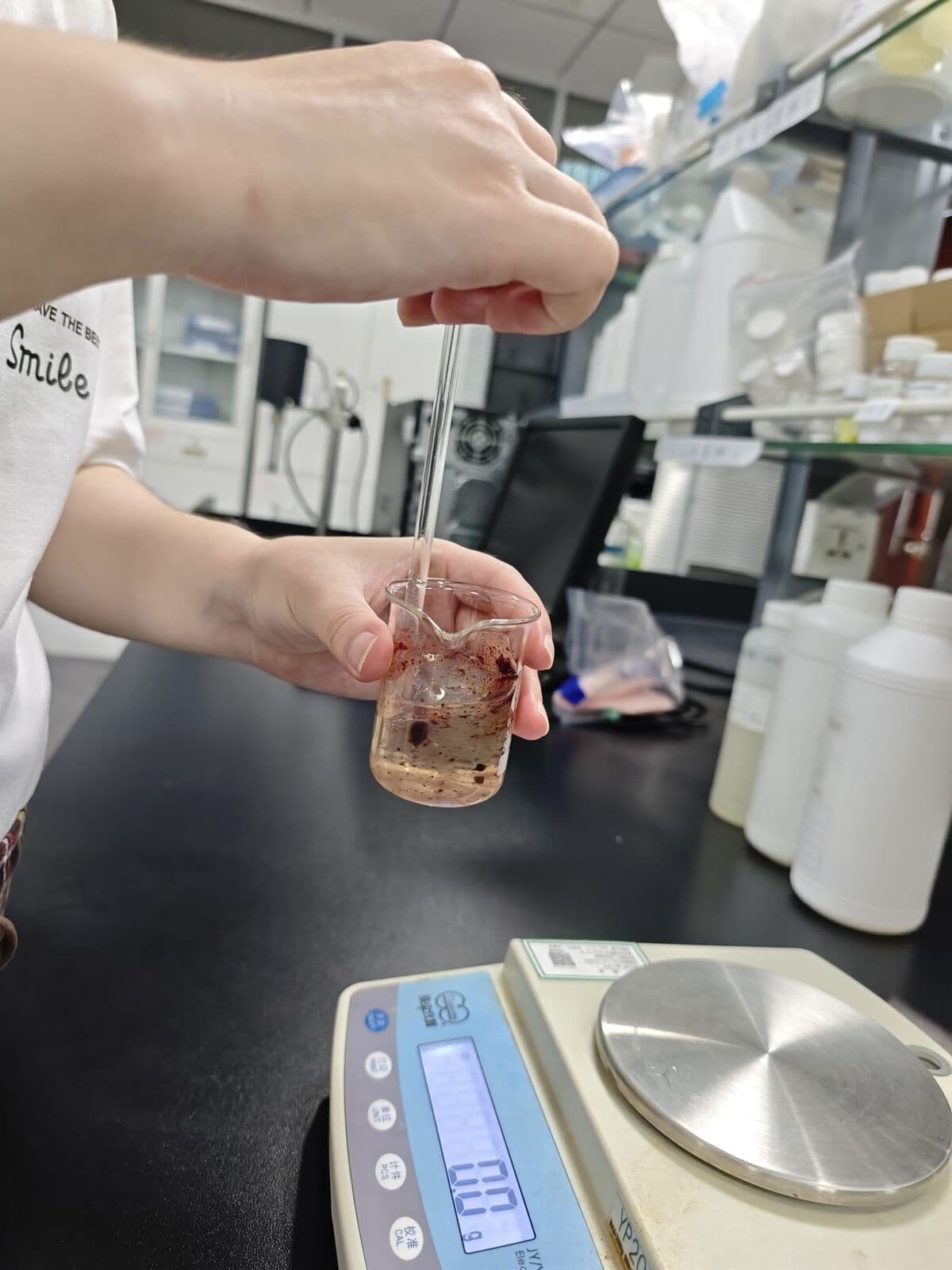
Bench flocculation test weighed on a lab balance: floc size and firmness are the practical read-out when comparing charge levels on one water sample
What Is Charge Density?
Charge density in polyacrylamide measures the mole percentage of ionic monomers in the polymer chain — cationic PAM ranges from 5-70% positively-charged monomers (using DMDAAC or AETAC co-monomers) while anionic PAM ranges from 0-45% negatively-charged monomers (via hydrolysis of amide groups to carboxylate) — and this percentage directly controls the polymer's electrostatic attraction strength to oppositely-charged sludge particles.
Example: CPAM with 50% charge density means 50% of the monomers carry a positive charge, and 50% are neutral. This is measured in mole percent (mol%).
Charge density ranges:
- CPAM: 5-70% charge density (5% = very low, 70% = very high)
- APAM: 0-45% hydrolysis degree (0% = nonionic, 45% = high)
- NPAM: 0% (nonionic, no charge)
How Charge Density Affects Performance
Charge density controls four performance dimensions simultaneously — flocculation speed (higher charge = faster particle capture), dosage requirement (60% charge CPAM achieves equivalent results at half the dosage of 30% charge), charge reversal risk (over-dosing high-charge polymer restabilizes particles), and floc shear resistance (higher charge produces more brittle flocs that break in centrifuges above 2,000 G).
Flocculation Strength
Higher charge density = stronger electrostatic attraction to oppositely charged particles. For CPAM treating negatively charged particles (sludge, clay), higher charge density means faster flocculation and larger flocs. This is the same principle behind PAM flocculant selection for water treatment — matching charge to particle surface chemistry.
But there is a limit. Beyond the optimal charge density for your specific water, additional charge does not improve performance — it just wastes money.
Dosage Requirement
Higher charge density = lower dosage needed. A CPAM with 60% charge density might achieve the same result at 4 ppm as a 30% charge density CPAM at 8 ppm. However, the higher-charge product costs more per ton, so the cost per ppm might be similar.
Charge Reversal Risk
Over-dosing CPAM causes charge reversal — excess positive charge restabilizes particles, making water turbid again. Higher charge density CPAM is more prone to charge reversal because it reaches saturation at lower dosage.
This is why jar testing is critical. The optimal dose is where you get maximum performance without charge reversal. Our step-by-step jar test procedure walks through the protocol.
Shear Sensitivity
Higher charge density polymers tend to form more brittle flocs that break apart under shear (centrifuge, pump, pipe flow). Lower charge density polymers form more flexible flocs that survive shear better.
For centrifuge dewatering, medium charge density (30-50%) often outperforms high charge density (60-70%) because the flocs survive the G-force better.
Charge Density Selection by Application
Optimal charge density maps directly to sludge organic content — municipal activated sludge requires 30-50% CPAM at 3-6 kg/ton dry solids, anaerobically digested sludge needs 50-70% at 5-10 kg/ton, food/beverage sludge uses 40-60% at 4-8 kg/ton, while inorganic mining tailings use APAM at 20-35% hydrolysis where bridging dominates over charge neutralization.
The right charge density depends on your sludge type. Use this table — it covers 90% of applications we supply:
| Application | Charge Density | Typical Dosage | Why This Range |
|---|---|---|---|
| Municipal activated sludge | 30-50% | 3-6 kg/ton DS | Moderate organic load, belt press or centrifuge |
| Digested sludge (anaerobic) | 50-70% | 5-10 kg/ton DS | Dense, high organic, needs strong charge neutralization |
| Food/beverage wastewater | 40-60% | 4-8 kg/ton DS | High anionic trash from dissolved organics |
| Paper mill sludge | 50-70% | 4-8 kg/ton DS | Mixed fiber + filler + anionic trash |
| Oily sludge (refinery) | 40-60% | 5-12 kg/ton DS | Oil emulsion needs moderate charge + high MW |
| Mining tailings (inorganic) | APAM 20-35% hydrolysis | 1-3 ppm | Inorganic solids, bridging mechanism dominates |
Per AWWA and WEF wastewater treatment standards, charge density selection should always be confirmed by jar testing on actual sludge samples — the table above is a starting point, not a final answer.
Municipal Sludge Dewatering
Activated sludge is organic-rich and negatively charged. Optimal charge density: 30-50% CPAM. This provides strong flocculation without excessive charge that would cause over-dosing problems. See our municipal WWTP sludge dewatering guide for equipment-specific recommendations.
Industrial Organic Sludge (Food, Paper, Slaughterhouse)
Higher organic content = higher charge demand. Use 40-60% CPAM. The higher charge handles the increased anionic trash (dissolved organics that consume cationic polymer). Where charge demand is very high, dosing a low-molecular-weight polyDADMAC coagulant ahead of the polymer absorbs that demand and often lets you drop back to a cheaper medium-charge CPAM. A polyamine coagulant does the same job at a lower cost per kilogram of active, provided the coagulation pH stays below about 8.5.
Digested Sludge
Digested sludge has concentrated organic matter and is more difficult to dewater. Use 50-70% CPAM. The high charge provides strong flocculation needed for dense, incompressible flocs.
Paper Mill Sludge
Paper mill sludge contains fiber, filler, and organic matter. Use 50-70% CPAM. The high charge handles the mixed contaminants and anionic trash from recycled fiber. For retention aid applications (wet end), lower charge (20-40%) is used — see our paper making retention aid guide.
Water Clarification (Inorganic Solids)
For clarifying water with inorganic suspended solids (mining tailings, sand washing, metal finishing), use APAM (anionic) rather than CPAM. Charge density is less critical — 20-35% hydrolysis works for most applications.
High-Salinity Wastewater
In high-salinity water (TDS >50,000 ppm), dissolved salts screen ionic charges. Ionic PAM becomes less effective. Either increase charge density (use 60-70% CPAM) or switch to NPAM (nonionic). Where a mixed-charge feed also needs some ionic activity, an amphoteric polyacrylamide can hold flocculation across a wider salinity and pH window than a single-charge grade.
Need PAM for your application?
Free sample + jar test report. WhatsApp: +86 187-3759-0940
How to Verify Charge Density
Verifying supplier-claimed charge density requires COA documentation showing actual mol% values (not vague "high/medium/low" labels), ideally confirmed by third-party colloid titration testing — batch-to-batch variation exceeding ±2% indicates poor manufacturing control and will cause unstable dosing requirements that fluctuate between 4-7 ppm for the same wastewater.
- Ask for the COA — Certificate of Analysis should state the actual charge density value in mol%
- Request third-party test report — independent lab verification is the gold standard
- Run jar tests — compare settling performance with a known reference. Higher charge should give faster settling at lower dosage.
- Check dosage consistency — if the same supplier's product requires very different dosages between batches, charge density may be inconsistent
One thing not to use as a proxy: solution viscosity. Viscosity tracks molecular weight, not charge, so a correctly specified high-charge grade can read lower than a low-charge one and still be the right product. Buyers who screen incoming batches on viscosity alone end up rejecting good material and accepting under-charged material. If you do run a viscosity check as part of goods-in, our guide to polyacrylamide viscosity measurement covers the test conditions that make the number comparable between your lab and the supplier's.
What Happens When You Choose Wrong
Incorrect charge density selection costs $5,000-$100,000+ annually per plant — charge too low doubles dosage consumption (5 tons/month becomes 10 tons at $1,800/ton = $9,000/month extra), charge too high causes reversal that increases cake moisture from 78% to 85% and raises disposal costs 30-40%, and inconsistent batches make stable operation impossible.
- Charge too low (e.g. 20% for digested sludge): Dosage doubles to compensate. A plant using 5 tons/month of CPAM at $1,800/ton now uses 10 tons = $9,000/month extra. Per WEF guidelines, under-charged polymer is the most common cause of excessive chemical costs in sludge dewatering.
- Charge too high (e.g. 70% for municipal activated sludge): Charge reversal at normal dosage. Operators keep reducing dose, flocs become weak, cake moisture increases from 78% to 85%. Disposal cost increases 30-40% because you are hauling more water.
- Inconsistent charge between batches: Operators cannot maintain stable dosage. One batch works at 4 ppm, next batch needs 7 ppm. This causes sludge quality swings and operator frustration.
The fix is simple: jar test before committing to a supplier, and demand COA with every shipment showing actual charge density ±2% tolerance.
Charge Density Selection by Industry
Industry-specific charge density requirements vary from 20-35% for textile chemical sludge (low organic, inorganic precipitates) to 50-70% for anaerobic digested sludge and paper mill biosludge (high organic, strong negative surface charge) — with site-specific jar testing required because even two municipal plants in the same city can differ by 10-15% in optimal charge due to process configuration differences.
| Industry | Sludge Type | Recommended Charge (%) | Typical Dosage (kg/ton DS) |
|---|---|---|---|
| Municipal WWTP | Activated sludge | 30–40% | 3–5 |
| Municipal WWTP | Digested sludge | 50–70% | 5–8 |
| Paper mill | Primary + bio sludge | 40–55% | 4–7 |
| Textile dyeing | Chemical sludge | 20–35% | 2–4 |
| Dairy/food | DAF sludge | 40–60% | 4–6 |
| Oil refinery | Oily sludge | 50–65% | 6–10 |
These are starting points. According to EPA biosolids management guidelines, every plant should run site-specific polymer trials because even two municipal plants in the same city can have different optimal charge densities depending on their process configuration (extended aeration vs. conventional activated sludge vs. MBR).
Temperature Effects on Charge Density Performance
One thing many operators miss: charge density performance changes with temperature. In cold climates (sludge below 15°C), polymer chains are less flexible and charge neutralization is slower. You typically need 5–10% higher charge density in winter compared to summer for the same sludge.
We had a customer in Canada who kept switching suppliers every winter because "the polymer stopped working." The real issue was temperature. Their summer-optimized 35% charge CPAM needed to be swapped to 40–45% charge in winter months. Once they set up seasonal polymer rotation, their cake solids stayed consistent at 22–24% year-round.
How Charge Density Interacts with Molecular Weight
Charge density and molecular weight work together. High charge + low MW gives fast charge neutralization but weak flocs. Low charge + high MW gives strong bridging but slow initial capture. The sweet spot depends on your dewatering equipment:
- Belt press: Medium charge (30–45%) + high MW (10–15M). Needs strong flocs that resist shear on the belt.
- Centrifuge: Higher charge (40–60%) + medium MW (8–12M). High G-force breaks weak flocs, so charge neutralization matters more than bridging.
- Screw press: Medium charge (35–50%) + medium-high MW (10–14M). Slow dewatering allows time for bridging to work.
For more on molecular weight selection, see our molecular weight guide.
Our CPAM Charge Density Range
Our Xinxiang factory produces CPAM across the full 5-70% charge density spectrum in four tiers — light-duty (5-20%), standard municipal (20-40%), industrial-strength (40-60%), and extreme-condition (60-70%) — with every batch verified by colloid titration to ±2% tolerance and documented on the Certificate of Analysis shipped with each delivery.
- 5-20% charge: light organic loads, low-cost applications
- 20-40% charge: municipal sludge, standard applications
- 40-60% charge: industrial sludge, paper mill, high organic content
- 60-70% charge: digested sludge, high-salinity wastewater, extreme conditions
Every batch is tested for charge density with ±2% tolerance. We provide COA with every shipment showing the actual charge density value.
Not Sure Which Charge Density to Choose?
Send us your sludge or wastewater analysis (solids concentration, volatile solids %, pH, conductivity) and we will recommend the optimal charge density. Free samples available for jar testing.
See also: Anionic vs cationic PAM selection | CPAM for sludge dewatering | Molecular weight guide
WhatsApp: +86 187-3759-0940 | Request a quote
Get a Quote
Our factory in Xinxiang produces confirmed grade availability across core APAM, CPAM, NPAM, and PHPA products. MOQ 500kg, delivery 7-10 days standard. Contact us for pricing and free sample:
- WhatsApp: +86 187-3759-0940
- Email: info@chinapolyacrylamide.com
Recommended Product Grades
For the application discussed above, these are the polyacrylamide grades we ship most often:
Not sure which is right for you? Try our PAM Selector tool or request a quote.