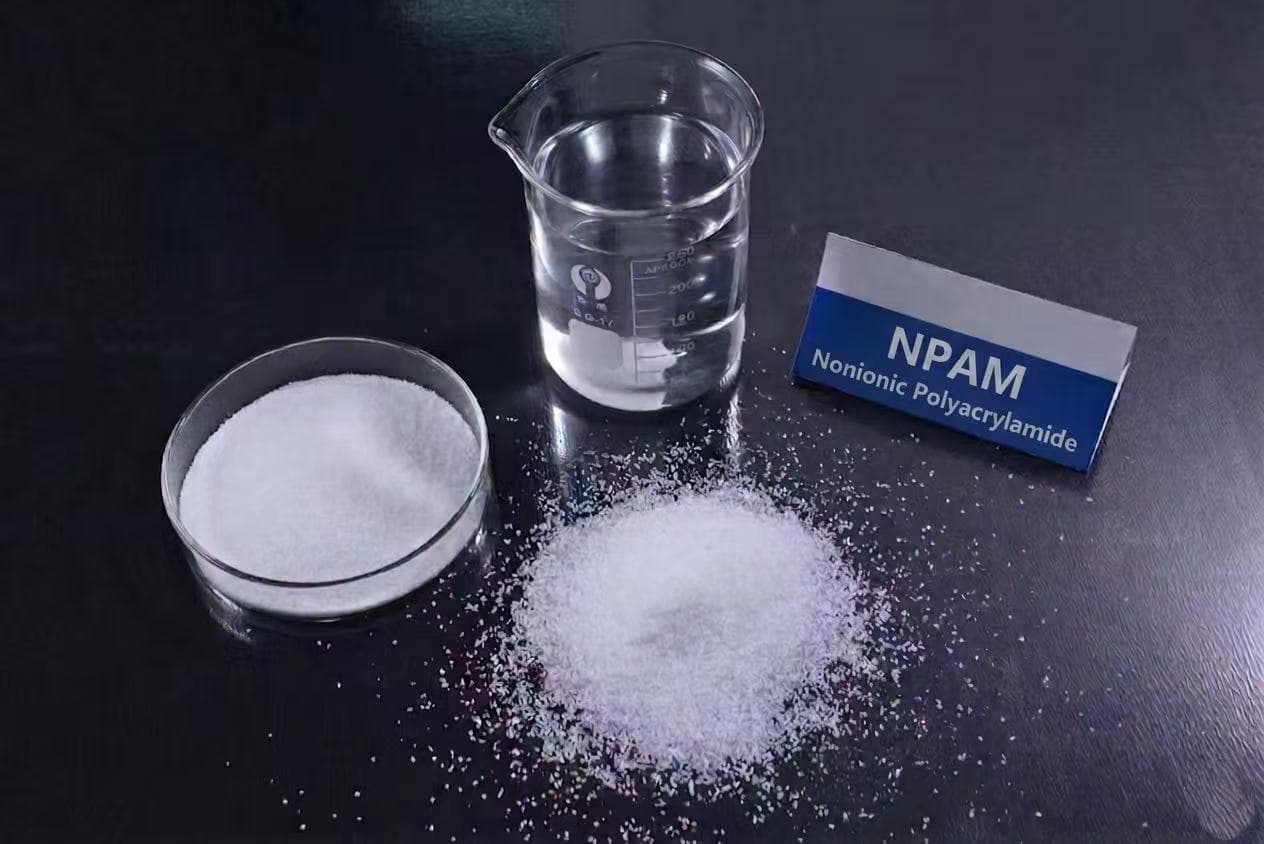
Nonionic polyacrylamide (NPAM) is the specialist grade — it handles conditions where anionic and cationic PAM both fail. Strongly acidic water, high-salinity environments, and applications requiring zero ionic interference all call for NPAM. We produce it at our Xinxiang factory specifically for these challenging applications.
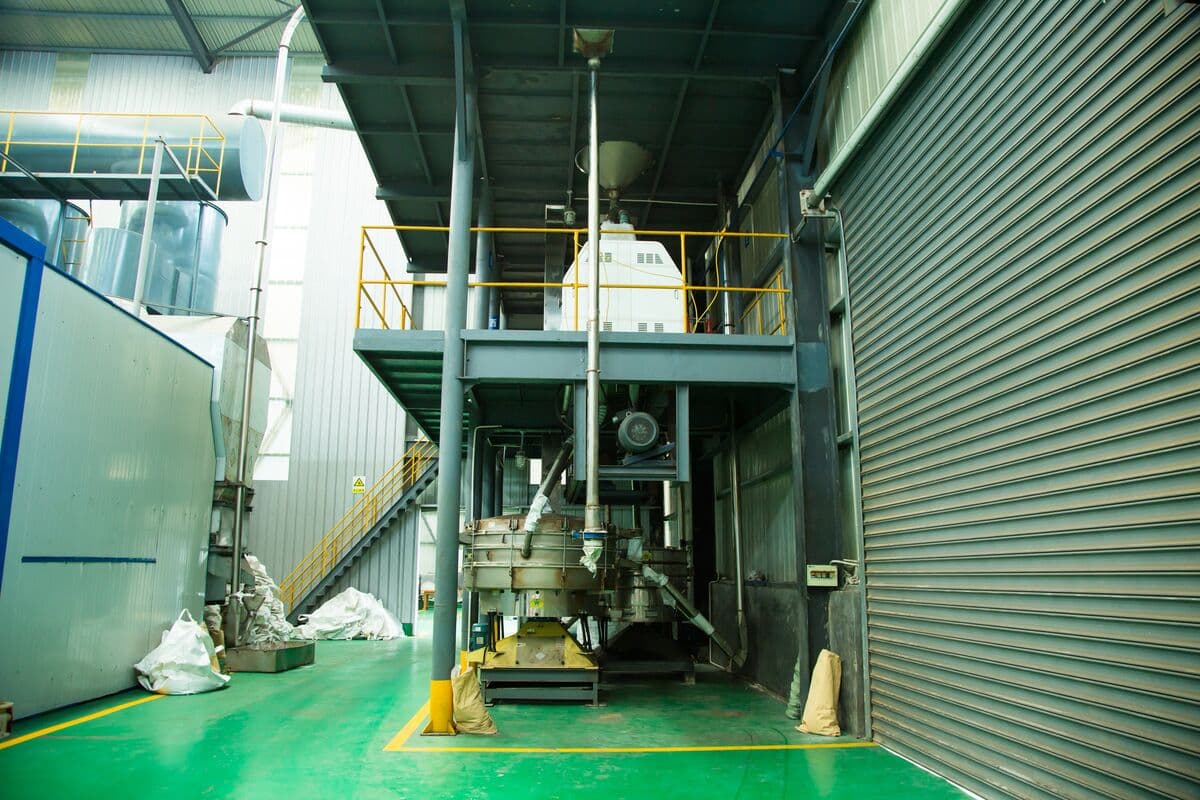
Production floor: granular PAM is screened to the specified mesh range before packing, which is what keeps dissolution time consistent between batches
NPAM Applications at a Glance
Nonionic polyacrylamide (NPAM) is a zero-charge, water-soluble polymer with molecular weight of 8-15 million Da that functions through hydrogen bonding and van der Waals forces rather than ionic attraction, making it effective in extreme pH (2-12), high-salinity (>50,000 ppm TDS), and regulated-use applications where ionic PAM grades fail.
| Application | Why NPAM? | MW Range | Dosage |
|---|---|---|---|
| Acid mine drainage (pH 2-4) | Ionic PAM fails below pH 4 | 10-15M Da | 3-10 ppm |
| Textile acid dye wastewater | pH 3-5, ionic PAM ineffective | 8-12M Da | 3-8 ppm |
| Soil stabilization & erosion control | No charge interference with soil | 12-15M Da | 5-20 kg/hectare |
| Sugar juice clarification | No ionic interference with sugar | 8-12M Da | 2-5 ppm |
| High-salinity wastewater | Salt screens ionic charges | 10-15M Da | 5-15 ppm |
| Gel electrophoresis (lab grade) | Neutral matrix required | Low MW | N/A |
How NPAM Works Without Charge
NPAM flocculation mechanism relies exclusively on hydrogen bonding and physical polymer bridging between particles, with long-chain molecules (10-15 million Da) adsorbing onto surfaces through van der Waals forces independent of solution pH or ionic strength — unlike anionic/cationic PAM which loses effectiveness when charges are screened or neutralized. Unlike anionic and cationic PAM, NPAM carries zero ionic charge. The long polymer chains grab onto particle surfaces through hydrogen bonds and van der Waals forces, then bridge between multiple particles. No charge needed.
This is why it works in conditions that kill ionic PAM. pH 2? Still works. pH 12? Still works. Salinity at 100,000 ppm TDS? Still works. The mechanism simply doesn't depend on charge.
The honest tradeoff: in normal conditions (pH 6-9, low salinity), NPAM is weaker than ionic grades. APAM or CPAM will outperform it because charge neutralization adds to the bridging effect. I always tell customers — don't use NPAM unless you actually need it. It's the specialist, not the generalist.
Acid Mine Drainage Treatment
NPAM for acid mine drainage (AMD) treatment provides reliable flocculation at pH 2-4 where anionic PAM loses charge (carboxyl groups protonate) and cationic PAM precipitates with dissolved metals, achieving 80-90% TSS removal at 3-10 ppm dosage with 10-15 million Da molecular weight. AMD is nasty stuff — pH 2-4, dissolved iron, aluminum, manganese, plus fine suspended solids. At that pH, APAM's carboxyl groups protonate and it loses its charge. CPAM precipitates out with the dissolved metals. Neither works.
We've supplied NPAM to copper mines in Peru and gold operations in Ghana dealing with exactly this problem. Dosage runs 3-10 ppm depending on TSS load. Use 10-15M molecular weight for gravity settling. If you can pre-treat with lime to push pH up to 4-5, performance improves — but in remote mining locations, that's not always practical.
Our grade dissolves in 60-90 minutes — see the dissolving procedure — and maintains performance across the full pH 2-4 range without adjustment.
Soil Stabilization and Erosion Control
NPAM for soil stabilization binds soil particles through charge-neutral hydrogen bonding at 5-20 kg/hectare, reducing erosion by 50-90% without interfering with soil cation exchange capacity (CEC) or nutrient availability — the key reason it is preferred over ionic PAM grades for agricultural and environmental applications per USDA NRCS guidelines. This is one of NPAM's biggest markets by volume.
Three main application methods:
- Spray application — dissolve NPAM at 0.01-0.05% and spray on exposed soil. 5-20 kg/hectare.
- Irrigation water additive — add 1-5 ppm to furrow irrigation water. Reduces sediment loss 70-90%.
- Seed coating — mix with seed before planting to improve germination in sandy soils.
Why not ionic PAM for soil? Because it messes with the soil chemistry. CPAM can bind essential nutrients and reduce plant uptake. APAM can interfere with calcium and magnesium exchange. NPAM just holds particles together and stays out of the way. For more detail, see our PAM for agriculture and soil and soil stabilization guide.
Need PAM for acidic wastewater treatment?
Free sample + jar test report. WhatsApp: +86 187-3759-0940
Sugar Juice Clarification
NPAM for sugar juice clarification removes suspended fiber, wax, and colloidal impurities from raw cane juice at 2-5 ppm dosage after liming to pH 7-7.5, producing clear juice for crystallization without introducing ionic contamination that could affect sugar color or quality — meeting regulated-use standards with residual monomer ≤0.05%. Sugar mills are particular about what goes into their juice. Any ionic contamination can affect crystal quality and color.
The process: lime the juice to pH 7-7.5, then add 2-5 ppm NPAM. Suspended particles bridge into large flocs and settle in the clarifier within 30-60 minutes. Clean juice goes to evaporation and crystallization.
We supply sugar-grade NPAM to mills in Brazil, India, and Thailand. Our product meets regulated-use standards with residual monomer ≤0.05%. Where a mill is fighting slow clarifier settling on a nonionic duty, the gap between an under-specified grade and a correctly specified one is typically tens of minutes of settling time at the same dosage — the variable is polymer quality, not dose rate. Send us your juice sample and we will confirm against it before quoting.
High-Salinity Wastewater
NPAM for high-salinity wastewater (TDS >50,000 ppm) maintains 75-85% flocculation efficiency where ionic PAM grades lose 50-80% effectiveness due to charge screening by dissolved salts, making it the only viable polymer flocculant for oilfield produced water, desalination brine, and chemical plant high-salt effluent. When dissolved salts exceed 50,000 ppm TDS, they screen the ionic charges on APAM and CPAM. The polymer chains still extend, but they can't "see" the particles through the salt fog. Performance drops 50-80%.
NPAM doesn't care about salt because it never relied on charge in the first place. Applications include oilfield produced water, desalination brine, and chemical plant high-salt effluent. Dosage: 5-15 ppm depending on TSS and salinity. For brackish or produced-water cases, our PHPA oilfield grade is often the better fit.
I had a desalination plant in Saudi Arabia using APAM at 8 ppm for brine clarification — getting only 45% TSS removal. Switched to NPAM at 6 ppm: TSS removal jumped to 82%. Lower dosage, better results. The salt was completely screening the anionic charge. They'd been wasting money for months before someone thought to try nonionic.
Textile Acid Dye Wastewater
NPAM for textile acid dye wastewater achieves 85-95% color removal and 90%+ TSS removal at pH 3-5 when dosed at 3-8 ppm after inorganic coagulant (PAC or ferric chloride), overcoming the 60-80% effectiveness loss that ionic flocculants suffer below pH 5 per WEF industrial wastewater treatment guidelines. Textile dyeing with acid dyes produces wastewater at pH 3-5 — right in the zone where ionic PAM falls apart.
The dosing sequence matters: coagulant first (PAC or ferric chloride to destabilize colloids), then NPAM at 3-8 ppm to bridge and settle. Get the order wrong and you waste both chemicals.
For textile wastewater treatment details including dosing sequences and equipment recommendations, see our dedicated textile wastewater treatment guide.
Cost Analysis: NPAM vs Ionic Grades
NPAM costs 5-10% more per ton than APAM ($1,800-2,200/ton vs $1,600-2,000/ton FOB China) due to more complex polymerization, but total treatment cost is often lower in target applications because it eliminates pH adjustment chemicals, reduces failed batches from pH fluctuations, and requires lower dosage when ionic screening would otherwise force overdosing of ionic grades. NPAM is more expensive per ton — 5-10% premium over APAM. But in the applications where you actually need it, total cost is usually lower.
Why? No pH adjustment chemicals needed. Fewer failed batches from pH swings. Lower dosage because you're not fighting charge screening. Longer shelf life too — no charge degradation over time.
For a typical acid mine drainage plant treating 500 m³/hour: switching from APAM (which wasn't working) to NPAM costs an extra $200-400/month in chemical cost. But it saves $5,000-10,000/month in compliance fines and retreatment. The math isn't even close.
Our pricing: $1,800-2,200/ton FOB China depending on molecular weight and order volume. MOQ 500kg for trial orders. We offer free jar test service — send us your water sample and we'll test NPAM against ionic grades to confirm which performs best. This eliminates guesswork and prevents expensive on-site trial failures.
Bulk pricing (10+ tons): contact us for contract pricing. We supply several mining companies on annual contracts with quarterly delivery schedules. Every batch tested for molecular weight, dissolution time, and residual monomer before shipping. COA included with every shipment.
Our NPAM Specifications
We produce NPAM at our Xinxiang factory with the following specifications:
- Molecular weight: 8-15 million Da
- Ionic degree: 0% (truly nonionic)
- Solid content: ≥90%
- Dissolution time: ≤90 minutes
- Residual monomer: ≤0.05%
- Appearance: white granular powder
Documents/QC: TDS, SDS, batch COA, and documented quality-control records. Document confirmation is required for regulated-use applications such as sugar or potable water.
MOQ: 500kg for first orders. Standard delivery: 7-10 days. Urgent timing can be checked against China factory stock by grade.
NPAM vs Ionic PAM: Performance Comparison
NPAM performance comparison across conditions shows it excels in extreme pH and high salinity (75-90% efficiency) while ionic grades dominate in neutral conditions (90-95% vs NPAM's 60-75%), making grade selection dependent on water chemistry rather than a one-size-fits-all choice.
| Condition | NPAM Performance | APAM Performance | CPAM Performance |
|---|---|---|---|
| pH 2-4 (strong acid) | Good (80-90%) | Poor (20-40%) | Poor (precipitates) |
| pH 6-8 (neutral) | Moderate (60-75%) | Excellent (90-95%) | Excellent (90-95%) |
| TDS >50,000 ppm | Good (75-85%) | Poor (30-50%) | Poor (30-50%) |
| Potable and food contact (sugar, drinking water) | Preferred (no ionic residue) | Acceptable | Not recommended |
Per AWWA water treatment guidelines, NPAM is the recommended flocculant for applications where ionic interference must be avoided. This includes regulated-use water treatment and processes where residual charge could affect product quality.
According to EPA industrial wastewater treatment standards, NPAM is approved for use in all pH ranges without restriction. Ionic PAM grades have pH limitations noted in their approval documentation.
Frequently Asked Questions
When should I choose NPAM over APAM or CPAM?
Choose NPAM when: pH is below 4 or above 11, salinity exceeds 30,000 ppm TDS, you need regulated-use document review, or your process cannot tolerate ionic contamination. In neutral pH with low salinity, APAM or CPAM will give better flocculation performance at lower dosage.
Does NPAM work for sludge dewatering?
Rarely the best choice. Sludge dewatering relies heavily on charge neutralization, which NPAM cannot provide. CPAM is standard for sludge dewatering because it neutralizes the negative charge on sludge particles. The exception: acidic sludge (pH below 4) where CPAM precipitates — then NPAM is your only option.
What molecular weight NPAM should I use?
For flocculation and settling: 10-15 million Da (higher MW = longer polymer chains = better bridging). For soil stabilization: 12-15 million Da. For sugar clarification: 8-12 million Da (lower MW dissolves faster and does not over-flocculate delicate sugar juice). See our molecular weight selection guide for detailed recommendations.
How do I dissolve NPAM properly?
Same as other PAM grades: add powder slowly to clean water while stirring, target 0.1-0.3% stock solution, stir 60-90 minutes. NPAM dissolves slightly slower than ionic grades because it lacks charge repulsion to help uncoil the polymer chains. Do not use hot water — it degrades the polymer. Full procedure in our dissolving method guide.
Need NPAM for Your Application?
If your wastewater is strongly acidic, high-salinity, or requires zero ionic interference — NPAM is likely your answer. Send us your water analysis and we will confirm whether NPAM is the right choice or if another grade would work better.
WhatsApp: +86 187-3759-0940 | Request a quote
Get a Quote
Our factory in Xinxiang produces confirmed grade availability across core APAM, CPAM, NPAM, and PHPA products. MOQ 500kg, delivery 7-10 days standard. Contact us for pricing and free sample:
- WhatsApp: +86 187-3759-0940
- Email: info@chinapolyacrylamide.com
Recommended Product Grades
For the application discussed above, these are the polyacrylamide grades we ship most often:
- nonionic PAM (NPAM) for mineral processing
- APAM Medium Molecular Weight grade
- Magnafloc 351 and 351 SSK equivalent — the nonionic position most often named on incoming enquiries
- Superfloc N-300 equivalent — for gold circuits carrying activated carbon
Not sure which is right for you? Try our PAM Selector tool or request a quote.