Municipal drinking water treatment uses anionic polyacrylamide as a flocculant aid at 0.5–2.0 ppm to bridge coagulated particles into fast-settling flocs, improving settling rates 5–10× and extending filter run lengths 20–40% — enabling plants to handle seasonal turbidity spikes without capacity upgrades. ChinaPAM supplies APAM from our Henan PAM factory, with documents confirmed by grade and batch before regulated-use orders.
The role of PAM in drinking water is subtle but critical. Without it, conventional coagulation with alum or ferric chloride produces small, slow-settling flocs that overload filters and reduce plant throughput. It is a common enough failure that plants run well below rated capacity through monsoon season simply because there is no polymer in the treatment train. One chemical addition, $60–300/day for a 100,000 m³ plant, and suddenly they're handling peak turbidity without breaking a sweat. For how this fits into grade selection across the full treatment train, see our complete guide to PAM for water treatment.
Municipal Drinking Water Treatment Process
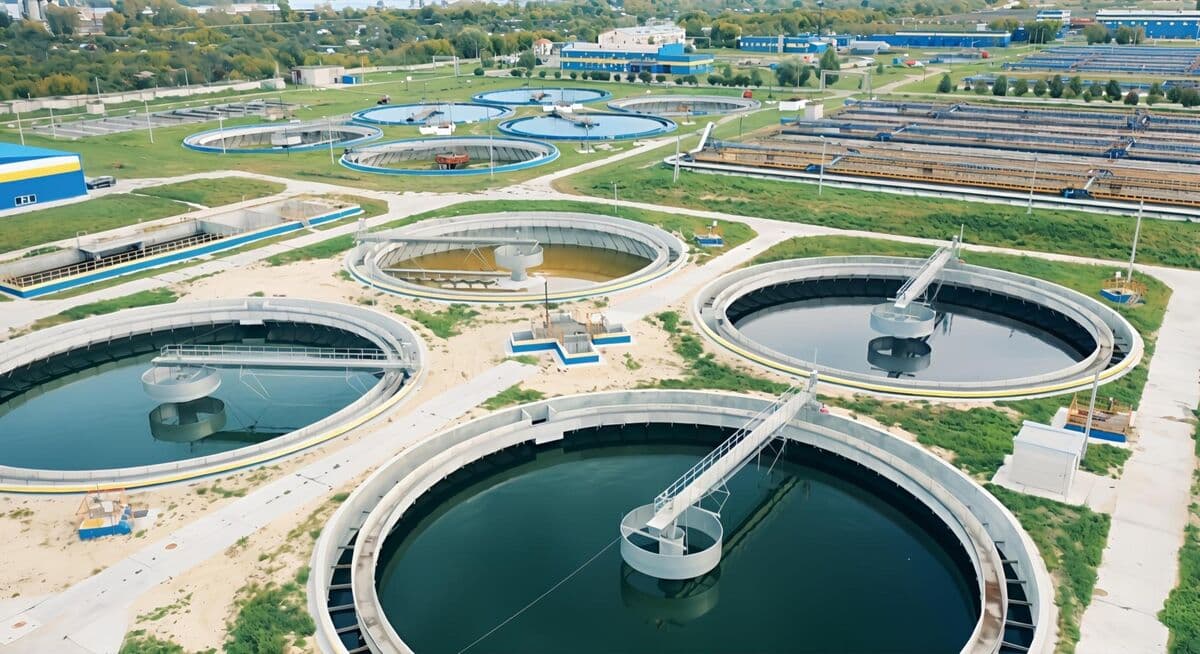
In the municipal drinking water treatment sequence, PAM is dosed at the flocculation stage (after coagulant addition and rapid mixing) at 0.5–2.0 ppm, where it bridges charge-neutralized particles into large aggregates that settle 5–10× faster in clarifiers and extend downstream filter runs by 20–40%.
The coagulant (typically aluminum sulfate or ferric chloride at 20-80 mg/L) does the charge neutralization. PAM then bridges those neutralized particles into large aggregates that drop out fast. Think of it as the coagulant doing the prep work and PAM doing the heavy lifting.
| Treatment Stage | Purpose | PAM Role | Typical Dosage |
|---|---|---|---|
| Coagulation | Neutralize particle charge | Coagulant aid (optional) | 0.1-0.5 ppm |
| Flocculation | Bridge particles into large flocs | Primary flocculant | 0.5-2.0 ppm |
| Settling | Remove flocs by gravity | Improves settling rate 5-10× | Same as flocculation |
| Filtration | Polish water to <0.1 NTU | Improves filter run length 20-40% | Same as flocculation |
The dosage is remarkably low — 0.5-2.0 ppm means a 100,000 m³/day plant uses only 50-200 kg of PAM per day. At $1,200-1,500/ton, that's $60-300/day in chemical cost for treating water for 200,000-500,000 people. No other treatment chemical comes close to this cost-performance ratio. We've had utility managers tell us PAM is the cheapest upgrade they've ever made.
Water Source Characteristics & PAM Selection
PAM grade selection for drinking water depends on source characteristics: river water with seasonal turbidity spikes (10–500 NTU) requires high-MW APAM (8–12M Da) for rapid bridging, while stable lake sources (1–10 NTU) use moderate-MW APAM (6–10M Da), and humic-rich bog water needs higher hydrolysis (25–30%) for dissolved organic interaction.
Different water sources present different treatment challenges. I've worked with utilities that tried using the same PAM grade year-round on a river source — works fine in dry season, falls apart during monsoon when turbidity jumps from 20 to 500 NTU overnight.
| Water Source | Turbidity | Color | Recommended PAM |
|---|---|---|---|
| River (seasonal) | 10-500 NTU (variable) | 5-50 Pt-Co | APAM 8-12M MW, 20-25% hydrolysis |
| Lake (stable) | 1-10 NTU | 10-30 Pt-Co | APAM 6-10M MW, 15-20% hydrolysis |
| Groundwater (low turbidity) | <1 NTU | 0-5 Pt-Co | APAM 4-8M MW, 10-15% hydrolysis |
| Humic-rich (bog water) | 5-50 NTU | 50-200 Pt-Co | APAM 10-15M MW, 25-30% hydrolysis |
The key principle: higher turbidity needs higher molecular weight for faster bridging, while higher color (organic matter) needs higher hydrolysis degree for better interaction with dissolved organics. Our APAM range covers 6-28M molecular weight and 10-45% hydrolysis, so we can match any water source.
Performance Benefits of PAM in Drinking Water
Adding anionic PAM to conventional coagulation-flocculation delivers 75–80% faster settling, 100%+ longer filter runs, turbidity reduction to below 0.1 NTU, 20–30% less sludge volume, and 15–30% increased plant capacity — all from a single chemical addition at $60–300/day for a 100,000 m³ plant.
Here's what changes when you add PAM to a conventional system:
- Settling time: drops from 4-8 hours to 1-2 hours
- Filter run length: extends from 12-24 hours to 24-48 hours
- Turbidity: from 5-20 NTU down to under 0.1 NTU (meets WHO/EPA standards)
- Sludge volume: 20-30% less to dispose
- Coagulant savings: PAM enhances coagulant efficiency by 20-40%, so you use less alum/ferric
- Plant capacity: 15-30% more water treated with existing infrastructure
The filter run extension is where utilities really notice the difference. Longer runs mean fewer backwashes, less backwash water wasted (typically 3-5% of plant output), and more consistent treated water quality. For a 100,000 m³/day plant, extending filter runs from 18 to 36 hours saves 1,500-2,500 m³/day in backwash water. That's water you're already paying to treat — now it goes to customers instead of back to the head of the plant.
Potable Water Documentation and Food Safety
Documentation review is mandatory for any polyacrylamide used in drinking water treatment — it verifies that the polymer does not leach harmful substances at maximum recommended dosage (2.0 ppm), with residual acrylamide monomer controlled below 0.05% (500 ppm) to ensure treated water stays well under WHO's 0.5 ppm acrylamide guideline.
This is non-negotiable for any water utility. A low price does not matter if the exact grade cannot pass document review. Confirm these items before order:
- Regulated-use documents: Confirmed by exact grade, batch, and destination requirement
- Residual monomer: Confirm by COA and buyer-required limit before order
- Solid content: ≥90% (higher purity = lower residual monomer per active unit)
- Batch traceability: Full COA with molecular weight, hydrolysis degree, residual monomer testing
- Third-party testing: Available via SGS or Intertek on request
The residual monomer limit is the critical safety parameter. Acrylamide monomer is toxic; the polymer itself is high molecular weight and is used at very low dosage. For drinking water projects, the buyer should confirm COA data, SDS, grade scope, and local document requirements before any plant trial.
Dosage Optimization & Jar Testing
Optimal PAM dosage for drinking water is determined through jar testing at 0.25–2.0 ppm increments, with most plants finding the sweet spot between 0.5–1.5 ppm — overdosing wastes money and can reduce filter efficiency as excess polymer passes through to downstream units.
The standard optimization method is straightforward:
- Collect 1-liter samples of raw water in 6 jars
- Add coagulant at your current dose to all jars
- Add PAM at 0, 0.25, 0.5, 1.0, 1.5, 2.0 ppm to jars 1-6
- Rapid mix at 200 rpm for 1 minute
- Slow mix at 40 rpm for 15 minutes
- Settle for 30 minutes
- Measure supernatant turbidity and color
- Select the lowest PAM dose that achieves target quality
Most plants find the optimal dose between 0.5-1.5 ppm. Over-dosing wastes money and can actually worsen performance — excess polymer passes through to filters and clogs them faster. Under-dosing gives incomplete flocculation and poor settling. The window is narrow, which is why jar testing matters.
We provide free jar testing service for water utilities ordering 10+ tons/month. Send us 20 liters of your raw water, and we test with 5-8 PAM grades at varying dosages. Results include settling curves, optimal dosage recommendation, and annual cost projection. For the complete jar test methodology, see our jar test procedure guide.
If the project requires potable-water or food-contact style document review, use the PAM document checklist for regulated projects before requesting a formal quote.
Getting the dosage right saves real money. A 100,000 m³/day plant using 0.3 ppm more PAM than necessary wastes $40,000-60,000/year. Our dosage calculation guide walks through the math for different plant capacities and water conditions.
Need PAM for municipal water treatment?
Free sample + jar test report. WhatsApp: +86 187-3759-0940
Worked Example: 500,000 m³/day Utility on Monsoon Raw Water
This worked example — modelled, not a delivered project — shows what PAM-based flocculation with automated turbidity-feedback dosing is worth on a 500,000 m³/day utility fighting monsoon raw water: settling time falling from 6 hours to around 1.5 hours even at 500 NTU, and a net benefit in the low six figures per year after chemical cost. The arithmetic is below so you can substitute your own tariffs.
Facility: 500,000 m³/day municipal water treatment plant serving 2 million people
Problem: Seasonal turbidity spikes during monsoon (raw water 200-500 NTU) causing filter clogging, treatment failures, and boil-water advisories. Existing coagulation system could not handle peak loads without PAM.
Approach: PAM-based flocculation with automated dosing (flow-proportional plus turbidity-feedback control), running an APAM 10M MW, 22% hydrolysis grade selected by jar test against the raw water.
Modelled outcome:
- Settling time reduced from 6 hours to 1.5 hours (even at 500 NTU raw water)
- Filter run length extended from 18 hours to 36 hours
- Turbidity consistently <0.1 NTU (vs 0.5-2.0 NTU previously during monsoon)
- Monsoon-season treatment failures eliminated, which is the point of the exercise
- Coagulant consumption reduced 25% (PAM improved coagulant efficiency)
- Annual PAM cost: 1.0 ppm × 500,000 m³/day × 365 days = 182.5 tons/year × $1,200/ton = $219,000/year
- Annual savings from reduced coagulant + fewer filter backwashes: $340,000/year
- Net benefit: $121,000/year plus eliminated boil-water advisories
Our Production & Quality for Municipal Water
ChinaPAM supplies municipal water buyers from our Henan PAM factory, with grade availability, batch documents, and regulated-use documents confirmed before quotation where required.
Municipal water treatment demands absolute consistency — a single bad batch can affect water quality for hundreds of thousands of people. We take that seriously. Here's what backs it up:
- Factory: Xinxiang, Henan supply base with documents available by grade and batch
- Factory experience: polyacrylamide production since 2009 behind the ChinaPAM export brand
- Three-tier QC: In-process monitoring (monomer purity, reaction temperature) → batch testing (MW, hydrolysis, residual monomer) → pre-shipment inspection
- Retention samples: 200-500g kept for 24 months per batch
- Documents: COA, SDS, shipment documents, and regulated-use document review where available by grade
- Capacity: 100,000 tons/year documented PAM annual capacity
For municipal water utilities, we offer annual supply contracts with guaranteed batch consistency (±0.5M MW, ±2% hydrolysis), scheduled monthly deliveries, and dedicated technical support.
Frequently Asked Questions
Is PAM safe for drinking water?
It can be used only when the exact grade is document-supported and dosed correctly under the buyer's local rules. The main review point is residual acrylamide monomer, which must be confirmed by COA and the required local document before the material is approved for use.
Can I use cationic PAM for drinking water?
Generally no. Cationic PAM (CPAM) is not recommended for drinking water because cationic polymers can form disinfection byproducts (DBPs) when they react with chlorine during disinfection. Anionic PAM (APAM) is the standard choice for drinking water — it does not form DBPs and is regulated-use for this application.
How does PAM interact with chlorine disinfection?
Anionic PAM does not react with chlorine at normal disinfection doses (1-3 ppm free chlorine). The polymer settles out with the flocs in the clarifier and is removed by filtration — it does not reach the disinfection stage. This is why proper dosing is important: over-dosing can allow excess polymer to pass through to filters and potentially reach the disinfection stage.
What happens during seasonal turbidity changes?
Most plants adjust PAM dosage seasonally: lower dose (0.3-0.5 ppm) during dry season when raw water is clear, higher dose (1.0-2.0 ppm) during monsoon/flood season when turbidity spikes. Automated dosing systems with turbidity feedback control handle this automatically. We recommend installing a streaming current detector for real-time coagulation optimization. For plants also handling sludge dewatering, see our municipal WWTP sludge dewatering guide.
Get Municipal Water Treatment PAM Pricing
We supply APAM for water-treatment buyers from our Henan factory. Common grades may have China factory stock, but regulated-use documents and availability must be confirmed by grade before order. Contact us for bulk pricing, free jar testing with your water sample, and technical support:
Request a Quote
Tell us your plant capacity, raw water source, and current treatment process. We recommend the optimal PAM grade and provide pricing within 24 hours.
Recommended Product Grades
For the application discussed above, these are the polyacrylamide grades we ship most often:
- regulated-use PAM
- APAM High Molecular Weight grade
- FLOPAM DW 533 equivalent — the page that explains why potable approval is the first question, not price
See the full range of municipal and industrial water treatment applications for equipment context and selection criteria across this industry.
For potable plant design context, see our drinking water treatment solution.
Not sure which is right for you? Try our PAM Selector tool or request a quote.
Standards Note
According to WHO drinking-water guidance, coagulant-aid chemicals must be reviewed together with dosage, residuals, and local approval requirements. The same review applies to the coagulant itself, whether that is a metal salt or an organic product such as a polyamine coagulant, where residual epichlorohydrin is the parameter a regulator looks at.
Per AWWA treatment practice, jar testing and filter-run monitoring should be used before full-scale polymer adoption.