Sludge dewatering is where cationic polyacrylamide (CPAM) earns its keep. Whether you run a belt press, centrifuge, or filter press, the right CPAM grade can drop cake moisture by 5-10% — which translates directly to lower disposal costs. We supply CPAM to municipal and industrial plants across multiple export markets, and charge density selection is the single most important decision you will make. Understanding how charge density works is essential before selecting a grade. If you are still mapping out the wider treatment train, our complete water treatment buyer's guide covers where sludge dewatering fits alongside clarification and effluent polishing.
CPAM for Sludge Dewatering: Quick Reference
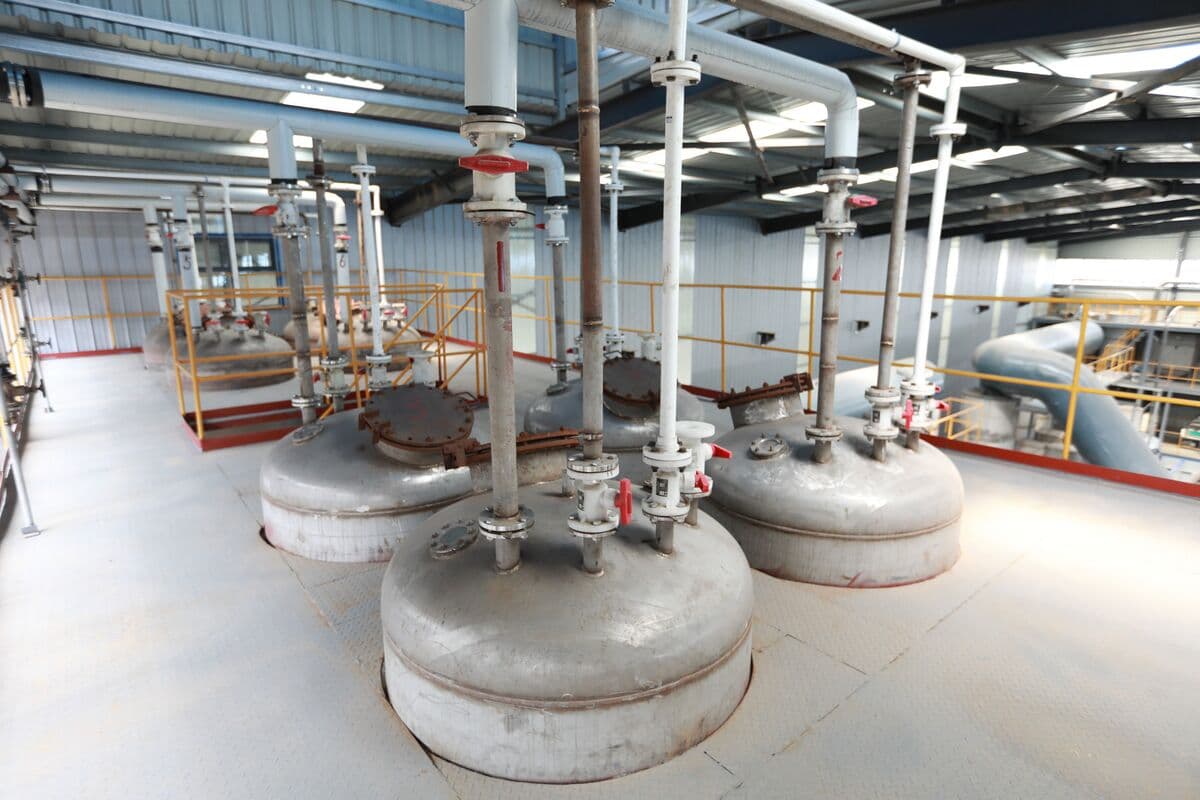
Centrifuge dewatering equipment for sludge treatment
| Sludge Type | Charge Density | Molecular Weight | Dosage (kg/ton DS) |
|---|---|---|---|
| Municipal activated sludge | 30-50% | 10-15M Da | 4-8 |
| Primary sludge (raw) | 20-35% | 12-18M Da | 3-6 |
| Digested sludge | 40-60% | 8-12M Da | 5-10 |
| Food processing sludge | 40-60% | 10-15M Da | 5-12 |
| Paper mill sludge | 50-70% | 8-12M Da | 3-8 |
| Oily sludge | 50-70% | 8-12M Da | 8-15 |
Why Cationic PAM for Sludge?
Sludge particles — bacteria, organic matter, cell fragments — carry a negative surface charge. CPAM's positive charge neutralizes this, allowing particles to aggregate. The high molecular weight polymer chains then bridge between neutralized particles, forming large, dense flocs that release water easily under mechanical pressure.
The result: faster dewatering, drier cake, and less polymer consumption compared to inorganic conditioners like ferric chloride or lime. According to US EPA Biosolids Technology Fact Sheets on polymer conditioning, CPAM typically achieves 18-25% cake solids on belt presses and 20-30% on centrifuges — compared to 15-20% without polymer conditioning.
Charge Density: The Critical Variable
Charge density determines how strongly CPAM interacts with sludge particles. Too low: incomplete neutralization, weak flocs, wet cake. Too high: over-conditioning, restabilization, wasted chemical.
- Low charge (5-20%) — Light organic loads. Primary sludge with low volatile solids. Rarely used for dewatering.
- Medium charge (20-50%) — Most municipal activated sludge. This is the workhorse range for WWTPs worldwide.
- High charge (50-70%) — Heavily loaded industrial sludge: paper mills, food processing, oily waste. Also for digested sludge where organic content is concentrated.
Our CPAM range covers 5-70% charge density across 10 different specifications, with factory production support and confirmed grade availability by order.
Matching CPAM to Your Equipment
Belt Filter Press
Belt presses need large, shear-resistant flocs that release water quickly in the gravity drainage zone. Use higher molecular weight (12-18M Da) with medium charge density (30-50%). Flocs must survive the pressure zone without breaking apart.
Typical performance: 18-25% cake solids, 200-500 kg DS/m/hr belt throughput.
Centrifuge (Decanter)
Centrifuges apply high G-force (2000-4000G), so flocs must be extremely shear-resistant. Use medium-high molecular weight (10-15M Da) with medium charge (30-50%). The polymer must condition quickly — residence time in the centrifuge is only seconds.
Typical performance: 20-30% cake solids, lower polymer consumption than belt press.
Filter Press (Plate & Frame)
Filter presses operate at high pressure (5-15 bar) and need dense, incompressible flocs. Use lower molecular weight (8-12M Da) with higher charge density (40-60%). Smaller, denser flocs pack better and allow water to drain through the filter cloth.
Typical performance: 25-40% cake solids (highest of all methods), but batch operation.
Dosage Optimization
CPAM dosage for sludge dewatering is expressed as kg polymer per ton of dry solids (kg/ton DS). The optimal dose depends on sludge characteristics:
- Volatile solids (VS) content — Higher VS = higher charge demand = more polymer needed
- Sludge concentration — Thicker sludge (3-5% solids) needs less polymer per ton DS than thin sludge (0.5-1%)
- pH — Optimal range 6-8. Below 5 or above 9, CPAM performance drops
- Temperature — Cold sludge (<10°C) needs 20-30% more polymer
Start with the table values above, then optimize through jar testing. The goal: find the minimum dose that achieves target cake dryness. Over-dosing wastes money and can actually worsen dewatering.
Solution Preparation
CPAM powder must be dissolved before use. Proper preparation is critical:
- Prepare at 0.1-0.2% concentration in clean water
- Add powder slowly to a gentle vortex — prevents lumping
- Stir at low speed for 60-90 minutes until fully dissolved
- Do not use high-shear mixers — breaks polymer chains
- Use within 24 hours — solution degrades over time
- Water temperature: 15-40°C optimal
For plants that cannot wait 60-90 minutes, our emulsion CPAM dissolves in under 5 minutes. It costs 15-20% more per active unit but eliminates the need for large aging tanks and reduces floor space requirements.
Need PAM for sludge dewatering?
Free sample + jar test report. WhatsApp: +86 187-3759-0940
Worked Example: Belt Press Blinding on Rainy-Season Sludge
Modelled, not a delivered project. Take a municipal plant running a 40% charge, 15M Da CPAM on a belt press. Rainy season shifts the sludge — lower solids, higher organic fraction — the belt starts blinding and cake moisture goes past 82%. This is the most common seasonal failure on municipal belt presses, so it is worth knowing the fix before it happens.
The adjustment is to raise charge density (40% toward 55%) and drop molecular weight slightly (15M toward 12M Da). Higher charge carries the increased organic load; lower MW gives denser flocs that drain faster instead of holding water in a bulky structure.
What that should get you, subject to confirmation on your own sludge:
- Cake moisture from 82% toward 74%
- Belt throughput up on the order of 15%, from reduced blinding
- Polymer consumption down around 10%, from better charge matching
- Disposal cost — the real prize — falling with every point of moisture removed
Our Quality Standards
Every batch of CPAM from our factory is tested for:
- Solid content: ≥90%
- Dissolution time: ≤90 minutes at 25°C
- Residual monomer: ≤0.05% (500 ppm)
- Charge density: within ±2% of specification
- Molecular weight: within ±0.5M of specification
We retain samples from every batch for 24 months. If you experience any performance change, we can compare your current batch against historical data to identify the cause.
Documents/QC: TDS, SDS, batch COA, and documented quality-control records. Our 3-tier QC system (in-process monitoring, batch testing, pre-shipment inspection) ensures the consistency that sludge dewatering operations demand.
Ordering & Logistics
MOQ: 500kg for first orders (enough for 2-4 weeks of trials at most plants). Standard delivery: 7-10 days from our Xinxiang factory to port. Urgent timing can be checked against China factory stock by grade.
Packaging: 25kg PE-lined kraft bags on pallets. 20 MT per 20ft container. For large plants consuming 50+ tons/month, volume discounts of 10-15% apply.
We currently supply CPAM for sludge dewatering to plants in Brazil, Colombia, UAE, Saudi Arabia, Indonesia, Vietnam, and South Africa.
Troubleshooting Common Dewatering Problems
When CPAM performance drops, the cause is almost always one of these five issues. Diagnose before changing polymer grade — most problems are operational, not chemical.
| Symptom | Likely Cause | Fix |
|---|---|---|
| Wet cake (>80% moisture) | Under-dosing or wrong charge density | Increase dose 20%; if no improvement, test higher charge grade |
| Turbid filtrate/centrate | Polymer not fully dissolved; gel particles passing through | Extend aging time to 90 min; check make-down water temperature |
| Belt blinding (gravity zone floods) | Flocs too small or too fragile; MW too low | Switch to higher MW grade (15-18M); reduce mixing intensity |
| Sludge sticking to belt/scroll | Over-dosing; excess free polymer creates sticky surface | Reduce dose 15-20%; check if sludge feed concentration changed |
| Performance varies day to day | Sludge composition fluctuating (industrial discharge, storm events) | Install online turbidity/SS sensor; auto-adjust dose proportionally |
| Dosing pump cavitating or pulsing | Solution too viscous (concentration >0.3%) or undissolved lumps | Dilute to 0.1%; install inline strainer before pump suction |
If you have tried all operational fixes and performance is still poor, the sludge itself may have changed. Common triggers: new industrial discharge entering the WWTP, seasonal temperature shift, or change in biological process (SRT adjustment, new aeration pattern). In these cases, send us a fresh sludge sample — we will re-test and recommend the updated grade at no charge.
Cost Analysis: CPAM vs Alternative Conditioners
Some plants still use inorganic conditioners (ferric chloride, lime, aluminum sulfate) either alone or combined with polymer. Here is how the economics compare for a typical 50,000 m³/d municipal WWTP producing 15 tons DS/day of waste activated sludge:
| Conditioner | Dose (kg/ton DS) | Unit Cost ($/kg) | Daily Cost | Cake Solids | Disposal Cost Impact |
|---|---|---|---|---|---|
| CPAM alone | 5-8 | $1.8-2.5 | $135-300 | 20-28% | Baseline |
| FeCl₃ alone | 80-150 | $0.15-0.25 | $180-563 | 15-20% | +40% (wetter cake = more volume) |
| FeCl₃ + CPAM | 40 + 3 | $0.20 + $2.0 | $210 | 22-30% | -10% (driest cake) |
| Lime alone | 200-400 | $0.05-0.08 | $150-480 | 25-35% | +60% (lime adds mass to cake) |
The hidden cost of inorganic conditioners is disposal volume. FeCl₃ produces wetter cake (more trucks, more landfill fees). Lime produces dry cake but adds 20-40% to cake mass — you are paying to dispose of lime, not just sludge. CPAM alone or CPAM + low-dose FeCl₃ gives the best total economics for most plants.
Worked Example: POME Sludge on a Belt Press
Modelled, not a delivered project. Palm oil mills dewatering DAF sludge on a belt press typically arrive at the same wall: a medium-charge CPAM at 10 kg/ton DS, cake moisture stuck around 78%, and belt washing needed every 4 hours because of blinding.
The problem: palm oil mill effluent (POME) sludge has extremely high organic content (VS >85%) and contains residual oil that interferes with polymer bridging. Standard medium-charge CPAM cannot handle this.
Our recommendation: high-charge CPAM (60% charge density, 10M MW) at 7 kg/ton DS. The high charge neutralizes the intense negative charge from organic acids and residual fatty acids. The lower MW produces compact flocs that do not trap oil within the floc structure.
What the grade change should deliver, subject to confirmation on your own POME:
- Cake moisture from 78% toward 71%
- Belt wash interval roughly doubling, from 4 hours to 8 — this is usually the operator's favourite part
- Polymer consumption from 10 to around 7 kg/ton DS
- Savings across polymer, disposal and labour together, with no capital spend to pay back
POME is a duty where charge density matters more than molecular weight, which is worth knowing because it is the opposite of the instinct most buyers bring from municipal sludge. Ask us for a sample of the high-charge grade and test it against whatever you are running now.
Seasonal Dosage Adjustment Guide
Sludge characteristics change with seasons. Plants that use a fixed dose year-round are over-dosing in summer and under-dosing in winter. Here is a practical adjustment framework:
- Summer (sludge >20°C) — Baseline dose. Polymer dissolves fast, floc formation is rapid. This is your reference point.
- Autumn transition — Increase dose 10% as temperature drops below 15°C. Monitor filtrate clarity as early warning.
- Winter (sludge <10°C) — Increase dose 20-30%. Consider switching to emulsion CPAM for faster dissolution. Extend aging time to 90+ minutes for powder grades.
- Spring (storm season) — Sludge dilution from infiltration/inflow. Solids concentration drops, organic fraction shifts. Adjust dose based on actual DS measurement, not flow rate.
- Rainy season (tropical) — Similar to spring in temperate climates. Sludge becomes more dilute and organic-heavy. May need higher charge density temporarily.
Plants with automated dosing systems can link polymer feed rate to sludge feed solids concentration (measured by inline density meter or microwave sensor). Per WEF (Water Environment Federation) guidelines on polymer conditioning, this eliminates seasonal guesswork and typically reduces polymer consumption 10-15% annually compared to manual fixed-dose operation.
Get the Right CPAM for Your Sludge
Send us your sludge data (solids concentration, VS content, pH, current polymer type and dose) and we will recommend the optimal CPAM grade within 24 hours. Free samples available for jar testing.
WhatsApp: +86 187-3759-0940 | Request a quote
CPAM for Industrial Sludge: Application-Specific Notes
Municipal sludge is relatively predictable. Industrial sludge is not. Each industry produces sludge with distinct chemistry that requires a tailored approach. Here is what we see most often from our customers across multiple export markets.
- Textile dyeing sludge — High color, surfactant residues, and often alkaline pH (8-10). Use high-charge CPAM (55-65%) with medium MW (10-12M). Surfactants interfere with floc formation — increase dose 30-50% above municipal baseline. Pre-neutralize pH to 7-8 if possible.
- Pharmaceutical sludge — Antibiotic residues and complex organics. High charge (60-70%) required. Regulatory note: confirm CPAM grade is compatible with your local pharmaceutical waste disposal regulations before ordering.
- Slaughterhouse/meat processing — High fat and protein content. Fat coats polymer chains and reduces efficiency. Use high-charge CPAM (50-65%) with a small dose of cationic coagulant (PAC or alum) to break fat emulsion first, then add CPAM. Typical CPAM dose: 6-10 kg/ton DS.
- Mining tailings (fine particle) — Very fine particles (<10 micron) with high surface area. Requires ultra-high MW APAM or CPAM (20-28M) for bridging. Charge density depends on ore type — consult us with your tailings mineralogy report.
- Electroplating sludge — Heavy metals (Cr, Ni, Cu, Zn) at high concentration. CPAM works but heavy metals can complex with polymer and reduce efficiency. Use medium-high charge (40-55%). Note: electroplating sludge is hazardous waste — disposal regulations vary by country.
- Paper mill sludge — High fiber content, variable pH. Primary sludge (mostly fiber): low-medium charge (20-35%), high MW (15-18M). Secondary sludge (biological): high charge (50-65%), medium MW (10-12M). Mixed sludge: blend approach or test both grades.
For any industrial application outside the standard municipal range, we recommend sending us a 5-10L sludge sample. Our applications lab runs jar tests within 48 hours and provides a written grade recommendation with expected performance data. This service is free for orders over 2 MT.
Frequently Asked Questions
How do I know if I need higher or lower charge density?
Run a simple jar test: take 500mL of your sludge, add CPAM at 5, 8, 12 kg/ton DS using three different charge densities (e.g., 30%, 45%, 60%). Stir 30 seconds at 200 rpm, then observe floc size and filtrate clarity. The grade giving the largest, fastest-settling flocs with the clearest filtrate is your match. If all three look similar, go with the lower charge density — it costs less. See our jar test procedure for step-by-step instructions.
Why does my CPAM work well in summer but poorly in winter?
Cold sludge (<10°C) has higher viscosity and slower polymer dissolution. Two fixes: (1) increase polymer dose by 20-30% in winter, or (2) switch to emulsion CPAM which dissolves in 5 minutes regardless of temperature. Also check that your make-down water is not too cold — dissolving CPAM in water below 10°C takes 2-3× longer and often leaves undissolved gel particles that clog dosing lines.
Can I use the same CPAM for both belt press and centrifuge?
Not ideal. Belt presses need high MW (12-18M) for large, shear-resistant flocs. Centrifuges need medium MW (10-15M) for denser flocs that survive high G-force. Using belt-press grade in a centrifuge often gives poor cake dryness. If you run both machines, we recommend two grades — the cost difference is small and the performance gain is significant.
What is the shelf life of CPAM powder?
24 months in original sealed packaging stored at 5-35°C away from direct sunlight. After opening, use within 30 days. Dissolved solution: use within 24 hours. Signs of degraded CPAM: slow dissolution, reduced viscosity in solution, poor floc formation. If in doubt, request a replacement batch — we retain samples from every production lot for comparison. Full details in our storage and shelf life guide.
Get a Quote
Our factory in Xinxiang produces confirmed grade availability across core APAM, CPAM, NPAM, and PHPA products. MOQ 500kg, delivery 7-10 days standard. Contact us for pricing and free sample:
- WhatsApp: +86 187-3759-0940
- Email: info@chinapolyacrylamide.com
Recommended Product Grades
For the application discussed above, these are the polyacrylamide grades we ship most often:
- high-charge-density CPAM
- medium-charge-density CPAM
- Zetag 8127 DL equivalent — for fresher sludge where charge demand is lower than a digested feed
- FLOPAM FO 4132, FO 4350 and FO 4400 — the mid-to-high charge steps of the cationic ladder
- Zetag 8180 equivalent — the waste activated sludge position, where charge has to be neutralised before any floc will hold
- Zetag 8190 equivalent — digested and long sludge age solids that resist a high-charge grade, including when not to move up to it
- Zetag 7652 equivalent — mid charge on our longest chain, for thickener and belt press duty where floc size governs throughput
Not sure which is right for you? Try our PAM Selector tool or request a quote.
For a complementary view, see our municipal WWTP sludge dewatering case studies. If you are evaluating a switch from a named brand, see our Superfloc C-492 equivalent guide for a matched cationic grade comparison, or the FLOPAM FO 4190, FO 4240 and FO 4290 equivalent if your current polymer sits in the low-charge end of that range. For plants running a medium-high charge grade, the Zetag 8160 equivalent page explains why we send two charge steps for that position instead of one.