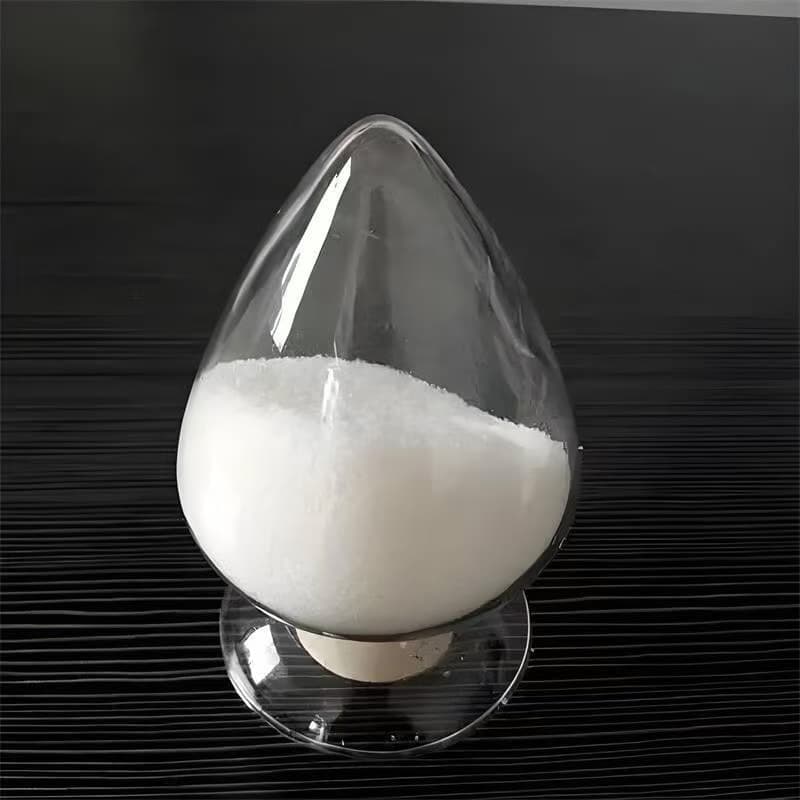
Polyacrylamide comes in two physical forms: dry powder and liquid emulsion. Both contain the same active polymer, but they behave very differently in practice. Choosing the wrong form can mean slow dissolution, poor performance, or unnecessary cost. Here is how to decide.
Powder vs Emulsion: Side-by-Side
Powder polyacrylamide contains ≥90% active polymer and dissolves in 60-90 minutes, while liquid emulsion contains 25-50% active polymer but dissolves in 1-5 minutes — powder costs 15-25% less per kilogram of active polymer but requires dedicated aging tanks and low-shear mixing infrastructure that emulsion systems eliminate entirely.
| Property | Dry Powder | Liquid Emulsion |
|---|---|---|
| Active content | ≥90% polymer | 25-50% polymer |
| Dissolution time | 60-90 minutes | 1-5 minutes |
| Price per ton active | $1,600-2,600/ton | $2,000-3,200/ton active |
| Storage | 2 years (dry, cool) | 6-12 months |
| Handling | Dust hazard, needs aging tank | Liquid, easy to pump |
| Molecular weight range | Full range (1-28M Da) | Limited (8-18M Da) |
| Best for | Large volumes, cost-sensitive | Fast dosing, space-limited |
Dry Powder PAM
Dry powder polyacrylamide at ≥90% active content delivers the lowest cost per kilogram of effective polymer ($1,600-2,600/ton) with 2-year shelf life, but requires 60-90 minutes dissolution in dual aging tanks with low-shear mixers at 50-100 rpm — making it the standard choice for operations consuming more than 500 kg/month where infrastructure investment is justified.
The main limitation is dissolution time. Powder must be dissolved in water before use, and this takes 60-90 minutes with gentle agitation. You need a dedicated aging tank (or two, for continuous operation) and a low-shear mixer.
Powder also creates dust during handling. Acrylamide monomer (residual in PAM) is a neurotoxin — operators must wear dust masks and gloves when handling powder. Our powder grades have residual monomer ≤0.05% (500 ppm), which is the industry standard, but dust exposure should still be minimized. See our safety and handling guide for detailed precautions.
Choose powder when:
- You have space for aging tanks (minimum 2 tanks for continuous operation)
- You consume >500 kg/month (volume justifies the handling infrastructure)
- Cost per unit of active polymer is the primary concern
- You need ultra-high MW grades (>20M Da) — only available in powder. See our molecular weight guide for grade selection.
- Long storage is needed (seasonal operations, remote locations). Check our storage guide for proper conditions.
Liquid Emulsion PAM
Emulsion polyacrylamide is a water-in-oil dispersion containing 25-50% active polymer as pre-formed 1-10 micron droplets that invert and dissolve in 1-5 minutes upon contact with water — eliminating the need for aging tanks and enabling instant dosage adjustment, which is why 70% of oil/gas and 60% of paper mill applications use this form despite the 15-25% cost premium per active kilogram.
This speed advantage is critical in applications where you cannot wait for powder to dissolve:
- Hydraulic fracturing (fracking) — continuous pumping, no time for powder dissolution
- Paper machine wet end — polymer must be ready instantly as machine speed changes
- Emergency treatment — rapid response to wastewater spikes
- Automated dosing systems — consistent, predictable dissolution
Emulsion is also easier to handle — it is a liquid, so you can pump it directly without dust exposure. No aging tanks needed, just a day tank and metering pump.
The tradeoffs: higher cost per unit of active polymer (15-25% premium over powder), shorter shelf life (6-12 months), and limited MW range (8-18M Da — ultra-high MW is not available in emulsion form).
Choose emulsion when:
- Dissolution speed is critical (<5 minutes required)
- Space is limited (no room for aging tanks)
- Dust exposure must be minimized (food plants, hospitals, enclosed spaces)
- Automated dosing is required (emulsion meters more precisely)
- You consume <500 kg/month (small volume, handling simplicity worth the premium)
Need PAM for your application?
Free sample + jar test report. WhatsApp: +86 187-3759-0940
Real Cost Comparison
On an active polymer basis, emulsion PAM costs 30-40% more than powder — 100 kg/day of active CPAM costs approximately $240/day as powder (109 kg at $2.20/kg) versus $333/day as emulsion (333 kg at $1.00/kg with 30% active content), creating a $34,000/year differential that justifies aging tank infrastructure for operations above 50 kg active/day.
Example: You need 100 kg of active CPAM per day.
- Powder: 100 kg ÷ 0.92 = 109 kg powder × $2.20/kg = $240/day
- Emulsion (30% active): 100 kg ÷ 0.30 = 333 kg emulsion × $1.00/kg = $333/day
Emulsion costs 39% more per day for the same active polymer. Over a year, that is $34,000 extra. For most large operations, this justifies the investment in aging tanks and powder handling equipment.
For small operations (<50 kg active/day), the infrastructure cost of powder handling may exceed the chemical savings. Emulsion makes more sense.
Equipment Requirements
A complete powder dissolution system requires $8,000-35,000 in equipment (dual aging tanks, low-shear mixer, screw feeder, progressive cavity pump, 15-30 m² floor space), while an emulsion system needs only $1,700-7,000 (single day tank, static mixer, metering pump, 3-8 m²) — the powder system pays back its investment in 6-18 months at consumption rates above 2 tons active polymer per month.
| Equipment | Powder System | Emulsion System | Cost Estimate |
|---|---|---|---|
| Aging/mixing tank | 2x 1000-5000L tanks | 1x 200-500L day tank | $3,000-15,000 vs $500-2,000 |
| Mixer | Low-shear paddle (60-100 RPM) | Static mixer or small agitator | $1,000-5,000 vs $200-800 |
| Dosing pump | Progressive cavity pump | Peristaltic or diaphragm pump | $2,000-8,000 vs $1,000-4,000 |
| Dry feeder | Screw feeder with hopper | Not needed | $2,000-6,000 vs $0 |
| Floor space | 15-30 m² | 3-8 m² | Varies by location |
Total equipment investment: powder system $8,000-35,000 vs emulsion system $1,700-7,000. The powder system pays for itself in 6-18 months through lower chemical cost if you consume more than 2 tons/month of active polymer. We can help you calculate the breakeven point for your specific consumption rate and local labor costs.
Space is often the real constraint. Many existing treatment plants were not designed with PAM dissolution in mind. Retrofitting two 3000L aging tanks plus a dry feeder into a crowded chemical room is sometimes physically impossible. In these cases, emulsion is the only practical option regardless of cost.
Industry Preferences
Industry adoption splits by operational constraints — municipal wastewater (80% powder) and mining (90% powder) favor cost efficiency at scale, while paper mills (60% emulsion) and oil/gas (70% emulsion) require sub-5-minute dissolution for real-time process control where a 60-minute aging delay is operationally unacceptable.
- Municipal wastewater: 80% powder (large volumes, cost-driven, space available)
- Mining: 90% powder (remote locations, bulk consumption, long storage needed)
- Paper mills: 60% emulsion (fast response needed for machine speed changes)
- Oil and gas: 70% emulsion (continuous pumping, no dissolution time available)
- Food and beverage: 50/50 (depends on plant size and automation level)
For paper making applications, emulsion is strongly preferred because the wet end chemistry changes rapidly with paper grade switches. A 60-minute dissolution delay is unacceptable when you need to adjust polymer dosage every 15 minutes. For mining operations where bulk consumption and remote storage are the norm, powder is the clear winner — see our mining tailings treatment guide for specific grade recommendations in mining contexts.
Our Powder and Emulsion Range
Our Xinxiang factory produces powder PAM across the full MW spectrum (APAM 6-28M, CPAM 6-20M, NPAM 8-15M at ≥90% solid content) and emulsion PAM in the most-demanded grades (APAM 8-18M, CPAM 8-15M at ≥30% active) — both forms are supported by documented quality control, residual monomer targets, and batch-specific COA for every shipment.
- Powder: APAM (6-28M MW), CPAM (6-20M MW), NPAM — full range
- Emulsion: APAM (8-18M MW), CPAM (8-15M MW) — most common grades
Both forms meet our standard quality specs: solid content ≥90% (powder) or ≥30% active (emulsion), residual monomer target ≤0.05%, and batch COA support.
MOQ: 500kg powder or 1,000L emulsion for first orders. Standard delivery: 7-10 days. Urgent timing can be checked against China factory stock by grade.
Switching from Powder to Emulsion (or Vice Versa)
Switching PAM form requires dosage re-optimization because emulsion polymer chains suffer less shear damage during dissolution — emulsion typically needs 5-10% less active polymer than powder of the same grade to achieve equivalent flocculation, per AWWA guidelines recommending 2-4 weeks of parallel testing before full conversion.
When switching from powder to emulsion: start at the same active dosage and run jar tests. Emulsion often needs 5-10% less active polymer because the chains are less damaged (no aggressive dissolution step). According to WEF process optimization guidelines, allow 2-4 weeks of parallel testing before fully switching.
When switching from emulsion to powder: invest in proper dissolution equipment first. A poorly dissolved powder performs worse than emulsion at any price. You need: aging tank (minimum 1 hour retention), low-shear mixer (60-100 RPM), and a metering pump for the dissolved solution. Budget for a controlled feeder or wetting cone too — dumping bags is the main reason powder systems produce gel balls, as covered in why polyacrylamide lumps.
Frequently Asked Questions
Can I mix powder and emulsion PAM together?
Not recommended. They have different dissolution characteristics and mixing them creates inconsistent dosing. If you need both fast response and low cost, use emulsion for your day tank (immediate dosing) and powder for your bulk aging tank (continuous supply). Two separate systems.
Does emulsion PAM freeze in winter?
Yes. Emulsion PAM freezes at -5 to -10°C depending on the carrier oil. Once frozen and thawed, the emulsion breaks irreversibly — the polymer separates from the oil phase and forms lumps. Store above 5°C. For cold climates, request our winterized emulsion formula (freeze point -20°C) or switch to powder for winter months.
Which form is better for sludge dewatering?
Both work equally well for sludge dewatering when properly dissolved. Powder is standard for large municipal plants (cost savings at scale). Emulsion is preferred for smaller plants or mobile dewatering units where space and dissolution time are limited.
How do I calculate the true cost per kg of active polymer?
Powder: price per kg ÷ solid content (0.90) = cost per kg active. Emulsion: price per kg ÷ active content (0.30-0.40) = cost per kg active. Always compare on active polymer basis, not product weight. A $1.00/kg emulsion at 30% active costs $3.33/kg active — more expensive than $2.50/kg powder at 90% active ($2.78/kg active).
Not Sure Which Form to Choose?
Tell us your application, daily consumption, and facility constraints. We will recommend the right form and grade, and provide samples for testing.
See also: Molecular weight selection guide | Anionic vs cationic PAM | Dissolving method guide | PAM supplier pricing | Price per ton guide
WhatsApp: +86 187-3759-0940 | Request a quote
Get a Quote
Our factory in Xinxiang produces confirmed grade availability across core APAM, CPAM, NPAM, and PHPA products. MOQ 500kg, delivery 7-10 days standard. Contact us for pricing and free sample:
- WhatsApp: +86 187-3759-0940
- Email: info@chinapolyacrylamide.com
Recommended Product Grades
For the application discussed above, these are the polyacrylamide grades we ship most often:
- APAM High Molecular Weight grade
- high-charge-density CPAM
- cationic polyacrylamide emulsion — the emulsion form of the above, for buyers replacing an existing cationic emulsion supply
- anionic polyacrylamide emulsion — a narrower case; the page explains when powder is the better answer
Not sure which is right for you? Try our PAM Selector tool or request a quote.