Magnafloc 6260 Equivalent: High-Charge Anionic PAM Powder Supply Route
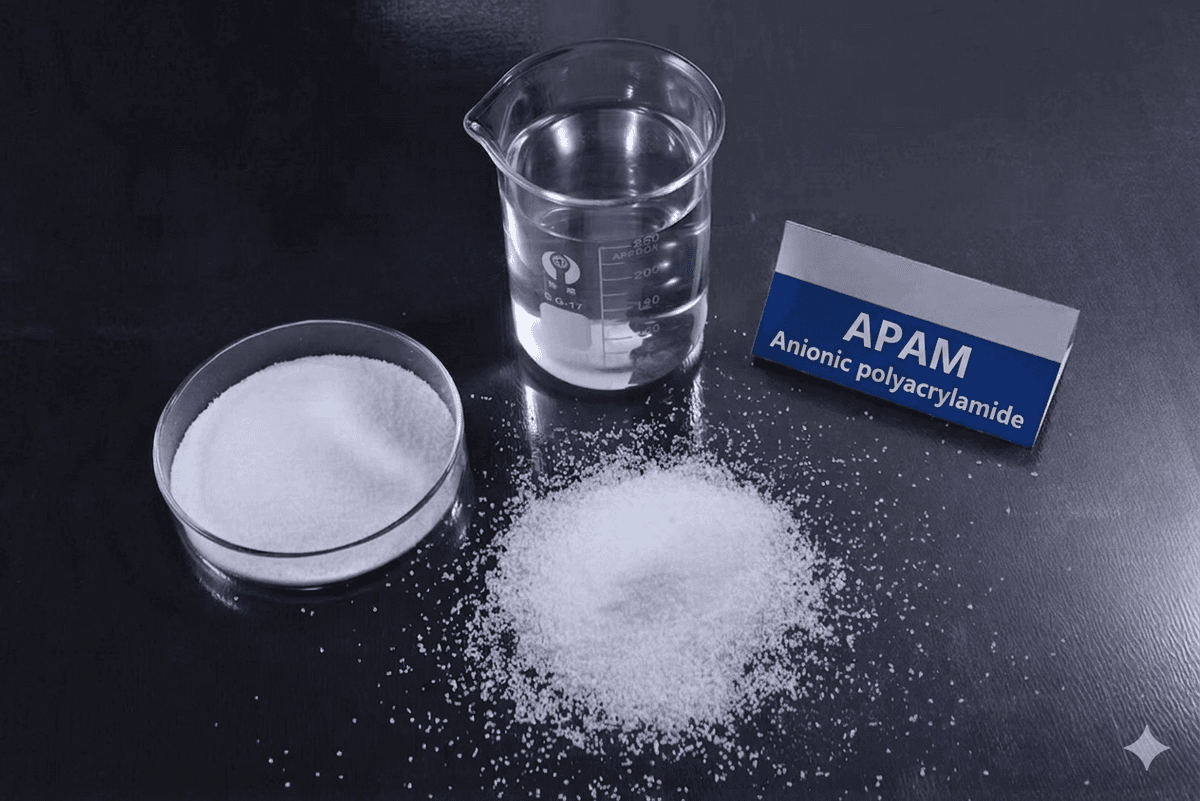
ChinaPAM supplies high-charge anionic PAM powder for Magnafloc 6260 duty — we can quote, issue applicable documents and arrange a same-feed settling trial now. CNfloc 1054 and 1054VK are the primary High-charge / High-MW screening lane, with 1054V and 1063 held as molecular-weight brackets either side.
Supply Route Comparison
Published reference data and the ChinaPAM route for BASF Magnafloc 6260
Reference facts are from page 1 of BASF's suggested-applications chart for mineral-grade Magnafloc flocculants, row Magnafloc 6260. The chart states charge descriptor and physical form only. It publishes no molecular-weight column and no dose column, so neither value is attributed to 6260 anywhere on this page. Its ticks mark suggested screening contexts, not quantitative performance guarantees, and blank cells do not prove a grade cannot work elsewhere. The chart carries no printed publication date. Magnafloc is a trademark of its respective rights holder; ChinaPAM supplies its own anionic PAM powder grades and this page implies no affiliation with or endorsement by the trademark owner. Charge and molecular-weight bands are defined independently by each manufacturer, so no numeric conversion between the two scales is offered or implied.
| Parameter | ChinaPAM Supply Route | BASF Magnafloc 6260 |
|---|---|---|
| Type | Anionic PAM powder | Anionic PAM powder — 'polvo' (BASF chart, row 6260) |
| Charge band | High (ChinaPAM scale — 1054 / 1054VK) | High anionic — 'aniónico alto' (BASF chart, row 6260) |
| Molecular-weight band | High (ChinaPAM scale); 1054V one step up, 1063 one step down | Not published — the chart has no molecular-weight column |
| Published duties | Screened per circuit against your feed | Zinc leaching, copper and coal tailings, brine, phosphate slurry, metal hydroxides and concentrates, iron and barium-sulphate tailings, clays and sands (BASF chart, row 6260) |
| Make-up concentration | 1–3 g/L recommended, max 5 g/L | Not published — the chart has no dose or make-up column |
| Dissolution time | ≤60 min at working concentration | Not published in the held chart |
| Cross-scale comparison | Our High-charge band is set on our own scale | BASF's High descriptor applies to BASF's own scale; no numeric conversion exists between the two |
| Verification step | Same-feed jar and settling comparison across the 1054 / 1054VK lane plus one bracket either side | Not applicable — reference product |
Specifications
| Our Product | High-charge, high-molecular-weight anionic PAM powder |
| Positioned Against | BASF Magnafloc 6260 |
| Commercial State | SAME_TYPE_SCREENING — same ionic type and physical form; molecular-weight lane set by trial |
| Their Magnafloc 6260 | High anionic charge ('aniónico alto'), powder ('polvo') — BASF applications chart, row Magnafloc 6260 |
| Their published duties | Neutral electrolytic zinc leaching; copper and coal tailings; brine clarification; phosphate slurry; metal hydroxides; metal concentrates; iron tailings; barium-sulphate tailings; clays and sands |
| Our primary lane | CNfloc 1054 and 1054VK — High charge / High MW on our scale |
| Our MW brackets | 1054V one step up in molecular weight; 1063 one step down |
| Chart gap | The chart prints no molecular-weight column and no dose column; neither is assigned here |
| Our Preparation | 1–3 g/L recommended; max 5 g/L; ≤60 min at working concentration |
| Source | BASF Magnafloc mineral-grade suggested-applications chart, page 1 — publication date not stated |
Key Features
- High-charge anionic powder supply route open now: quotation, applicable documents and sample discussion
- Primary lane named explicitly — CNfloc 1054 and 1054VK at High charge and High molecular weight on our scale
- Molecular-weight brackets held either side: 1054V upward for slow-settling fines, 1063 downward for shear-exposed circuits
- Ten-duty chart footprint handled as separate circuits, not as one averaged recommendation
- No molecular weight or dose is attributed to Magnafloc 6260 — the held chart publishes neither column
- No exact, identical or drop-in equivalence is claimed; the selected grade is fixed by a same-feed settling test
Applications
- Neutral electrolytic zinc leaching clarification where the incumbent is a high-charge anionic powder
- Copper, coal, iron and barium-sulphate tailings thickening and settling circuits
- Brine clarification duty requiring a high-charge anionic flocculant in powder form
- Phosphate slurry, metal hydroxide and metal concentrate settling where charge demand is high
- Clays and sands separation where the incumbent grade is specified by the Magnafloc 6260 name
Get a Quote for BASF Magnafloc 6260 Alternative Supply
Send the grade name or a bag-label photo plus the circuit — zinc leach, tailings, brine, phosphate slurry — and your current dose. We can price the enquiry and outline the trial today.
Related Articles
The Ten-Duty Footprint and What It Tells a Buyer
Row Magnafloc 6260 in the held BASF chart carries ticks across ten process contexts: neutral electrolytic zinc leaching, copper tailings, coal tailings, brine clarification, phosphate slurry, metal hydroxides, metal concentrates, iron tailings, barium-sulphate tailings, and clays and sands. Very few grades in that chart are ticked that widely. A buyer should read the breadth as positioning — this is a general-purpose high-charge anionic powder for mineral circuits — rather than as a claim that one dose and one make-up regime serves all ten.
The practical consequence for procurement is that the circuit must be named before a grade is quoted. A neutral zinc leach liquor at high ionic strength and a coal tailings thickener at low conductivity impose different demands on the same polymer. The chart does not distinguish between them, so the trial has to. We quote the lane, then the trial fixes the grade and the dose for your circuit specifically.
Where the chart is silent it stays silent on this page. There is no molecular-weight column and no dose column anywhere in that document, for 6260 or any other row. Publishing a molecular weight or a dose for 6260 would mean inventing a figure and attributing it to the manufacturer, so neither appears here or in the comparison table above.
Why the Primary Lane Is 1054 and 1054VK
CNfloc 1054 and 1054VK sit at High charge and High molecular weight on our own scale. That pairing is the closest same-type, same-form starting point to a grade the chart describes as high anionic charge in powder form, and it is where a Magnafloc 6260 enquiry is priced from. Both are real grades we supply, in the same physical form as the incumbent, so no equipment change is implied by the screening step.
The charge descriptor match is a label match, not an arithmetic one. BASF sets its charge bands on its own scale and we set ours on ours; the word High appearing on both sides does not make the two numerically interchangeable, and this page offers no conversion factor between them. What the match does give a buyer is a defensible place to start: same ionic type, same physical form, same broad charge region.
The Two Failure Modes This Lane Is Designed Around
The first failure mode is unstated molecular weight. Because the chart prints no molecular-weight column, a substitution chosen on charge alone can land at the wrong chain length for the duty. Too short and the fines never bridge into settleable floc, so the overflow stays cloudy and the operator chases it with dose. That is the case for bracketing upward to 1054V, which sits one step above the primary lane in molecular weight.
The second failure mode is reading a tick as a performance guarantee. A ticked duty is a screening context, and it says nothing about the salinity, pH window, temperature, solids loading or shear regime that will actually govern the result in your thickener. A grade selected purely for maximum chain length in a high-shear circuit produces floc that looks excellent in the jar and arrives at the thickener already broken. That is the case for bracketing downward to 1063, which trades molecular weight for shear tolerance.
Running the primary lane plus one bracket either side in the same test therefore covers both directions in a single pass, rather than committing to one grade and discovering the mismatch at volume.
What to Send Us and What Comes Back
To open the enquiry we need the grade name or a photograph of the bag label to confirm the exact model, the circuit it serves, the feed water chemistry you can share — pH, conductivity or salinity, suspended solids — the current dose in grams per tonne or ppm, and a note on your make-up equipment: batch tank or automatic make-up unit, and the make-up concentration it runs at. That last item matters because our preparation window is 1–3 g/L and existing systems are sometimes set for a different concentration.
What comes back is a quotation for the lane, the applicable product documents for the grade quoted, a sample quantity sufficient for bench work, and a written test plan naming the candidates, the dose points and the metrics to record. Once your results come back we go through them together and confirm the grade, dose and packaging for volume supply. Pricing and sample arrangements do not wait on the process data — those can move in parallel with the technical scoping.
Dosage Guide
The held BASF chart prints no dose and no make-up concentration for Magnafloc 6260, so no dose is carried across. Our own preparation window for the 1054 lane is 1–3 g/L recommended, 5 g/L maximum, dissolution within 60 minutes at working concentration. Establish the working dose on your actual process liquor: run the comparison at your current dose, then at roughly 70% and 130% of it, so the dose-response curve rather than a single point decides the grade. Zinc leach liquor, brine and tailings thickener feed behave very differently at the same nominal dose, so each circuit needs its own curve.
Frequently Asked Questions — Magnafloc 6260 Equivalent: High-Charge Anionic PAM Powder Supply Route
Can you supply and quote a high-charge anionic powder for Magnafloc 6260 duty?
Yes. ChinaPAM supplies high-charge anionic PAM powder and can quote, issue the applicable product documents and arrange a sample against a confirmed Magnafloc 6260 requirement. CNfloc 1054 and 1054VK are the named primary lane at High charge and High molecular weight on our scale. Tell us the circuit and your current dose and we will price it and propose the trial.
What does the BASF chart actually publish for Magnafloc 6260?
Two facts and a duty list. The row states high anionic charge and powder form, and it ticks ten suggested duties: neutral electrolytic zinc leaching, copper tailings, coal tailings, brine clarification, phosphate slurry, metal hydroxides, metal concentrates, iron tailings, barium-sulphate tailings, and clays and sands. The chart has no molecular-weight column and no dose column, so we do not state either for 6260 — assigning one would be invention, not reference.
Why are four of your grades in play instead of one?
Because charge is fixed by the chart and molecular weight is not. 1054 and 1054VK sit at High charge and High molecular weight and are the primary lane. 1054V sits one step up in molecular weight and is the candidate when fines settle too slowly. 1063 sits one step down and is the candidate when a long chain is being sheared apart in the pump or the flocculation launder. The trial decides which one, not the chart.
Do the ticks in that chart mean 6260 is only for those ten duties?
No. Ticks mark contexts BASF suggested for screening on its own scale. They are not exclusive uses and not quantitative performance thresholds, and a blank cell does not prove the grade cannot work in another duty. We treat the tick row as a map of where the grade has been positioned, then confirm suitability on your feed.
How should the settling test be set up?
Use your actual circuit feed at its normal solids and pH, not a synthetic slurry. Make up each candidate at 1–3 g/L, allow full dissolution, then run a jar or settling-column comparison against your incumbent at three dose points. Record initial settling rate, supernatant turbidity, floc shear resistance after pumping, and underflow density. Send the data back to us before any changeover; bulk grade and dose are fixed on the results, not on a catalogue row.
Related Products
Trademark notice. BASF Magnafloc 6260 and all other third-party product and brand names on this page are trademarks or registered trademarks of their respective owners. Henan Jinghua New Material Technology Co., Ltd. is not affiliated with, endorsed by, sponsored by or authorised by those owners, and no such relationship is implied. Those names are used here for the sole purpose of identifying the products our grades are compared against, which is necessary to describe what we supply. Our products are independently manufactured and are not licensed copies. Grade descriptors quoted for third-party products are taken from each manufacturer’s own published literature and follow that manufacturer’s own scale; we do not publish figures those manufacturers do not publish. Performance on your process should be confirmed by jar test or CST test before any change of supply.