The Middle East consumes 20,000+ tons of polyacrylamide annually, driven by three dominant applications: oil field enhanced oil recovery (EOR), desalination plant sludge management, and industrial wastewater treatment. Saudi Arabia, UAE, Kuwait, and Qatar are the largest buyers. We supply PAM to GCC and wider MENA buyers from our Henan factory, with grade documents and shipment terms confirmed by order.
The Middle East market is unique because it combines extreme technical demands (high temperature, high salinity, high hardness) with strict supply chain requirements, documentation, and emergency response planning. We address these needs through grade selection, TDS/COA/SDS, remote technical support, and China factory stock confirmation for common grades when timing is urgent.
Middle East PAM Demand by Country & Application
The market splits roughly 60/40 between oil and gas (EOR, drilling, produced water treatment) and industrial/municipal applications (desalination, wastewater, water treatment). EOR demand is concentrated in Saudi Arabia, Kuwait, and Oman. Industrial demand is spread across all GCC countries, with UAE and Saudi Arabia being the largest.
| Country | Primary Application | Annual Volume | Key Buyers |
|---|---|---|---|
| Saudi Arabia | EOR + industrial WWT | 8,000+ tons | Saudi Aramco, SABIC, SWCC |
| UAE | Industrial WWT + construction | 4,000+ tons | ADNOC, DEWA, Tabreed |
| Kuwait | EOR + refinery WWT | 3,000+ tons | KOC, KNPC |
| Qatar | LNG plant WWT + EOR | 2,500+ tons | QatarEnergy, Kahramaa |
| Oman | EOR (Marmul, Qarn Alam) | 2,000+ tons | PDO, OQ |
EOR (Enhanced Oil Recovery) Applications
Polymer flooding is the most widely used EOR method in the Middle East, particularly in Saudi Arabia and Oman. According to SPE (Society of Petroleum Engineers) technical papers on Middle East polymer flooding, high-MW HPAM (hydrolyzed polyacrylamide) is injected into reservoirs to increase water viscosity, improve sweep efficiency, and recover 10-20% additional oil beyond conventional waterflooding. Middle East EOR conditions are among the most demanding globally — high temperature (60-100°C), high salinity (50,000-200,000 ppm TDS), and high hardness (Ca²⁺, Mg²⁺) degrade standard HPAM rapidly.
| Reservoir Type | Temperature | Salinity | Recommended Grade | Concentration |
|---|---|---|---|---|
| Shallow carbonate (Saudi) | 60-80°C | 50,000-150,000 ppm TDS | HPAM 20-25M MW, 25-30% hydrolysis | 1,000-2,000 ppm |
| Deep sandstone (Kuwait) | 80-100°C | 100,000-200,000 ppm TDS | HPAM 25-28M MW, 30-35% hydrolysis | 1,500-3,000 ppm |
| Heavy oil (Oman) | 40-60°C | 20,000-80,000 ppm TDS | HPAM 18-22M MW, 20-25% hydrolysis | 2,000-4,000 ppm |
Our EOR-grade HPAM uses modified backbone chemistry to resist hydrolysis at 80-100°C and maintain viscosity in 150,000+ ppm TDS brine. Standard HPAM loses 50-70% of its viscosity under these conditions within weeks. Our modified grades maintain 80%+ of initial viscosity for 6+ months, enabling long-term EOR campaigns. We also offer PHPA oilfield grade for drilling-mud applications in the same reservoirs. For technical background on how molecular weight affects EOR performance, see our EOR polymer flooding guide and oil drilling PAM guide.
Industrial Wastewater Treatment
GCC industrial expansion (petrochemicals, desalination, construction, food processing) generates diverse wastewater streams requiring PAM treatment. Each application has different requirements — for dosage calculation methodology, see our PAM dosage guide:
- Desalination plant brine sludge: CPAM 10-15M MW for coagulation-flocculation of suspended solids in MSF/RO reject streams. Typical dosage: 5-15 ppm. Target: TSS <500 mg/L for discharge or reuse
- Refinery oily wastewater: CPAM 8-12M MW, 30-40% charge — breaks oil-water emulsions and flocculates suspended solids. Typical dosage: 8-20 ppm. Target: oil & grease <100 mg/L
- Construction site runoff: APAM 12-18M MW for turbidity control in stormwater — widely used in UAE mega-projects (Expo 2020, Jebel Ali expansion). Typical dosage: 5-10 ppm
- Food-processing wastewater: document-reviewed CPAM for wastewater from dairy, meat, and beverage plants. Typical dosage: 5-12 ppm
- Produced water treatment (oil & gas): APAM 15-20M MW for oil removal and solids settling. Typical dosage: 10-30 ppm depending on oil content
Shipping & Logistics to Middle East
We ship to the Middle East via four main routes, with Jebel Ali (Dubai) being the primary gateway for GCC distribution:
| Route | Transit Time | Destination |
|---|---|---|
| Shanghai → Jebel Ali (Dubai) | 14-18 days | UAE + GCC hub |
| Qingdao → Dammam (Saudi) | 16-20 days | Eastern Province |
| Shanghai → Shuaiba (Kuwait) | 16-20 days | Kuwait |
| Qingdao → Sohar (Oman) | 14-18 days | Oman industrial zone |
GCC import duties on PAM: 5% (standard GCC common external tariff per GCC Customs Union regulations). No anti-dumping duties. Regulated-use documents must be confirmed by grade and batch before quotation. Total lead time order-to-delivery: 4-5 weeks including production, inspection, and sea freight.
Export Support & Documentation
ChinaPAM does not claim GCC overseas warehouse stock. Orders ship from China, with common-grade China factory stock confirmed by model before urgent quotes. For critical operations, buyers should plan buffer stock locally based on actual consumption.
Our export support includes:
- Grade selection support in English
- TDS, COA, and SDS by confirmed grade and batch
- Remote jar-test and dosage guidance
- China factory stock confirmation for common grades
- MENA-compliant documentation and invoicing
Need PAM for Middle East operations?
Free sample + jar test report. WhatsApp: +86 187-3759-0940
GCC Import Documentation Checklist
GCC customs clearance for PAM requires specific documents. Missing any one of them causes delays at port — we have seen shipments held 2-3 weeks over a missing certificate of origin. Here is what you need for a standard FCL shipment:
| Document | Required By | Notes |
|---|---|---|
| Commercial Invoice | All GCC countries | Must show HS code 3906.90, unit price, total value |
| Packing List | All GCC countries | Gross/net weight per pallet, number of bags |
| Bill of Lading | All GCC countries | Consignee details must match import license exactly |
| Certificate of Origin (Form A or CO) | All GCC countries | Issued by China Council for Promotion of International Trade (CCPIT); needed for 5% GCC tariff rate |
| COA (Certificate of Analysis) | Saudi Arabia, UAE, Kuwait | MW, charge density, solid content, residual monomer — per batch |
| MSDS / SDS | All GCC countries | English + Arabic version required for Saudi Arabia |
| Quality-management documents | Saudi Aramco, ADNOC, KOC vendors | Documented quality-control records often required for oil & gas vendor approval |
| Buyer-required regulated-use document | Food/drinking water applications only | Required if PAM contacts potable water or food products |
We prepare standard export documents for every GCC shipment. Arabic SDS and CCPIT certificate of origin can be arranged when required. Any food-processing or regulated-use document must be named before quotation and confirmed by exact grade and batch; last-minute document requests add 3-5 days to lead time. For a full overview of our export process, see the China PAM supplier guide which covers payment terms, lead times, and sample ordering in detail. Also review our SDS and safe handling guide for MSDS template details, and our shelf life guide for storage recommendations specific to hot climates.
Compliance & Documents
GCC buyers require specific compliance documentation. We provide the core shipment documents with every order and confirm regulated-use documents before quotation:
- Quality-control records — production and batch traceability documents when required by vendor review
- SDS support — English SDS as standard; Arabic SDS can be arranged when required
- Regulated-use document review — for potable-water, food-processing, or other document-sensitive applications
- EU or local chemical documents — confirm by destination, grade, and buyer requirement before order
- Buyer-required document confirmation — no blanket certification claims without grade-specific proof
- COA per batch — molecular weight, charge density, solid content (≥90%), residual monomer (<0.05%)
- Third-party testing: SGS or Intertek pre-shipment inspection available
Summer Heat: The Regional Variable Most Quotes Ignore
Every supplier quoting into the Gulf sends the same technical datasheet they send to northern Europe, and the datasheet assumes ambient storage. Between roughly May and September a steel container standing on a quayside or a truck bed in the region reaches internal temperatures far above the shaded air temperature, and an uninsulated site store without ventilation is not much better. Polyacrylamide powder is hygroscopic and thermally sensitive in a specific, practical way: heat plus absorbed moisture accelerates caking, and a caked bag does not dissolve cleanly no matter how good the make-up rig is. The polymer has not degraded chemically so much as become physically unusable, and the symptom at the plant — fish-eyes in the make-up tank, gel on the strainer, dose that no longer responds — is identical to receiving a poor-quality product.
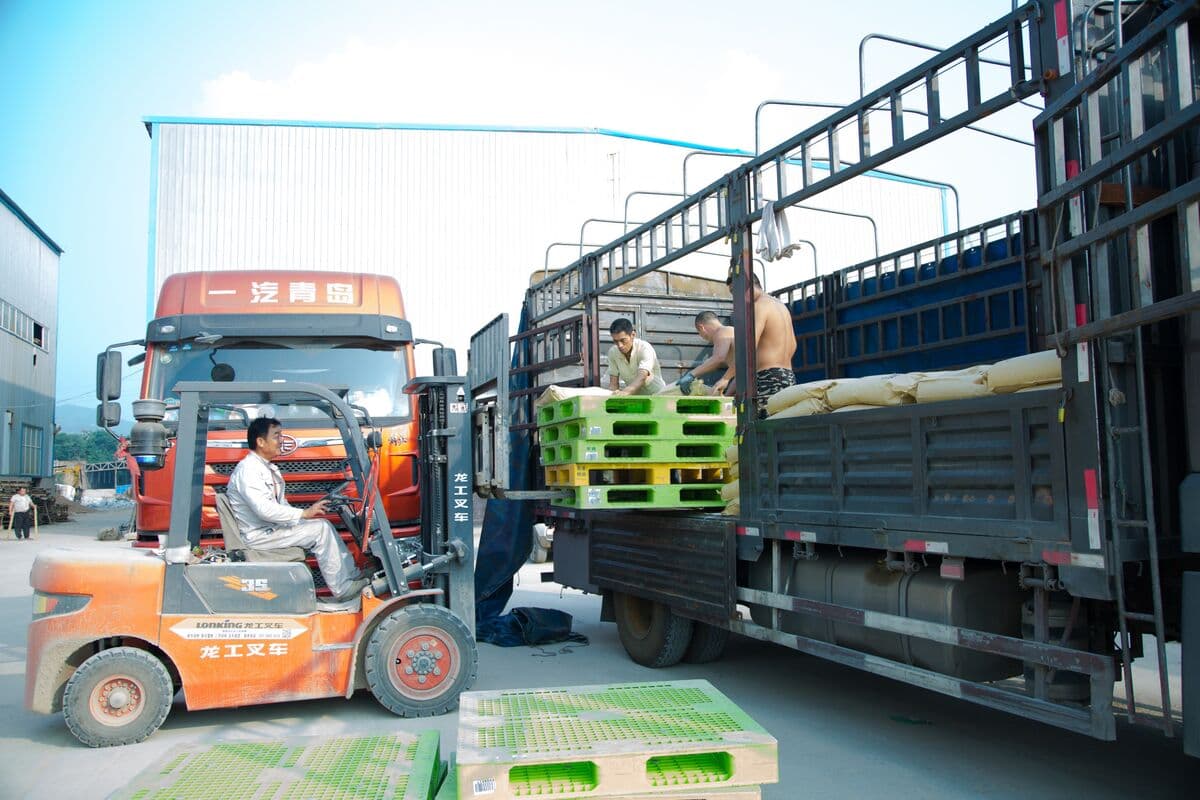
This is avoidable, and it is worth writing into the order rather than discovering in August. Three things matter. First, transit timing: a shipment that sits in a summer transhipment yard for two weeks has a materially different thermal history from one that clears in four days, so where the schedule allows we would rather move the shipping window than the price. Second, the liner: our standard export packing is a kraft paper bag with an inner plastic liner precisely because the liner is the moisture barrier, and a bag whose liner has been punctured during handling is the one that cakes first. Third, on-site storage: pallets kept off the floor, out of direct sun, in a ventilated store, with stock rotated first-in-first-out, and bags opened only as needed rather than slit and left. None of this is exotic, but a quote that never mentions it is a quote written for a different climate.
Emulsion products invert the problem rather than solving it. They avoid the caking failure mode entirely, which is genuinely useful on a site with no covered store, but they have a shorter shelf life and are less tolerant of thermal cycling than a properly stored powder — so an emulsion drum left in the sun for a season is its own kind of loss. Where a site has poor storage and a slow turnover, we would usually recommend smaller, more frequent powder shipments over a bulk emulsion order, even though the freight cost per tonne is worse. Ask us to work it both ways before you decide.
Lead Times Against the Regional Calendar
Two calendar effects catch first-time buyers, and both are easy to plan around once known. Ramadan and the two Eid holidays shift by roughly eleven days each year against the Gregorian calendar, and around them customs clearance, port productivity, and buyer-side approvals all slow materially — Eid closures can add a week to an otherwise routine clearance. Confirm the dates for your own destination against the year in question rather than assuming last year’s window.
Chinese New Year does the same thing from the other end of the chain. Our factory and the freight market both slow for one to two weeks around it, and the pre-holiday container squeeze pushes rates up well before the shutdown. When both holidays fall close together, a shipment planned for arrival that quarter needs its order placed noticeably earlier than the nominal lead time suggests. We will flag this against your requested delivery window rather than quoting a lead time that ignores it — the seven-to-ten-day production figure is a factory figure, not a door-to-door one, and pretending otherwise just moves the disappointment downstream.
Pricing & Payment Terms
Our CIF Jebel Ali pricing for GCC buyers:
- EOR-grade HPAM (18-28M MW): $1,400-2,200/ton CIF Jebel Ali
- Industrial-grade APAM (10-20M MW): $1,100-1,600/ton CIF Jebel Ali
- CPAM for wastewater (8-15M MW): $1,300-1,900/ton CIF Jebel Ali
- Salt-resistant HPAM (for extreme conditions): $1,800-2,500/ton CIF Jebel Ali
Payment terms: 30% deposit, 70% against B/L copy (standard). For established customers with 6+ months history: 60-day LC or 30-day TT after delivery. Volume discounts: 5-10% for 20+ ton orders, 10-15% for annual contracts exceeding 200 tons. All product ships from our Xinxiang factory (confirmed grade availability, documented supply workflow) — the same facility that supplies our global network across multiple export markets.
Frequently Asked Questions
How does your EOR-grade HPAM compare to Floerger or SNF products?
The honest answer is that the comparison has to be made on your core, not on a datasheet. Our EOR grades are formulated for hydrolysis resistance at elevated reservoir temperature and for viscosity retention in high-salinity brine, which are the two properties that decide whether a polymer flood survives the first year. Whether that translates into equivalence with a specific Floerger or SNF grade in your reservoir depends on temperature, TDS, divalent content, and residence time — variables no supplier can answer from a distance. We supply free samples in core-flood quantities so your laboratory or your service company can run the side-by-side itself, and we will tell you if we think the duty is outside our range rather than let the core-flood find out for us.
Which local-content or in-country-value documentation can you support?
GCC in-country-value frameworks differ by country and by operator, and several are tender-specific rather than national: Saudi Arabia’s IKTVA programme, the UAE’s ICV certification, and Oman’s ICV framework each score a supplier differently, and a distributor’s own registration often carries more weight in the score than ours does. What we can supply is the underlying paperwork — certificate of origin, manufacturer’s declaration, batch traceability records, and the mill-to-port documentation a locally registered distributor needs to file on your behalf. What we will not do is claim a blanket local-content qualification. Send us the specific clause from the tender or the operator’s vendor pack and we will tell you plainly which parts we can evidence and which parts need a local partner.
What about emergency supply for critical oil & gas operations?
We do not claim local GCC safety stock. For critical applications (EOR campaigns, desalination plant shutdowns), contact us early so we can confirm China factory stock, airfreight options, and realistic delivery timing before order.
Do you have experience with produced water treatment?
Yes — and it is worth being precise about what makes produced water hard, because it is not the oil. Produced water carries oil, suspended solids, and dissolved salts together, and it is the salinity that breaks most flocculant selections: at high TDS the dissolved ions screen the charge on an anionic chain and collapse it, so a polymer that performs on a freshwater effluent does very little on brine. That is why produced-water duty is a salt-tolerance question first and a molecular-weight question second. We select against your measured TDS, divalent hardness, and residual oil content rather than assuming a nominal case, and we quote a dose window from a jar test rather than a single number. Where the water is destined for reinjection, the acceptance criterion is usually a particle-size and residual-oil specification set by the injection formation, so tell us the reinjection spec and not only the inlet analysis. We do not claim installed produced-water references in the region; what we offer is samples and a documented selection so your own trial produces the evidence.
Request Middle East Pricing
We supply EOR-grade HPAM and industrial PAM to oil companies and water authorities across the GCC from China. Contact us for technical specifications, China factory stock confirmation, and CIF Jebel Ali pricing:
Request Middle East Pricing
Tell us your application (EOR/wastewater/desalination), monthly volume, and reservoir/wastewater specifications. We respond with CIF pricing within 24 hours.
Recommended Product Grades
For the application discussed above, these are the polyacrylamide grades we ship most often:
Compare global suppliers in our Top 10 PAM Manufacturers guide. Ready to order? View factory pricing and MOQ or request a quote.
Standards Note
According to API RP oilfield practice, polymer choice for EOR should consider salinity, temperature, shear, and injection-water compatibility.
Per IADC drilling-fluid practice, field polymer selection should be confirmed under actual mud chemistry rather than by product name alone.