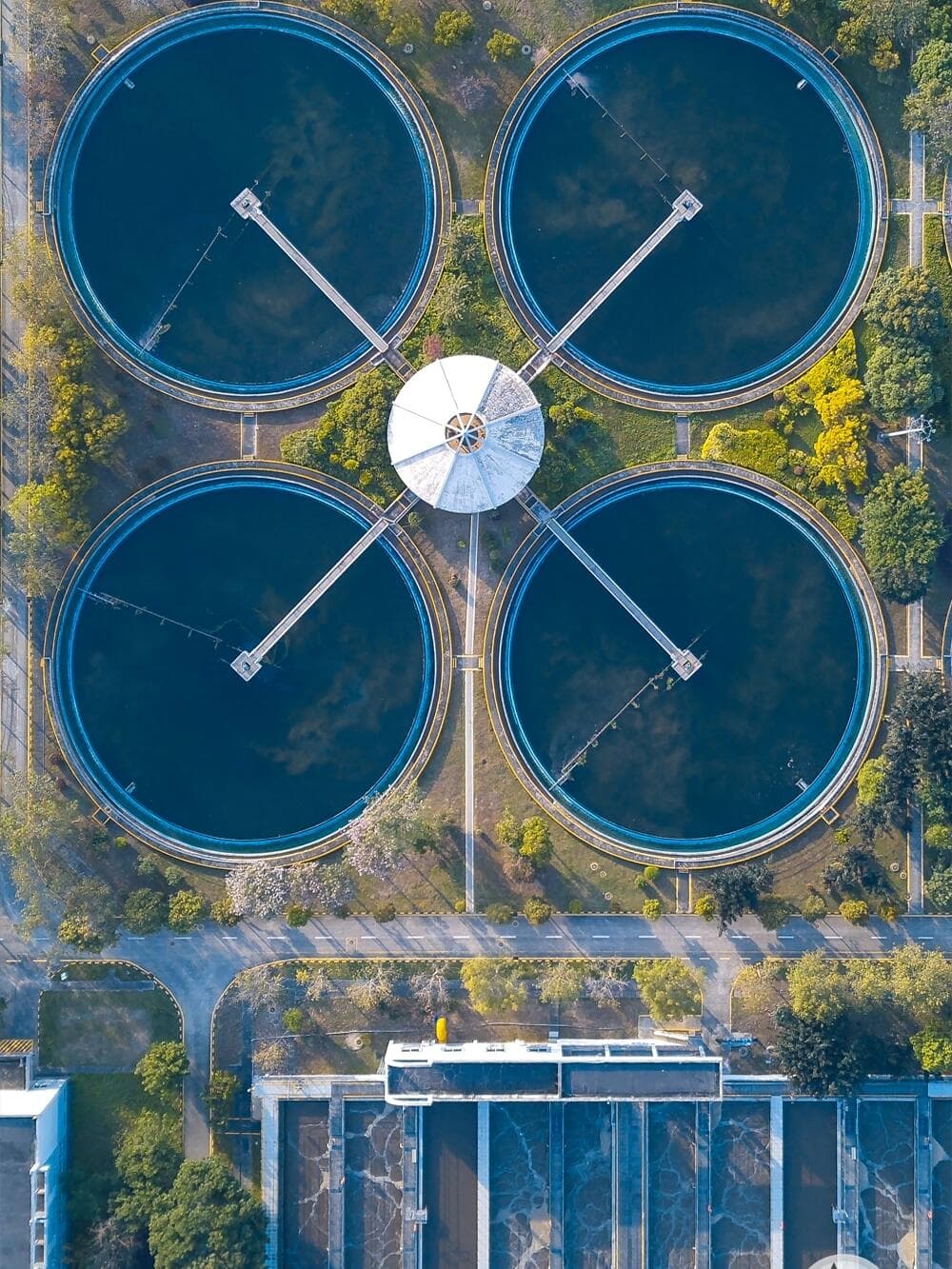
Sludge dewatering is one of the largest operational costs in municipal wastewater treatment. Polyacrylamide (PAM) can reduce sludge moisture content by 10–15%, cutting disposal costs by 30–50%. This guide covers PAM selection, dosing optimization, and real-world performance data from municipal treatment plants. To see how dewatering fits alongside clarification and effluent treatment, our complete water treatment buyer's guide covers the full grade-selection picture.
The Sludge Dewatering Challenge
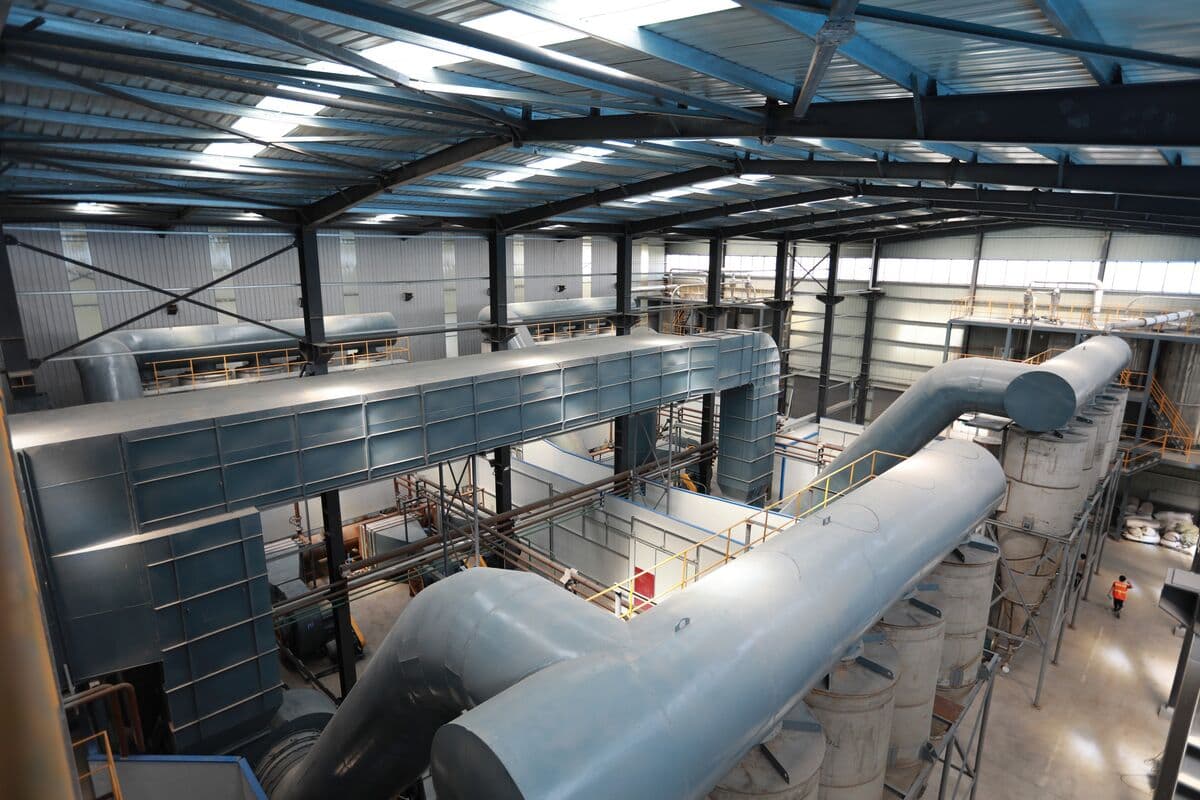
Municipal wastewater treatment facility with sludge handling
A typical municipal WWTP treating 100,000 m³/day generates 50–100 MT of dry solids daily. After primary and secondary treatment, this sludge is 95–98% water. Dewatering reduces moisture to 75–80%, cutting disposal volume by 75–80%. According to Water Environment Federation (WEF) biosolids handling references, hauling cost typically dominates total sludge management cost — so every percentage point of cake dryness translates directly to operating savings.
Without proper flocculant, dewatering is slow and incomplete. With optimized PAM dosing, the same equipment can process 2–3× more sludge or achieve significantly drier cake. Per US EPA biosolids land application guidance, cake characteristics also drive whether biosolids qualify for Class A or Class B reuse — affecting downstream disposal options and permitting.
Dewatering Equipment Types
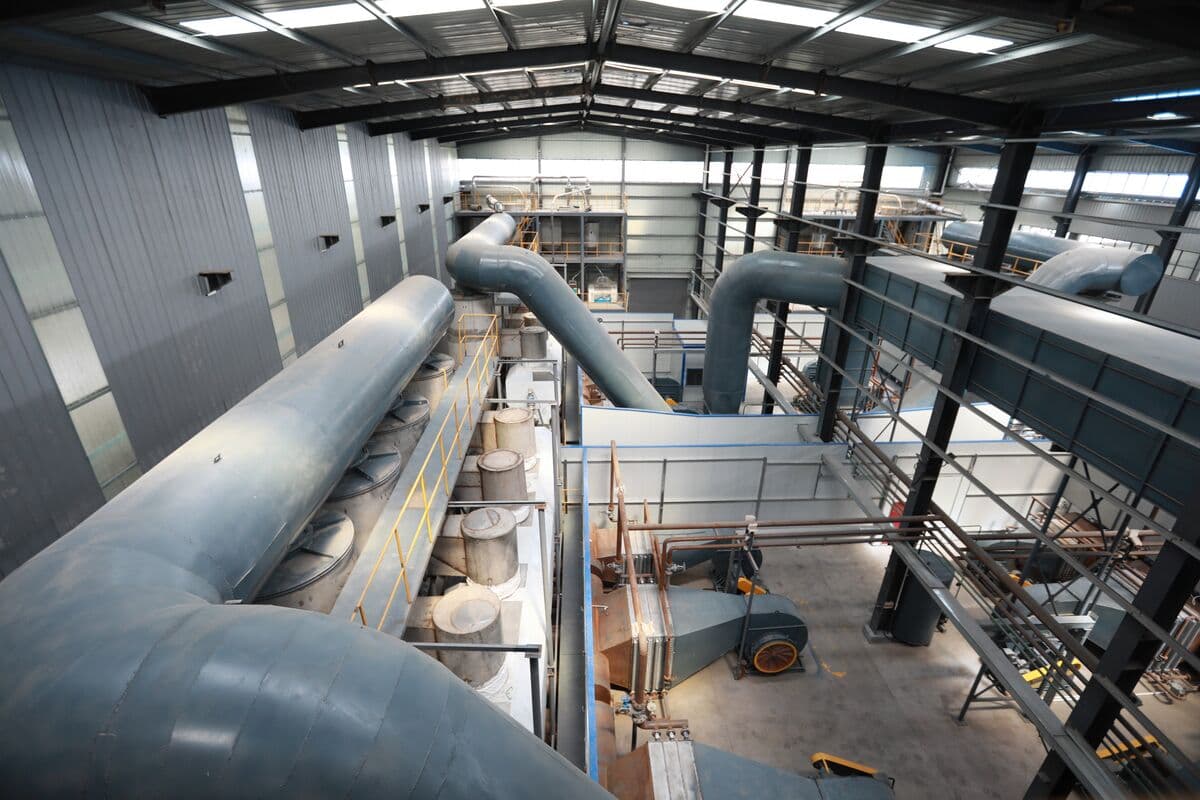
Sludge dewatering equipment and treatment systems
| Equipment | Recommended PAM | Typical Dosage | Cake Moisture |
|---|---|---|---|
| Belt Filter Press | CPAM, medium-high charge (40–60%) | 5–12 g/kg DS | 75–80% |
| Centrifuge | CPAM, high charge (60–80%) | 8–15 g/kg DS | 72–78% |
| Drying Beds | CPAM, medium charge (30–50%) | 3–8 g/kg DS | 60–70% |
| Screw Press | CPAM, high charge (60–80%) | 10–18 g/kg DS | 70–76% |
Selecting the Right PAM
Cationic PAM (CPAM) — The Standard Choice
Activated sludge from municipal WWTPs is negatively charged due to bacterial cell walls and extracellular polymeric substances (EPS). Cationic PAM neutralizes this charge, allowing particles to aggregate into large, fast-draining flocs. For bulk purchasing options, see our CPAM wholesale guide.
For municipal sludge, medium-to-high charge CPAM (40–80%) is recommended. The exact charge depends on sludge characteristics:
- Low organic content (<50% VSS) — Use 40–50% charge CPAM
- High organic content (>60% VSS) — Use 60–80% charge CPAM
Molecular Weight Considerations
For sludge dewatering, medium-to-high MW CPAM (8–12 million Da) is typical. Higher MW creates stronger flocs that resist shear in centrifuges and belt presses. Our molecular weight guide explains how to choose the right MW for your equipment.
Dosage Optimization
Step 1: Baseline Jar Test
Conduct jar tests with your sludge at 5, 10, 15, 20, and 25 g/kg dry solids. Measure:
- Floc size and settling rate
- Supernatant turbidity (lower is better)
- Cake dryness (visual assessment)
Step 2: Pilot Testing
Run your dewatering equipment (belt press, centrifuge) with the recommended dosage from jar tests. Measure actual cake moisture and throughput. Adjust dosage ±20% based on results.
Step 3: Continuous Optimization
Monitor sludge characteristics weekly. Seasonal changes in influent (higher organic load in summer) may require dosage adjustments of 10–15%. For detailed dosage calculation methods, see our water treatment dosage guide and PAM flocculant overview.
Need PAM for municipal sludge dewatering?
Free sample + jar test report. WhatsApp: +86 187-3759-0940
Worked Example: Belt Filter Press Optimisation
Modelled, not a delivered project — the before/after below is what correcting a generic PAM on a 15 MT/h belt press duty is worth, so you can compare it against your own plant's numbers.
Modelled scenario — municipal WWTP, belt filter press
Before PAM Optimization
After ChinaPAM CPAM (60% charge, 10M MW)
Annual Impact
Equipment-Specific Dosage Detail
The summary table earlier in this guide gives broad ranges. The table below adds the operational targets and polymer specs that experienced operators actually tune to. Numbers reflect typical performance on conventional activated sludge with VSS/TSS around 0.65.
| Equipment | CPAM Spec | Dose (g/kg DS) | Make-up Conc. | Cake Target | Filtrate TSS Target |
|---|---|---|---|---|---|
| Belt press (gravity + wedge) | 10-12M MW, 45-55% charge | 5-10 | 0.2-0.3% | 75-80% | <500 mg/L |
| Decanter centrifuge (2500-3500 G) | 11-13M MW, 60-75% charge | 8-15 | 0.15-0.25% | 72-78% | <300 mg/L |
| Screw press | 12-14M MW, 65-80% charge | 10-18 | 0.2-0.35% | 70-76% | <800 mg/L |
| Plate-and-frame filter press | 8-10M MW, 30-50% charge | 4-8 | 0.2-0.5% | 62-72% | <200 mg/L |
| Rotary drum thickener (pre-thickening) | 8-10M MW, 30-45% charge | 2-5 | 0.1-0.2% | 5-8% (TS) | <1,000 mg/L |
Two practical notes. First, the make-up concentration matters as much as the dose. Above 0.4% the polymer solution becomes too viscous to dose accurately and pumps have to fight thick gel. Below 0.1% you waste tank volume and storage time. Second, filtrate TSS is your real-time alarm — if it rises during a run, polymer feed is dropping out before sludge feed.
Cake Moisture Targets by Disposal Method
How dry your cake needs to be depends entirely on what happens after dewatering. Pushing for an extra 2-3% dryness costs polymer and equipment wear; if your downstream disposal does not pay you back for that effort, do not chase it.
| Disposal Route | Min. Cake Solids | Why That Threshold |
|---|---|---|
| Landfill (sanitary) | 20-25% | Most landfills require >20% TS to refuse "wet load" status; "paint filter" test must pass |
| Land application (agricultural) | 15-20% | Spreadability with conventional manure equipment |
| Composting | 22-28% | Bulking agent ratio works best at this moisture |
| Incineration (auto-thermal) | 28-32% | Below 28% TS, supplemental fuel is needed |
| Cement kiln co-firing | 35-40% | Cement plants pay tipping credit only above this threshold |
| Thermal drying feed | 22-26% | Sticky phase (35-55%) must be avoided in dryer feed |
Cost per Ton Dry Solids — Working Calculation
For internal benchmarking and cross-plant comparison, calculate dewatering cost on a per-ton-DS basis. This normalizes across equipment, sludge characteristics, and plant size.
Polymer cost per MT DS:
= Dose (g/kg DS) × Polymer price ($/MT) ÷ 1,000
Example: 10 g/kg × $2,000/MT ÷ 1,000 = $20/MT DS in polymer
Disposal cost per MT DS:
= Disposal $/MT cake × (1 ÷ Cake solids %)
Example: $80/MT cake at 75% solids = $80 ÷ 0.25 inverse moisture = $107/MT DS
Wait — correction: $80/MT cake means $80 per wet ton. To convert to per dry ton: $80 ÷ 0.25 (cake solids fraction) = $320/MT DS
Total dewatering cost per MT DS:
= Polymer + Disposal + Energy + Labor + Maintenance
Typical municipal: $300-450/MT DS in 2026 China; $450-700/MT DS in EU/US
The leverage point is cake solids. Improving from 22% to 25% cake solids cuts disposal mass per MT DS by 12% — usually $30-50/MT DS in disposal savings. That alone justifies $5-10/MT DS in extra polymer cost (a 50-100% polymer price increase). The arithmetic almost always favors the better polymer.
FAQ: Sludge Dewatering
How often should we re-optimize CPAM dosage?
Major re-optimization (full jar test sweep with 2-3 alternative grades) every 12-18 months, or whenever influent characteristics shift significantly — new industrial discharger connected, major plant expansion, or seasonal change you can't compensate for with dose adjustment alone. Day-to-day fine-tuning happens through dose monitoring; once a week, walk the belt or check centrate solids and adjust dose ±5-10%.
Why does cake solids drop after a long weekend shutdown?
Septic conditions in the holding tank during shutdown break down EPS and produce volatile fatty acids, both of which interfere with flocculation. On Monday morning, expect to dose 20-30% more polymer for the first 4-8 hours of operation while the system flushes through. Some plants run a small bleed-down on Friday afternoon to leave the holding tank emptier. If septic re-stabilization is a recurring issue, micro-aeration in the holding tank is a longer-term fix.
Can I switch CPAM brands without losing performance?
Yes if the new product matches MW and charge density within ±15%. Do a side-by-side jar test first, then a 4-8 hour trial run on the dewatering equipment. Plan for a 1-2 day stabilization period as the system adjusts. Do not blend two CPAM grades in the same make-up tank — they can interact, especially if their charge densities differ by more than 20 percentage points. Run one tank dry before refilling with the new product.
What is the role of inline flocculation tube length?
Polymer-sludge contact time before the dewatering machine matters. Too short (under 10 seconds): incomplete floc formation, fines escape into filtrate. Too long (over 60 seconds): floc breakdown from pipe shear, polymer wasted. Most belt presses run best with 20-40 seconds residence time between injection and equipment inlet. Centrifuges typically use shorter contact times (5-15 seconds) because they finish flocculation inside the bowl.
How do anaerobic vs aerobic digested sludges differ for dewatering?
Anaerobically digested sludge dewaters less well than aerobic — typically 3-5 percentage points lower cake solids at the same polymer dose, because the digestion process produces fine colloidal material and dissolved organics that bind polymer. Plan for 30-50% higher polymer dose on anaerobic sludge, and use higher charge density (65-80%) than you would on the same plant's WAS. Cake solids of 70-75% is realistic on anaerobic sludge in a centrifuge; pushing for 78%+ usually means diminishing returns.
Cost-Benefit Analysis
For a 100,000 m³/day municipal WWTP:
- Sludge production: ~80 MT/day dry solids
- Current flocculant cost: ~$2,000/month (generic PAM at 15 g/kg DS)
- With optimized ChinaPAM: ~$1,100/month (10 g/kg DS, better performance)
- Monthly savings: $900
- Annual savings: $10,800 (flocculant alone)
- Plus disposal savings: $15,000–25,000/year (drier cake = less volume)
- Total annual ROI: $25,000–35,000
CPAM Pricing for Sludge Dewatering (2026)
Municipal Sludge Dewatering Grade CPAM — FOB China
MOQ: 1 MT. FCL (20MT+): 10–12% discount. Annual contract (200MT+): 15–18% discount.
Implementation Checklist
- ✓ Analyze your current sludge (VSS/TSS ratio, organic content)
- ✓ Request free CPAM samples from ChinaPAM
- ✓ Conduct jar tests at 5, 10, 15, 20 g/kg DS
- ✓ Run pilot test on your dewatering equipment
- ✓ Measure cake moisture and throughput improvement
- ✓ Calculate ROI (flocculant savings + disposal savings)
- ✓ Place initial order (1–5 MT for testing)
- ✓ Monitor performance weekly and adjust dosage as needed
Related reading: cationic PAM sludge dewatering techniques and textile wastewater treatment.
For a municipal buyer case note in Latin America, see the Mexico municipal wastewater PAM guide.
Get CPAM for Your WWTP
Tell us your sludge volume and current dewatering equipment. We'll recommend the right CPAM grade and send free samples for jar testing.
Recommended Product Grades
For the application discussed above, these are the polyacrylamide grades we ship most often:
- high-charge-density CPAM
- medium-charge-density CPAM
- FLOPAM DW 533 equivalent — for plants that treat both raw water and sludge and need one polymer approved for both duties
- Zetag 8140 equivalent — the most widely specified municipal charge step, bracketed with two of ours because their band is wider than one of our rungs
- Zetag 8180 equivalent — for plants whose sludge is mostly waste activated and where dose creep points to a charge deficit
- Zetag 8115 equivalent — the low-charge end, where upstream coagulation carries the charge load and the flocculant only has to bridge
See the full range of municipal and industrial water treatment applications for equipment context and selection criteria across this industry.
For plant-level design context, see our municipal wastewater treatment solution, which covers clarification, thickening and dewatering as a single treatment train.
Not sure which is right for you? Try our PAM Selector tool or request a quote.
For a complementary view, see our cationic PAM sludge dewatering deep dive or browse all water treatment chemicals we supply. Procurement teams evaluating brand alternatives can review our Superfloc C-492 equivalent for a matched cationic grade comparison, or the Zetag 8160 equivalent if the plant is specified on the BASF medium-high charge step.