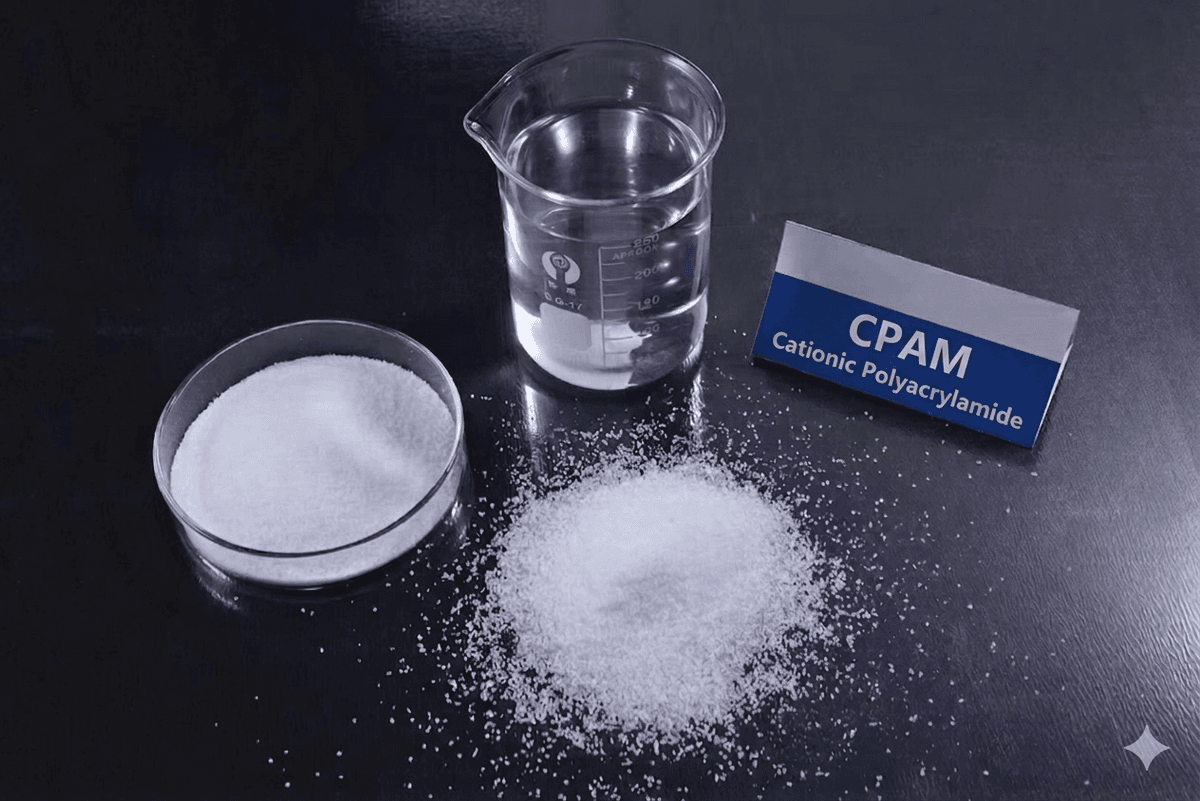
FLOPAM FO 4350 Equivalent — Medium Charge Cationic Polyacrylamide
ChinaPAM supplies cationic polyacrylamide positioned against SNF FLOPAM FO 4350 for municipal sludge dewatering on belt presses, centrifuges and screw presses. Free trial sample, MOQ 500 kg.
Supply Route Comparison
Published reference data and the ChinaPAM route for SNF FLOPAM FO 4350
| Parameter | ChinaPAM Supply Route | SNF FLOPAM FO 4350 |
|---|---|---|
| Type | Cationic PAM powder | Cationic PAM powder |
| Charge (published) | Medium (our scale) | Medium (SNF published) |
| Molecular Weight | High (our scale) | Standard (SNF published) |
| Brookfield at 5 g/L | Not published; confirm by CST on your sludge | 450 cps (SNF FO catalogue) |
| Recommended make-up | 1–3 g/L; max 5 g/L; ≤60 min | 5 g/L; max 10 g/L; 60 min (SNF published) |
| MOQ | 500 kg | Set by regional distributor |
| Trial Sample | Free 5 kg with CST protocol | Via distributor request |
Specifications
| Our Product | Cationic polyacrylamide powder |
| Positioned Against | SNF FLOPAM FO 4350 |
| Charge (SNF published) | Medium charge / Standard MW |
| Brookfield (SNF, g/L→cps) | 5.0 g/L → 450 cps; 2.5 g/L → 200 cps; 1.0 g/L → 100 cps |
| SNF recommended conc. | 5 g/L (max 10 g/L); dissolution 60 min |
| Our charge / MW | Medium charge / High MW (our scale) |
| Our make-up | 1–3 g/L recommended; max 5 g/L; ≤60 min |
| Appearance | White granular powder |
| Packaging | 25 kg PP woven bags + PE liner |
Key Features
- Positioned against published SNF FO 4350 medium charge / standard MW profile
- SNF original Brookfield and concentration data cited from the FO catalogue
- Distinct from FO 4440: different Brookfield ladder and recommended concentration
- Free trial sample with CST test protocol
- MOQ 500 kg, direct from factory
Applications
- Municipal and industrial sludge dewatering
- Belt filter press, centrifuge and screw press duty
- Dissolved air flotation on oily and organic effluent
- Industrial wastewater clarification on negatively charged solids
- Food, beverage and rendering plant effluent
Get a Quote for SNF FLOPAM FO 4350 Alternative Supply
Start with the grade name, a bag-label photo or your purchasing requirement. We can discuss current pricing and sample options now; process details can follow.
Related Articles
FO 4350 in the cationic dewatering range — where it sits and why it matters
The SNF FO series codes charge density into its grade numbers. FO 4350 sits in the medium charge band, confirmed by the original FO catalogue entry that gives Brookfield viscosities of 450/200/100 cps at the standard 5.0/2.5/1.0 g/L test concentrations and a recommended working concentration of 5 g/L. The entry for FO 4440 on the same catalogue page gives 400/200/80 cps and a recommended concentration of 4 g/L — closely related but independently specified, which is why they are different pages.
Medium charge is the workhorse position for most municipal dewatering duty. It neutralises the negative charge on waste activated sludge and mixed liquors without overshooting into re-stabilisation, which is the failure mode of high-charge grades on lower-demand sludge. Where the sludge is fresher or the biological fraction is low, a lower charge step may still be needed; where the sludge is heavily aged or the organic fines load is high, medium charge may under-neutralise. The test to resolve it — a capillary suction time comparison across two charge steps on the same sludge sample — costs one afternoon and is more reliable than any specification comparison.
Make-up concentration: why the SNF and ChinaPAM figures differ
The SNF catalogue recommends 5 g/L for FO 4350 with a maximum of 10 g/L and a 60-minute dissolution time. For our cationic powder, we specify 1–3 g/L recommended, maximum 5 g/L, and ≤60 minutes. The difference reflects different dissolution characteristics between the two products, not a difference in the polymer duty.
Operating our powder at SNF's recommended 5 g/L would produce a solution that is too viscous to dose uniformly in a standard system. Operating at our 1–3 g/L gives a fully hydrated, pumpable working solution. When comparing dose rates between products, always convert to active polymer per dry tonne of sludge — never compare on as-supplied product volume, because the working concentrations differ.
| Parameter | FO 4350 (SNF catalogue) | FO 4440 (SNF catalogue) |
|---|---|---|
| Charge (SNF) | Medium | Medium |
| MW (SNF) | Standard | Standard |
| Brookfield at 5.0 g/L | 450 cps | 400 cps |
| Brookfield at 2.5 g/L | 200 cps | 200 cps |
| Brookfield at 1.0 g/L | 100 cps | 80 cps |
| Recommended conc. | 5 g/L | 4 g/L |
| Max conc. / dissolution | 10 g/L / 60 min | 10 g/L / 60 min |
What we will and will not claim
We are an independent manufacturer with no affiliation to, endorsement from, or distribution agreement with SNF. FLOPAM is their trademark and appears here only to identify the product a buyer is looking to replace. The Brookfield viscosity data and concentration figures cited above are drawn from the published SNF FO powder catalogue; they describe the competitor product, not ours.
We do not claim our product is identical to FO 4350. We manufacture cationic polyacrylamide at medium charge / high molecular weight on our own scale, we supply it at 1–3 g/L recommended working concentration, and a free sample lets you confirm suitability by CST on your own sludge. Dewatering evaluation methodology is documented by the Water Environment Federation.
Dosage Guide
Sludge dewatering duty is set on dry solids, commonly 2–8 kg/t at medium charge. Start from your current FO 4350 dose rate, make up at 1–3 g/L (max 5 g/L), and confirm by CST or filtration test before full changeover.
Frequently Asked Questions — FLOPAM FO 4350 Equivalent — Medium Charge Cationic Polyacrylamide
What distinguishes FO 4350 from FO 4440?
Both are medium charge / standard MW in the SNF FO cationic ladder, but the original catalogue publishes different Brookfield viscosities and different recommended make-up concentrations. FO 4350 is listed at 450/200/100 cps and recommended at 5 g/L; FO 4440 is listed at 400/200/80 cps and recommended at 4 g/L. That difference is small but it means the two are independently specified and cannot simply be swapped without a trial.
What is the key performance criterion for a medium charge cationic on municipal sludge?
Charge neutralisation without overshoot. Medium charge suits sludge of moderate age and fines content. If you are seeing a dose-response that peaks then degrades, you may be at or above the neutralisation point — step down in charge before adjusting dose further.
How do I set the right make-up concentration?
For our powder grade, 1–3 g/L is the recommended working range. SNF publishes a higher recommended concentration for FO 4350 because their dissolution profile differs — use our concentration window when making up our product, not the SNF figure, or you will operate outside the optimum viscosity window.
Is a trial mandatory before switching?
Yes, and a capillary suction time test on your own sludge at your own dose range is the minimum. Two plants running the same grade number can need different outcomes depending on sludge conditioning history and machine configuration. The trial takes an afternoon and the result is transferable; a specification comparison on paper is not.
Do you supply a copy of FLOPAM FO 4350?
No. We supply independently manufactured cationic polyacrylamide positioned against the published FO 4350 profile. We are not affiliated with SNF, we do not claim our product is identical, and FLOPAM is their trademark. Confirm suitability by CST test on your own sludge.
Related Products
Trademark notice. SNF FLOPAM FO 4350 and all other third-party product and brand names on this page are trademarks or registered trademarks of their respective owners. Henan Jinghua New Material Technology Co., Ltd. is not affiliated with, endorsed by, sponsored by or authorised by those owners, and no such relationship is implied. Those names are used here for the sole purpose of identifying the products our grades are compared against, which is necessary to describe what we supply. Our products are independently manufactured and are not licensed copies. Grade descriptors quoted for third-party products are taken from each manufacturer’s own published literature and follow that manufacturer’s own scale; we do not publish figures those manufacturers do not publish. Performance on your process should be confirmed by jar test or CST test before any change of supply.