If you need coal ash wastewater turned into stackable solids, the deciding question is not which polymer to buy — it is whether your problem is water clarification, solids dewatering, or both. Run a three-stage protocol: jar tests to fix coagulant and flocculant direction, cylinder tests to confirm settling and decant quality, then an equipment pilot on the press, geotube or centrifuge you will actually use. Polymer improves separation and dewatering. It does not remove metals, certify leachability, or change how the material is classified.
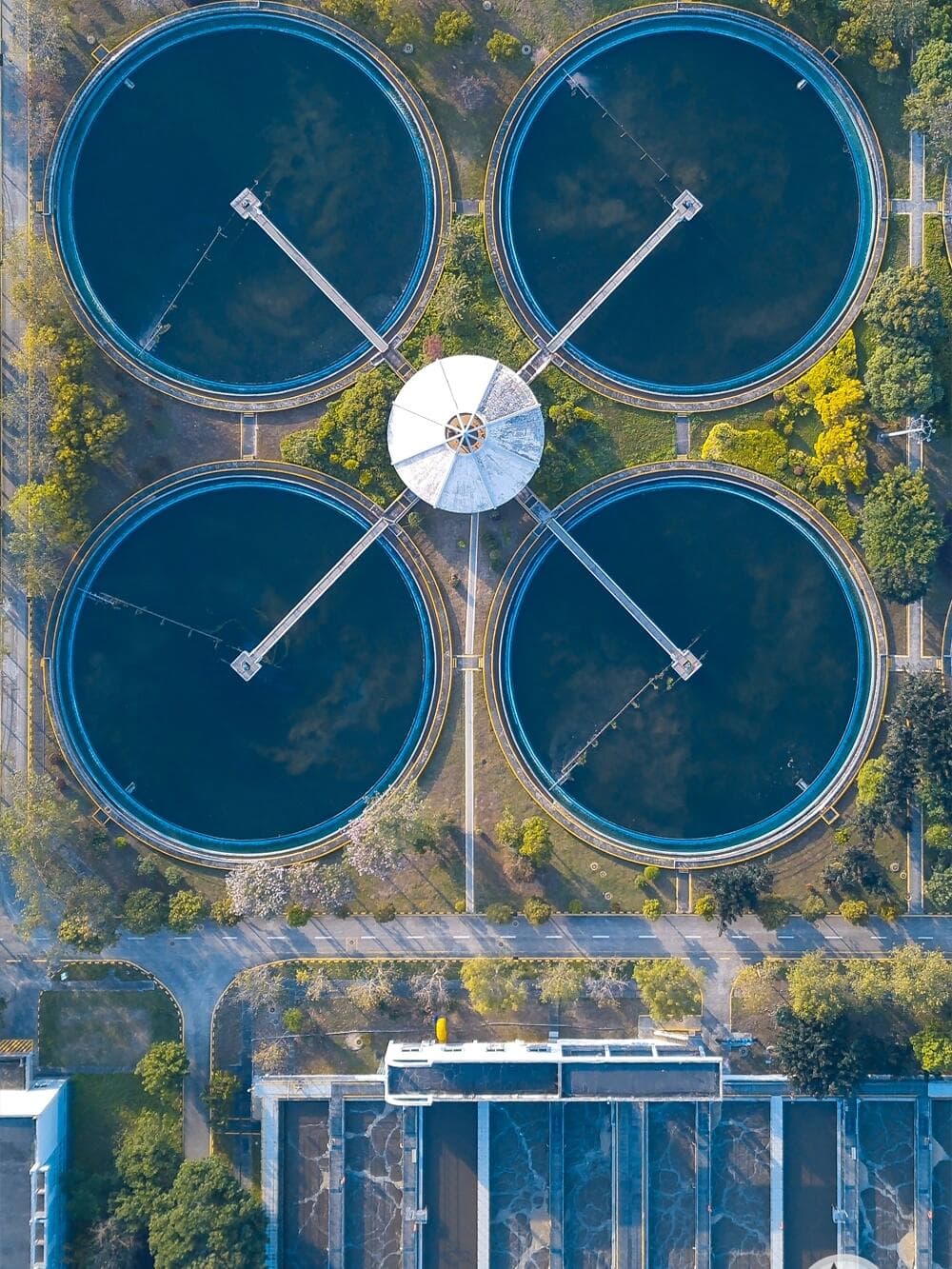
Gravity separation stage in a wastewater treatment plant. Illustrative of the settling step described below; not a photograph of a coal ash installation or of a ChinaPAM trial.
Coal ash is not coal washing — and the difference matters
These two applications are constantly conflated in search results, and they are different processes with different solids, different water chemistry and different regulatory exposure.
Coal washing (coal preparation) handles raw coal fines and clay in a wash plant circuit. The objective is clarifying process water for reuse and thickening tailings so the circuit stays in balance. The solids are unburned coal and clay. For that application, see coal washing water treatment and polyacrylamide in coal washing plants — both cover a different process from this article.
Coal ash is combustion residue — fly ash, bottom ash, boiler slag and flue gas desulphurisation material. It comes from a power plant, not a wash plant. The particles are fired mineral matter, often with a distinct alkalinity, and the associated water can carry dissolved constituents that a wash plant never sees. In the United States it is regulated as coal combustion residuals under a specific federal rule, and impoundment closure or conversion programmes are usually what puts a stackable-solids project on your desk in the first place.
If you are treating ash pond water or converting an impoundment to dry handling, use this article. If you are clarifying wash-plant water, use the coal washing pages instead.
Site characterisation before you think about polymer
Polymer selection cannot start until you know what is in the water and what is bound to the solids. The two are related but distinct, and each drives a different part of the treatment approach.
Water characterisation means measuring TSS, turbidity, pH, conductivity and hardness, plus the dissolved constituents relevant to your permit limit. Coal combustion residuals ponds can carry elevated boron, arsenic, selenium and other trace elements, depending on the coal and the plant design. The US EPA Coal Combustion Residuals rule requires closure characterisation for a reason: the water chemistry drives whether your filtrate can be discharged, and no amount of polymer optimisation changes that threshold.
Solids characterisation means a full particle size distribution rather than a single cut point — and from that distribution, the fine and colloidal fraction identified using the method your project uses, since that is the material the coagulant and flocculant programme has to act on. Add LOI or organic carbon content, and, for press or centrifuge sizing, specific resistance to filtration if you have the equipment. Fly ash is typically a finer, more uniform particle than bottom ash. Mixed pond solids can vary significantly with pond age, layer and proximity to the inlet.
Water balance is the third item, and it is frequently missed. Know how much water leaves with the wet cake at the planned target solids, how much evaporates and how much must be discharged or recycled. A treatment system that produces a cake but creates an unmanageable filtrate volume is not a solution.
The three-stage test protocol
Run these in order. Do not skip to equipment selection based on jar test results alone.
Stage 1: Jar test — fix chemistry direction
Standard jar test with pH and conductivity recorded. Test coagulant type (alum, ferric, PAC), dose and pH adjustment in a first pass, then hold the best coagulant condition and vary flocculant charge and molecular weight. Vary one variable per run. Record supernatant clarity (turbidity or NTU), floc formation time and floc character. See the jar test procedure for the method.
Stage 2: Cylinder test — confirm settling and decant quality
Condition the slurry under the best chemistry from Stage 1, record interface height at 1, 2, 5, 10 and 30 minutes, and take a decant sample for turbidity and for any dissolved constituent that appears in your permit limit. This step confirms that the decant is manageable before you commit to equipment.
Stage 3: Equipment pilot — settle on press, geotube or centrifuge
Run conditioned slurry through a small-scale version of the dewatering unit. Record cake solids, drainage rate, filtrate turbidity and polymer consumption in kg active per dry tonne. This is the number you use for economic comparison.
Equipment choice: filter press, geotube and centrifuge
| Route | Typical cake solids | Polymer implication | Main constraint |
|---|---|---|---|
| Filter press | Highest of the three; depends on ash type and pressing time | Coagulant/flocculant balance critical; cloth blinding stops the cycle | Batch operation; capital and cycle time |
| Geotextile tube | Lower at fill; consolidates over weeks to months | Flocs must survive the fill line; conditioning governs filtrate quality | Large footprint; weather and schedule |
| Centrifuge | Intermediate; continuous; more sensitive to feed variation | High shear; polymer must be shear-tolerant; higher shear changes screening; establish working dose in the actual unit or pilot | Energy cost; abrasion with coarser bottom ash |
“Stackable” is a site-specific acceptance criterion, not a universal solids percentage. Confirm the required geotechnical test (bearing capacity, unconfined compressive strength, paint-filter test) with the receiving site or regulator before optimising solids target.
What coagulants and flocculants each do
Coagulant and flocculant are different products with different mechanisms, and conflating them leads to poor screening and false conclusions about what the product is doing.
Coagulant neutralises the surface charge that keeps colloidal particles suspended. Inorganic coagulants — alum, ferric sulphate, polyaluminium chloride — are the standard first step for fine fly ash, which tends to be colloidally stable and low in organic content. A coagulant-only programme produces a slow-settling, fragile floc in most ash applications.
Flocculant (PAM) bridges micro-flocs into large, fast-settling, dewatering-capable aggregates. Where the fines are colloidally stable and need charge destabilisation first, PAM is commonly screened after a coagulant rather than instead of one. Some ash slurries can be screened with flocculant alone, but only where tests on the actual water and equipment support it — that is a test result, not an assumption. When both are used, flocculant dose and molecular weight govern floc size and structure while coagulant dose governs charge neutralisation, so the two do different jobs and should be optimised in sequence.
A note on superabsorbent polymer queries
Searches for “superabsorbent polymer for coal ash” and for stackable solids appear regularly and deserve a direct answer, because the two product families are not interchangeable. Superabsorbent polymer (SAP) absorbs water into a swollen gel matrix and holds it there. Polyacrylamide flocculant aggregates suspended particles so that solids and water can be separated by a settling, pressing or filtering step, and the water released is then handled as filtrate or decant. Those are different mechanisms with different downstream consequences.
A query phrased around “stackable solids” is not by itself enough to recommend either one — not SAP and not PAM. What decides it is the target you have to meet and the equipment that has to meet it: the placement or handling test the receiving site or regulator actually requires, the dewatering route available to you, what happens to the released water, and the volume and schedule involved. Define those first. The chemistry follows from them, and the bench and pilot work in the previous sections is how you confirm it on your own material.
Cost model with visible variables
Compare on cost per dry tonne handled, not on polymer unit price:
- Polymer cost = (kg active per dry tonne, from pilot) × (delivered cost per kg active)
- Filtrate treatment cost = any additional step needed to reach the discharge limit on dissolved constituents
- Equipment cost = capital or rental, energy and consumables per dry tonne
- Disposal cost = (wet tonnes per dry tonne, set by cake solids) × (transport and placement cost)
- Compliance cost = sampling, analytical and permit-reporting burden per tonne handled
See the dosage calculation guide for converting bench dose to a cost-per-tonne estimate.
Filtrate quality and stackability
Filtrate quality. Turbidity and TSS are the visible test. The harder requirement is dissolved constituents — boron, arsenic, selenium and others that may appear in the permit limit for your discharge point. Polymer does not remove dissolved metals. A filtrate that passes turbidity but fails a dissolved constituent limit needs a different treatment step. Lime co-precipitation and ion exchange are examples of the kind of step that gets considered here; neither is automatically suitable for your water, and which one applies — if either does — comes out of site-specific treatability testing and design, not from the constituent name. Know this before sizing the system.
Safety boundary. Polymer improves separation and dewatering. It does not remove metals by itself, certify leachability, render material non-hazardous or replace site-specific compliance testing. Coal combustion residuals are regulated at the federal level under 40 CFR Part 257. Whether your output is classified as beneficial use, managed waste or requires a lined disposal cell depends on characterisation and jurisdiction, not on how dry the cake is.
Failure modes
| Symptom | Likely cause | Check before changing chemistry |
|---|---|---|
| Poor floc, cloudy supernatant in jar test | Coagulant under-dosed or pH out of range | Adjust pH first; step coagulant dose; re-run before changing flocculant |
| Press cycle stops early; cloth blinded | Flocculant over-dose or fines breakthrough | Reduce flocculant; check coagulant balance; inspect cloth condition |
| Good turbidity, fails dissolved constituent limit | Dissolved metals not removed by polymer | A separate polishing step is needed; select it from site-specific treatability testing rather than by default. The polymer programme is not the problem |
| Cake meets solids target but fails placement | Solids target not aligned to placement specification | Confirm the required test with site or regulator; adjust target |
| Performance degrades through the shift | Feed solids or pH changing as pond layer changes | Log feed solids and pH continuously; tie dose to load, not to flow |
What the protocol proves and cannot prove
A three-stage bench and pilot protocol can prove: that a coagulant and flocculant type and dose window works on your ash in your water; approximate cake solids achievable at the bench scale; filtrate turbidity and TSS; and relative polymer consumption across candidates, giving you a cost-per-tonne basis for comparison.
It cannot prove: that the filtrate meets a dissolved constituent discharge limit (requires analytical testing of your actual water); that the dewatered material meets a waste classification or beneficial-use standard (requires site characterisation and regulatory determination); what the equipment cycle time and throughput will be at full scale; or that the grade identified in the bench phase will not require dose adjustment once it runs through the real feed variability of the pond.
RFQ checklist before requesting quotes
- Water chemistry: TSS, turbidity, pH, conductivity, dissolved constituents relevant to permit limit.
- Solids characterisation: full particle size distribution with the fine/colloidal fraction identified by your project's method, LOI, fly ash vs bottom ash vs mixed.
- Feed slurry solids concentration and variability.
- Volume to be handled, schedule and any regulatory deadline.
- Regulatory context: CCR rule applicability, beneficial use or disposal, permit limit text.
- Intended dewatering route, or the constraint that decides it.
- Return-water destination and the discharge limit that applies.
- Placement or disposal test: what the receiving site or permit requires for stackability.
- Make-down capability: water quality, mixing equipment, powder/emulsion/solution preference.
- Acceptance criteria: kg active polymer per dry tonne, filtrate turbidity, cake solids, drainage rate.
Sources
- US EPA, Coal Ash Basics. epa.gov/coalash/coal-ash-basics
- US EPA, Coal Combustion Residuals (CCR) — federal regulation under 40 CFR Part 257. epa.gov/coalash
- US Army Corps of Engineers, Long Island Sound DMMP Programmatic EIS — cited for dewatering method context only. nae.usace.army.mil (PDF)
Third-party sources are cited for reference only. They do not indicate any affiliation with ChinaPAM and no figure from them describes a ChinaPAM project or result. Polymer does not render coal combustion residuals non-hazardous or change their regulatory classification. Performance depends on site-specific water chemistry, solids and operating conditions and must be established by testing on your own material with a qualified engineer.
Share your ash pond data and get a test plan
Send ash type (fly, bottom, mixed), water chemistry, TSS, feed slurry solids, volume and intended dewatering route. We will come back with a coagulant-flocculant candidate shortlist and a three-stage test plan, with acceptance criteria written down before any grade is named.
Quotation based on grade, quantity and destination · info@chinapolyacrylamide.com · WhatsApp +86 187-3759-0940