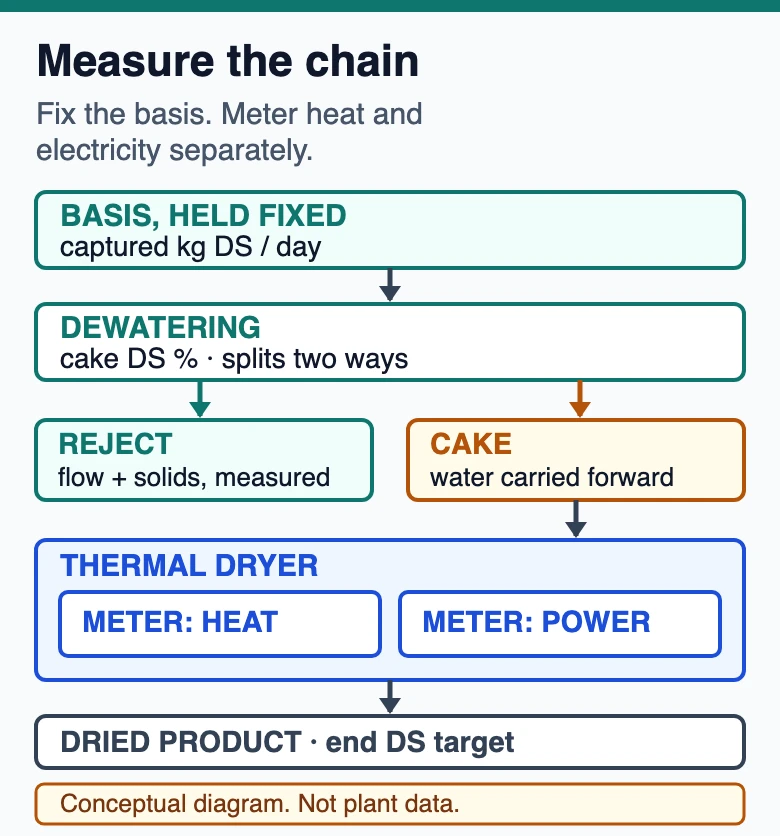
When dewatered cake goes to a thermal dryer, cake dry solids stops being the only figure that settles a polymer trial. The useful comparison is how much water leaves with the cake at the same quantity of captured dry solids, measured alongside what the dryer then consumes — with heat and electricity read separately. This article sets out who can evidence which part of that chain, and gives a handoff worksheet for buying against it. Sources were read on 13 November 2026.
Why the question is live
In a member press release published by ADBA on 10 November 2026, ELIQUO HYDROK states it has been selected by Dŵr Cymru Welsh Water to supply its ELODRY belt dryer for a sludge drying trial at Cardiff Wastewater Treatment Works. The temporary full-scale installation is to process dewatered sludge from the site's Advanced Anaerobic Digestion plant and assess performance across different sludge characteristics and operating conditions. 10 November 2026 is the publication date; the release gives no installation date and reports no measured performance results (ADBA newsroom, 10 November 2026).
That dates the question rather than answering it. If your own site sends cake to a thermal dryer, or is considering one, the useful move is to identify which figures your polymer trial measures and which come from the dryer.
What a dryer asks for
The ELODRY product page, retrieved 13 November 2026 with no publication date shown, describes dewatered sludge fed directly into the dryer and dry-material measurement that adjusts the process as the incoming dry-residue content fluctuates. Its enquiry form asks a prospective site for sludge quantity in kg TS per day and cake dry solids per cent, among other figures. ELIQUO HYDROK publishes both this page and the press release above, so the two agree because they share an origin (ELIQUO HYDROK, ELODRY).
Those two figures are measured dewatering outputs, influenced by the sludge, the machine, the polymer and the operating settings together rather than set by any one of them. A polymer decision therefore shows up in a dryer's sizing inputs, which is why a cake number alone under-describes what you bought.
EPA's September 2000 fact sheet on centrifuge thickening and dewatering states that dewatering removes water to produce a drier material called cake, lists reduced fuel requirements where the residuals are to be incinerated or heat dried among dewatering's advantages, and says the most cost-effective dewatering method depends on many factors including plant size, the cost of further processing, end use and disposal, odour-control requirements and space limitations (EPA 832-F-00-053, printed pp. 1–2, fact sheet PDF).
The principle is long-established, and so is the caution attached to it: the figures to act on are your own.
Who can evidence which figure
Both a polymer supplier and a dryer vendor can commit to real things, and the commitments are different. Writing the split down before a trial is what makes a later comparison defensible.
A polymer trial on your sludge and your machine can produce captured dry solids per day on a declared basis, cake wet mass and cake dry solids at a stated sampling point and method, the dose that produced them on a declared basis, and centrate quality under the same sampling regime. Those are measurements, and they are the ones a supplier should be willing to stand behind as measurements of that trial.
Heat input, electrical input, throughput at a given feed and end-product dry solids are read on the dryer. They belong to the dryer's meters and the dryer vendor's data, whoever ends up compiling the business case from them.
Cake acceptability is the row people skip. Whether the cake a given polymer produces can be fed and distributed by the dryer at the proposed rate is confirmed by the equipment owner or vendor, not inferred from a dry-solids reading. A cake that scores well and then will not feed has not improved anything.
Estimates built across that boundary are legitimate, and worth asking for. What matters is labelling: an estimate derived from stated assumptions, OEM figures and site data is a calculation, and it is a different object from a measured result on your plant or a contractual guarantee. Ask for the assumptions alongside the number, and the estimate becomes something you can check rather than something you have to trust.
Illustrative arithmetic: the water that leaves with the cake
The figures below are hypothetical, chosen to show the shape of the calculation rather than any plant's behaviour. They are not field performance, not a trial result and not an equipment recommendation. They hold captured dry solids equal and assume cake that both the dewatering machine and the dryer can handle at the stated rate; change either and the comparison stops being valid.
| Hypothetical line | Case A, 20% cake DS | Case B, 25% cake DS |
|---|---|---|
| Captured dry solids, kg DS/day, held equal by assumption | 1,000 | 1,000 |
| Wet cake leaving dewatering, kg/day = DS ÷ cake DS fraction | 1,000 ÷ 0.20 = 5,000 | 1,000 ÷ 0.25 = 4,000 |
| Water inside that cake, kg/day = wet cake − dry solids | 5,000 − 1,000 = 4,000 | 4,000 − 1,000 = 3,000 |
What the arithmetic establishes is one thing: at equal captured dry solids, the five-point difference in cake dry solids means 1,000 kg per day less water inside the cake handed forward. That is a statement about the cake stream only.
It deliberately says nothing about the reject stream. Whether the reject stream carries 1,000 kg per day more water depends on the incoming sludge water and on any make-up, dilution or wash water also being equal, and those flows may differ between trials. If you want a reject-side figure, lock those flows explicitly and measure it; do not derive it from this table.
It is also not an energy or cost figure. Turning a water mass into drying energy needs the dryer's measured heat and electrical consumption at that feed, its throughput limits, and end-product dry solids held constant. Those are obtainable — from the dryer's meters, or as a documented estimate from the dryer vendor with assumptions attached — but they do not follow from the cake arithmetic alone.
One constraint stays live at your plant. Equal captured dry solids has to be verified rather than assumed: a cake that reads drier while sending more solids out with the centrate has not carried the same dry solids, and the balance needs closing before the comparison means anything. That closure is its own piece of work, covered in centrifuge solids capture vs cake dryness.
The handoff worksheet
This is a worksheet for your own trial, not a standard and not a form from any vendor or public body. Fill one column per candidate polymer in the units written in the row, and treat a column with gaps as not yet comparable. The layout exists to keep heat and electricity on separate rows: a single “energy” line hides which input actually moved.
| Stage | Line, with the unit and basis fixed by you | Where the figure comes from |
|---|---|---|
| Dewatering | Captured dry solids, kg DS/day, with the sampling and analysis method named | Measured at your plant, supplier present |
| Dewatering | Cake wet mass, kg/day, and cake dry solids, %, at a stated sampling point | Measured at your plant |
| Dewatering | Polymer consumption, kg/day, stated twice: as commercial product, and on the active basis declared in the product documents | Plant log plus supplier product data |
| Dewatering | Reject stream flow and solids, measured, so returned load is a figure rather than an inference | Measured at your plant |
| Handoff | Written confirmation that this cake is acceptable to the dryer's feed and distribution equipment at the proposed rate | Dryer vendor or equipment owner |
| Handoff | Water entering the dryer with the cake, kg/day | Arithmetic from the cake wet mass and cake dry solids rows above |
| Dryer | Heat input, recorded on its own, with the fuel or heat source named | Dryer meter; or a documented estimate with assumptions stated |
| Dryer | Electrical input, recorded separately from heat | Dryer meter; or a documented estimate with assumptions stated |
| Dryer | Throughput achieved at that feed, and whether the dryer was the limiting stage | Dryer vendor data or site trial |
| Output | End-product dry solids target, and the end-use or disposal route it is produced for | Your plant with the end-use route owner |
| Commercial | Cost scope declared: which of polymer, power, heat, transport and disposal are inside the comparison and which are excluded | You, before the trial starts |
The last row settles more arguments than any technical row above it. Two bidders can both be truthful and still produce incomparable numbers if one counted transport and the other did not. Fix the scope before the trial, and fix the dose basis the same way: state whether a dose figure is commercial product or active polymer, and take the active content from the product documentation rather than assuming it. Writing both into the enquiry is the habit covered in the PAM RFQ specification template. If the duty is a conventional centrifuge or belt press tender with no dryer downstream, the gating and award mechanics are a different problem, set out in the emulsion polymer tender checklist.
Questions buyers ask at this handoff
Is a drier cake worth paying more for once a dryer is involved?
It depends on your measured costs and operating conditions, so the way to find out is to price it rather than assume it. At equal captured dry solids a drier cake hands less water forward, which is arithmetic. What turns that into value is the dryer's measured consumption at each feed condition, which stage limits throughput, what the extra dryness cost in polymer, and whether the cake still feeds properly. Those four figures come from your own plant and your own dryer, which is why the answer is built rather than looked up.
Can anyone estimate the drying energy a polymer change would affect?
Yes, with the assumptions on the table. A credible estimate needs the dryer's consumption data at the relevant feed, the throughput limits, end-product dry solids held constant, and the cake figures from your trial. The dryer vendor holds the equipment data, so that is where to ask. Ask for the inputs and assumptions next to the result. An estimate you can audit is useful; the same number with no stated basis is not, and neither is a measured trial result relabelled as a guarantee or a guarantee presented as a measurement.
A dryer trial is running at another utility. Does it tell me anything about polymer?
It tells you the question is being investigated, which is why it is worth preparing for. It does not transfer. Any such trial describes one plant's sludge, one dryer and one operating window, so a polymer conclusion for your plant still comes from a trial on your sludge and your machine, with the worksheet above filled in.
Taking this to an enquiry
If you are choosing dewatering polymer for a line that feeds a dryer, contact ChinaPAM to discuss cationic polyacrylamide options and a quotation. Start with your current polymer grade or the problem you want to solve. You do not need a completed worksheet to get in touch; any cake results or dryer requirements you already have can help make the discussion more specific.
ChinaPAM quotes cationic polyacrylamide for sludge dewatering duties and supplies the specification and batch documentation for the product quoted, so the active basis in your worksheet comes from a document rather than an assumption — the range is set out under cationic polyacrylamide. Where a figure depends on the dryer, we will say so and point to what the dryer vendor needs to supply, rather than filling the gap with an unverifiable number. Discuss polymer options and request a quote — start with the information you have.