
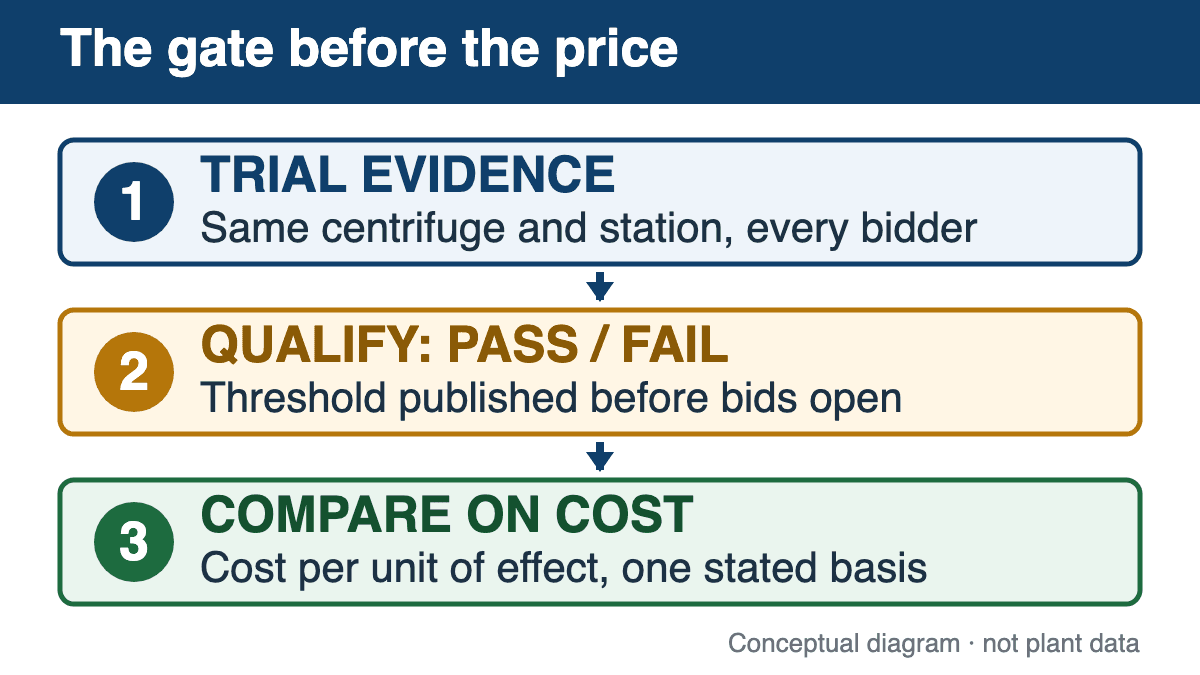
A municipal buyer in Łódź, Poland decided that no bid for dewatering polymer gets a score until the product has run on the buyer's own decanter centrifuge and cleared a pass/fail threshold published before bidding. Only the offers that clear it are compared on cost, and the cost figure is not a price per kilogram alone. That ordering, trial first and commerce second, is the part worth copying into your own tender. This article draws on the buyer's published tender documents, as of 6 November 2026, for procedure FZ.270.15.2026.RP in Łódź, Poland (ZWiK Łódź procurement platform, where the SWZ and its annexes are attached).
The technical qualification gate
The buyer holds the test rig constant instead of accepting each bidder's own trial.
Trial dewatering in the buyer's decanter centrifuge is described as the essential element of the procedure and of offer evaluation, run to a programme issued as a technical annex. The centrifuge is a type X4E nominated by the buyer and is the same for every bidder; the polyelectrolyte make-up station is likewise nominated and the same for every bidder, with each supplier supervising preparation of its own product (contract-description annex, OPZ IV.2, pp. 2–3).
What that fixes is the machine and the station. It does not by itself fix the operator, the solution age or the sludge on the day, so those remain things to pin down if you are writing a comparable clause.
The threshold itself is a pass/fail condition, and it is quantified.
A necessary condition for an offer to be evaluated is an average dry solids content in the dewatered sludge of at least 21%, together with average centrate suspended solids no greater than 800 mg/dm³. Five samples of dewatered sludge are taken and analysed in the buyer's laboratory; the two with the most extreme dry-solids results are discarded, and the arithmetic mean of the remaining three qualified samples is the figure that counts (OPZ IV.2–3, pp. 2–3, with the same condition in the specification of contract terms).
800 mg/dm³ is 800 mg/L. Both numbers are this plant's acceptance criteria, not industry standards and not a performance figure anyone should quote back as typical, because the feed they apply to is specified too.
The sludge is stabilised municipal sludge after anaerobic digestion, at 2.5–4.0% dry solids by weight, with organic matter at 55–68% of dry solids (OPZ III.1, p. 1).
A 21% cake from a 2.5–4.0% feed on a nominated machine is a specific local target. Discarding the two extreme samples is a decision about measurement scatter rather than chemistry, and it cuts both ways: it protects a supplier from one bad sample and stops anyone winning on one lucky one.
There is a second qualification gate that has nothing to do with the trial, and buyers often forget to write one.
Bidders must show references for at least one supply contract performed in the last three years for emulsion polyelectrolyte for dewatering digested sludge at a wastewater treatment plant, above a stated net value, and the list of supplies must give values, dates, recipients and clearly identify the subject as emulsion polyelectrolyte for digested sludge on decanter centrifuges. Bidders must also declare the knowledge, technical potential and resources to perform the contract, and their handling of empty polyelectrolyte packaging must comply with waste and packaging law throughout the contract (OPZ VIII, pp. 4–5).
Note what that reference requirement is actually screening for: not polymer in general, but emulsion polymer on digested sludge in centrifuges, which is the same duty being tendered. A reference threshold written loosely (“supplies of water treatment chemicals”) screens for almost nothing.
How cost enters, after the gate
Price does enter the comparison, and a bid price per kilogram is one of its inputs. It is simply not the whole basis.
The dominant criterion, weighted 90%, is the cost of raising dry solids in the digested sludge by 1.0% after dewatering under the trial's technical conditions, computed as K = k × d₀. Here k is the bidder's quoted purchase cost per kilogram of the polyelectrolyte in commercial form, and d₀ is the quantity of that commercial product, per tonne of dry solids, which produced a one-percent increase during the technical trial. K is therefore expressed per tonne of dry solids. The remaining 10% goes to the lowest centrate suspended solids achieved by the bidder in the trial, and each criterion is scored relative to the other offers by formulas set out in the documents (OPZ IV.4, pp. 3–4, and the specification's criteria section).
Three things follow. K is the cost of one percentage point of dryness computed by this contract's defined method; it is not a generic polymer cost, nor any promise of improvement at another plant. Because K multiplies price by the dose actually needed, a cheap product that needs proportionally more scores no better, and a dearer product that needs materially less scores better. And the dose term comes out of the trial, so efficiency cannot be asserted in a covering letter.
The dose basis is the detail most worth stealing. This buyer defined d₀ as commercial product per tonne of dry solids, not active polymer. For emulsions the two differ substantially, which is the practical reason the form matters commercially as well as technically, covered in PAM emulsion vs powder. Write a cost-per-effect formula without pinning that basis and two honest bidders will compute it differently, which destroys the comparison the formula was built for.
The bid comparison sheet
This is a worksheet for your own tender, not a form from any procurement file and not a ChinaPAM condition of sale. Fill one column per bid, in the units written in the header, and refuse to score a column with gaps. The first data row is illustrative arithmetic to show how the cost line is built; it is not a bid, a tender result or a quotation.
| Line, with the unit fixed by you | Illustrative arithmetic only | Bid A | Bid B |
|---|---|---|---|
| Price per kg of product as supplied, currency per kg, commercial form | 2.00 / kg | ||
| Dose basis, stated explicitly: commercial product or active polymer | Commercial product | ||
| Trial dose for +1% cake dry solids, kg product per tonne dry solids | 1.50 kg/t DS | ||
| Cost of +1% dry solids = price × dose, currency per tonne dry solids | 2.00 × 1.50 = 3.00 / t DS | ||
| Cake dry solids achieved, mean %, and how many samples the mean came from | Mean of 3 qualified of 5 taken | ||
| Centrate suspended solids, mg/L, same sampling basis | Stated in mg/L by every bidder | ||
| Machine and make-up station used, plus solution strength and maturation time | Named machine, named station | ||
| Packaging type, and who collects the empties at whose cost | 1 m³ IBC, supplier collects | ||
| Unloading and dosing equipment, if packaging differs from your standard | Supplied by bidder | ||
| Reference supply of the same duty: emulsion polymer, digested sludge, centrifuges | Value, date, recipient |
The one line people leave blank is the dose basis, and it is the line that makes the cost row meaningful. If a bidder will not state it, the cost figure in that column cannot be compared with the one next to it.
What the amendment changed, and what it did not
This procedure's dates have already moved once, and the amendment is a clean example of reading one for what it actually contains.
Modification No. 1 to the specification, dated 29 October 2026 and posted to the platform on 3 November 2026 at 10:36 local time, changes three things: the offer submission deadline, now 16 November 2026 at 11:00; the opening, now 12:00 the same day; and the offer-validity period, now no longer than 90 days, to 13 February 2027.
It is a schedule change, not a performance change. The qualification threshold, the sampling rule and the award weightings are untouched by it. If you are tracking a live procedure, read the amendment for dates and the specification and its annexes for anything technical. Only the binding documents govern, and a procedure can be amended again.
What a trial number cannot carry
A trial runs for days; a supply contract runs for months. This dossier closes that gap with an in-service remedy, which is the clause most polymer contracts leave out.
If the buyer finds, on a monthly-average basis in operating conditions, that mean cake dry solids after the centrifuge has fallen below 21%, it may require the supplier to verify the selected polyelectrolyte. The supplier then has 21 days from written notice to propose a different polyelectrolyte achieving the required effect, within the price per kilogram already offered in the tender; on a negative verification the supplier covers the difference in unit dewatering cost until a compliant replacement is in place (OPZ XI.9, p. 6).
Borrowing that clause converts a trial result into a continuing obligation. Note also that the scope of supply includes collection of the empty containers after use, with delivery in 1 m³ IBC containers on pallets, or other packaging if the bidder provides the equipment to unload and dose it (OPZ II and IX). Those obligations were priced inside the same bid as the chemistry, so whoever wins has absorbed them. Your own contract terms are the ones that matter; the point is only to price them deliberately rather than discover them later.
When to hold rather than award
If the trial evidence across bids is not symmetrical, holding costs less than awarding. Hold when bids were run on different machines or make-up stations; when the dose behind a cost figure is stated on active polymer in one bid and commercial product in another; when sample counts or outlier handling differ; when packaging return or unloading equipment is priced by some bidders and ignored by others; or when a claimed result arrives without the conditions and analysis records that would let you reproduce it. Our RFQ specification template lists the data to request before quoting, and centrifuge solids capture vs cake dryness explains why a cake-solids figure read on its own can mislead you about what the machine is doing.
Frequently asked questions
Does a 21% threshold mean my plant should expect 21% cake?
No. It is one buyer's acceptance criterion for its own digested sludge, at the feed solids and organic content quoted in its annex, on a nominated decanter centrifuge under a defined trial programme. Cake dryness depends on feed characteristics, machine type and setup, polymer make-down and dose, and conditioning. Read the number as evidence that a threshold can be defined and tested, not as a target that travels to another plant.
Should I ask for a price per kilogram or a cost per unit of effect?
Ask for both. A price per kilogram is comparable only if the dose is known, and a cost-per-effect figure is only as sound as its dose term. Whichever you score on, state in the tender whether the dose is commercial product or active polymer, per what quantity of sludge or dry solids, under what trial conditions, and witnessed by whom. If you cannot pin that down, a price per kilogram plus a separately reported trial dose is more honest than a composite number built on two different bases.
Writing a dewatering-polymer tender, or comparing bids?
Send us your centrifuge or press type, feed dry solids and organic content, current cake and centrate figures, and how you intend to define the dose basis. We will say what we can support with trial data, what needs a plant trial to answer, and what we cannot claim.
Request a quote or a technical discussion — include your sludge data and we will answer on the basis you plan to score on.