
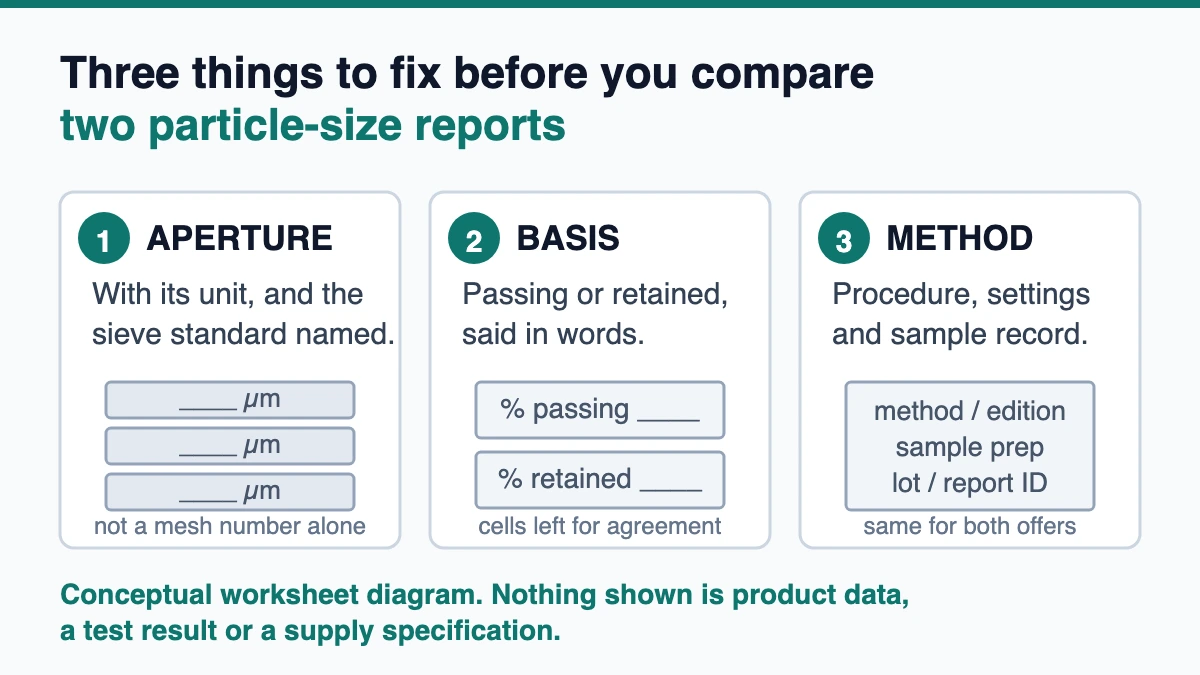
If you are asking for fine-powder anionic polyacrylamide and you write one mesh number into the enquiry, you have not yet specified anything two suppliers must answer the same way. Before you compare quotes, agree four things in writing: the sieve apertures with their units, whether each percentage is material passing or retained, the test method and its edition, and which sampled lot the report belongs to. Fix those and the offers become comparable. Leave them open and you will be ranking reports that were never measuring the same thing.
This article is about writing and comparing that one annex. It is not a general grade guide: cross-property specification ranges live in the polyacrylamide specifications table, document-by-document acceptance in the COA, TDS and SDS review, and the whole commercial enquiry in the RFQ specification template.
Particle size is not molecular weight
One distinction to fix at the outset. A particle-size report describes the size of the dry grains; it does not establish the polymer's molecular weight or its charge density. Those are separate properties, with their own methods and their own results, and how the product performs on your solids needs its own evaluation again. Ask for each on its own evidence rather than reading one from another.
The public scope of the ASTM dry-sieving test methods for plastic materials puts the point narrowly: particle size affects handling characteristics, and for some polymers it will also affect processing characteristics (ASTM D1921-26, Significance and Use 4.3, public scope page).
So treat particle size as a handling and feeding question, and keep it separate from performance. Molecular weight belongs in the molecular weight guide; make-up and wetting behaviour belong in the dissolving method. Nothing in a sieve report entitles anyone, including a supplier, to promise faster dissolution or a lower dose.
What a sieve report actually states
Three fields decide whether a sieve report can be compared with anyone else's.
The aperture, in units, with the sieve standard named
A mesh designation is a label from a particular sieve standard, not a dimension. Write the opening itself.
The ASTM specification for woven-wire test sieves is explicit that SI units are standard for the dimensions of the sieve cloth openings and the wire diameters, and it covers sieves with nominal apertures from 125 mm down to 20 µm (ASTM E11-24, Scope 1.1 and 1.3, public scope page).
That specification governs the sieve as equipment: the cloth, the frame, the inspection of both. It is not a polyacrylamide specification and it certifies no product. Its practical use to you is narrow and real: put the aperture in micrometres or millimetres beside any mesh designation, and name the standard the designation comes from. Deliberately absent from this article is a mesh-to-micrometre conversion table, because a conversion is only meaningful once the applicable sieve standard is identified, and that is the supplier's to state rather than ours to assume.
Passing or retained, in words
"90% at 20 mesh" is not a specification; it does not say which side of the aperture the 90% sits on.
The same ASTM public scope separates two approaches. Its Test Method A uses multiple sieves spanning the material's size range to determine mean particle diameter and the particle size distribution; Test Method B is an abbreviated form using a few specific sieves to determine percent passing or percent retained on a given sieve (ASTM D1921-26, Scope 1.2.1–1.2.2).
That distinction is the one your annex has to force. A single cut figure and a full distribution answer different questions, and both are legitimate; they are not interchangeable. A supplier answering with one when you needed the other is not necessarily evading the question, so ask for the form you actually need.
Worth knowing before you set an aperture: because these methods sieve dry, the public scope gives their lower measurement limit as about 38 µm, and recommends sedimentation methods below that (ASTM D1921-26, Scope 1.1).
Read that as a boundary of that dry-sieve scope, not a universal limit for every sizing technique, and emphatically not a supply limit for any product. If your interest is in the fines well below that figure, the honest next step is to ask the supplier or the testing laboratory which procedure is suitable for the range you care about, rather than to insist on a sieve figure the method is not built to deliver.
The method, the settings and the sample
Two laboratories can sieve one material and report different distributions, which is why the method line is not bureaucracy.
A sieving-method reference from a test-equipment manufacturer makes two points that matter to a buyer. Reliable characterisation depends on calibratable, monitored measuring equipment and on careful sample preparation. And the optimal parameter settings depend on the material: interval, speed, sieving time and amplitude all come into play, with the result that different sieving motions can produce different particle size distributions from the same sample — the reference illustrates this by sieving one wood sample two ways (RETSCH, sieving methods of sieve analysis).
Do not carry the size of that difference across to polyacrylamide; a wood example proves nothing about the magnitude for a water-soluble polymer. Carry across the principle only, which is enough to act on: if two reports do not state the same method and settings, you have not established that a difference between them is a difference in the product.
The particle-size annex, blank
Attach this to the enquiry. It is our worksheet, not a form from any standards body, and every limit cell is deliberately empty: the acceptance figures are for you and your supplier to agree against your equipment, not for us to pre-fill with plausible-looking numbers. Send it with the aperture rows filled in as far as your process requires, and leave the rest as "to be agreed" until someone has a reason to write something there.
| Field | What to write | Your entry |
|---|---|---|
| Reporting form required | Full distribution across several apertures, or named cut fractions | |
| Aperture 1, with unit | Opening in µm or mm; mesh designation optional, with its sieve standard named | |
| Aperture 2, 3 … with units | Add a row per aperture you need reported | |
| Basis, stated in words | Cumulative % passing, or % retained on that sieve, or % in the interval between two | |
| Quantity basis | Name it explicitly, e.g. by mass of the dry test sample | |
| Acceptance limit per row | To be agreed — leave blank until agreed | |
| Test method and edition | Procedure designation and year, as the testing party states it | |
| Settings and sample preparation | As recorded by the testing party; to be agreed if it must be held constant | |
| Lot and report identity | Lot or batch sampled, report number and date | |
| Supplier response | Confirmed / deviation stated / method to be agreed | |
| Feeder and make-up arrangement | Your dry feeder and make-up unit, so handling suitability is discussed separately |
The last row is there on purpose. A fines question is usually really a handling question — dust, bridging in the hopper, wetting at the eductor — and those belong to your equipment, not to a percentage on a certificate. Raise them as equipment-qualification questions with the figures in front of you.
Comparing two reports without fooling yourself
When the responses arrive, align them before you rank them. Work down these in order and stop at the first mismatch, because a mismatch high up makes everything below it uninterpretable.
- Same apertures, same units. Convert nothing silently. If one report states micrometres and the other a mesh designation from an unnamed standard, you have a question to ask, not a conversion to perform.
- Same basis. Passing, retained and interval percentages are three different statements. A cumulative figure and an interval figure at the same aperture are not contradictory just because they differ.
- Same method and settings. Different procedure, or the same procedure at different settings, is a plausible explanation for a gap between two reports and has to be excluded before the gap is attributed to the material.
- Sample and lot traceable. One report describes the lot that was sampled. A single report is not a statement about every future delivery, whoever issues it.
- Only then compare the numbers — and compare them against your agreed limits, not against each other's best figure.
Step four is worth one more line from the public scope, which notes that because these methods determine particle size distribution they are useful for determining lot-to-lot uniformity (ASTM D1921-26, Significance and Use 4.2).
Note what that does and does not give you. Uniformity is something repeated reports across lots can evidence. One report cannot, and neither can a datasheet. If consistency between deliveries is what you are actually buying, ask for the per-lot reporting arrangement explicitly, as a commercial term.
One caution on the other side, for buyers who have just built a strict annex: do not reject a real delivery because a worksheet field is blank or phrased differently than you expected. The annex exists to surface questions early, not to create paper grounds for rejection. A supplier reporting a different but clearly defined basis has given you something you can work with; a supplier reporting an undefined number has not.
What this annex does not settle
A tight particle-size annex gets you comparability on one property. It does not establish molecular weight, charge, flocculation performance, dissolution time or dust behaviour, and it is not a certification of anything — the ASTM documents cited above are a test method and a sieve-equipment specification, neither of which certifies a polyacrylamide product or a supplier. Those remain separate conversations, each with its own evidence.
It also does not state what any particular product is. This article deliberately quotes no particle-size figure for any grade we sell, because the figure that matters is the one on the report for the lot you would receive, and that comes with the offer.
Questions buyers ask
Can you just tell me the mesh size of your fine-powder APAM?
Not usefully in an article, and a single number would be the wrong answer anyway. Send the annex above with the apertures and reporting form your process needs, together with the application, and we will respond against the actual product documentation for what we would supply, including where a field has to be agreed rather than asserted. Our high-molecular-weight anionic grade page is here for context on the product family.
Is a finer powder better?
Finer is a handling and feeding characteristic, not a quality grade. Finer material wets differently and behaves differently in a dry feeder, which can help or hurt depending on your make-up equipment, and it carries its own dust considerations. Nothing in the sources behind this article supports a claim that finer powder dissolves faster, needs less dose or performs better, and we are not making one.
Two suppliers quoted the same mesh and the reports still disagree. Who is wrong?
Possibly neither. Check the three alignment fields first: the aperture in real units with its sieve standard, whether each figure is passing or retained, and the method with its settings. A difference in any of those is a possible explanation for the gap, though confirming which one actually produced it takes more than the two reports. Until they are aligned, the disagreement cannot be attributed confidently to the products themselves.
Sending it to us
If you want this reviewed against what we can actually document, start from the quotation request and copy the fields that matter into the message box — the apertures with their units, the reporting form you need, and the process and dry feeder the powder has to run through. If you already hold a particle-size report from anyone else, the email and WhatsApp contacts listed on that same page are the route for sending the document itself.
You do not need a complete annex to start. The application and whichever requirements you already have are enough for a first reply, and the open fields can be settled in the exchange. We will come back on the specification fields point by point, say plainly where something has to be agreed or tested rather than promised, and keep the handling and performance questions in their own columns.