
A dissolved air flotation unit was running one polymer, somebody changed the recycle flow, and the float looks different this week. The question that arrives next is usually "should we switch polymer?" — and it cannot be answered yet, because the recycle flow is part of the load on the separation zone. Change it and the two results you are comparing were produced under two different operating conditions. Before you credit or blame the polymer, write down what the recycle was doing in each case. More recycle on its own is not evidence that a different polymer is better, or worse.
This is about keeping a full-scale before-and-after comparison honest. It is not a DAF polymer selection guide — grades, dosing strategy and troubleshooting are in the DAF polyacrylamide guide — and it is not about bench work, which is covered in flotation bench testing for polymer selection.
Which flow, and which area
Name the two flows separately before any arithmetic, because "flow" in a control room can mean either.
A Western Australian asset owner's DAF design guideline sets out the nomenclature plainly: Qi is the raw water flow rate to the DAF and Qr the recycle flow rate, both in m³/h, with the recycle ratio r defined as Qr to Qi. For a separation zone of area Asz it computes the actual hydraulic loading rate as HLsz = Qi(1+r)/Asz, and distinguishes that from vL, a limiting hydraulic loading on the separation zone (Water Corporation Design Guideline DS211, Dissolved Air Flotation Unit Design Guideline, Ver 1 Rev 0, 2022, nomenclature pp. 9–10 and §10.3.4, p. 62).
Two cautions on that document before you lean on it. It is one asset owner's design guideline as stored, dated 2022, not a universal or current statutory standard, and its arrangement is a recycle stream joining the feed into a defined separation zone, which is not every DAF configuration. Check your own unit's drawings for where the recycle actually enters and what the vendor means by its rated area. If the recycle on your plant does not join the feed ahead of the separation zone, the arithmetic below does not describe it.
Then pin the area down. Use one definition of the effective separation area and keep it identical between the two runs you are comparing. Total tank footprint, contact zone area and a vendor nameplate rating are three different numbers, and swapping between them makes the two loading values incomparable.
What the recycle change does to the load
Here is the whole point of the article in four lines of arithmetic. These figures are illustrative only. They are not setpoints, not design values, not limits, not a ChinaPAM result and not a recommendation to operate any plant at any of them. They exist to show which number moves.
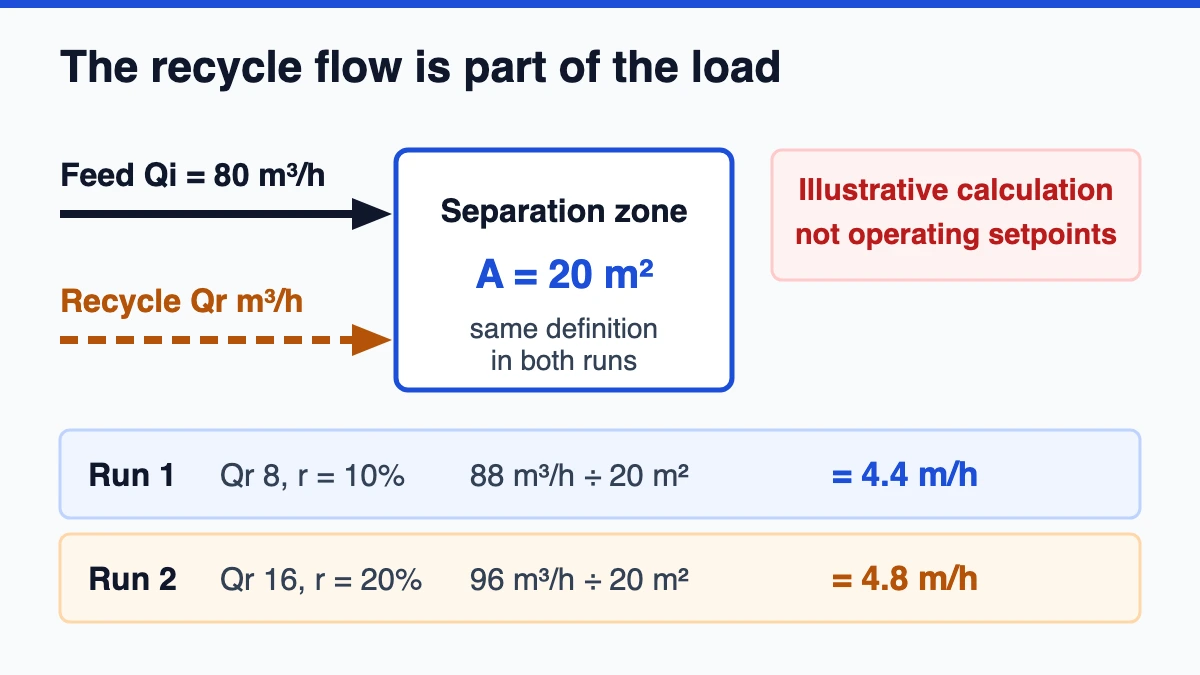
Take a feed Qi of 80 m³/h into a separation zone of area A = 20 m², and hold both constant.
- Run 1 — recycle Qr = 8 m³/h, so r = 8/80 = 10%. Total flow to the zone = 80 + 8 = 88 m³/h. Hydraulic loading = 88 ÷ 20 = 4.4 m/h.
- Run 2 — recycle Qr = 16 m³/h, so r = 16/80 = 20%. Total flow = 80 + 16 = 96 m³/h. Hydraulic loading = 96 ÷ 20 = 4.8 m/h.
The units are worth saying out loud, because this is where people lose track: m³/h divided by m² gives m³/m²/h, which reduces to metres per hour. The figure has the units of a velocity — it is a superficial loading rate across the area, not a measurement of how fast anything in the tank is actually moving.
Now read what happened. The incoming water did not change. The dose displayed on the panel need not have changed. Nothing about the polymer changed. And the hydraulic loading on the separation zone still rose by roughly 9%, purely because the recycle went up. If your before-and-after straddles that change, the two results are not a polymer comparison — they are a comparison of two operating conditions that also happened to have polymer in them.
This cuts both ways, which is why it is worth the arithmetic. A polymer that looks worse after a recycle increase may be running against a higher load. A polymer that looks better after a recycle decrease may be getting credit for a lighter one.
Hydraulic loading is one variable, not the answer
Having made the case for recording the recycle, the opposite error is just as expensive: matching the hydraulic loading between two runs and declaring the conditions equivalent. They are not. Loading is one line in the record.
An Australian vocational assessment document for operating and controlling DAF processes is useful here for one principle: recycle ratio and hydraulic loading are tracked as routine process calculations in the same operating record as dosing, sampling, air-side conditions and feed water quality — and process adjustments are made according to instructions (Assessment Requirements for NWPTRT033, Operate and control DAF processes, Release 1, document generated 21 December 2018, pp. 2–3).
That document is an archived training-package assessment requirement, not a plant design standard, not a test protocol and not evidence of what any regulator currently requires anywhere. Its value here is narrow: loading belongs in the same record as the other operating variables, and adjustments belong to the site's own instructions. Nothing in this article tells you to change a saturator pressure, a dispersion valve or a recycle rate. Those are your equipment manufacturer's and your plant's procedures to direct, and any trial has to be arranged within them.
One more distinction the design guideline draws, because it decides which outcome you should even be measuring.
Clarification and thickening are treated as fundamentally different applications. Clarification is judged on the quality of the subnatant and designed mainly around hydraulic loading; thickening is judged on how concentrated the float layer is and designed mainly around solids loading (DS211 §2.4 and Table 2-1, p. 12).
So decide which one you are judging before you compare anything. If the plant's job is clarified water, a thicker float is not automatically a win. If the job is a concentrated float for downstream handling, a clear subnatant alone does not tell you the polymer did its work. Two people scoring different objectives from the same run can reach different rankings, so settle which objective applies before anyone scores anything.
The record that makes two runs comparable
This is our worksheet, not a procedure from either document cited above and not a ChinaPAM requirement. It is a list of what to log so that a later argument can be settled from paper. Everything in the air-side rows is recorded as found: read it off the instruments and write it down, under your own operating instructions. Nothing here asks you to adjust pressurised equipment.
| Line to log | Why it decides the comparison |
|---|---|
| Time window, and the feed's origin on the day | Two runs on different feed are not one experiment |
| Feed flow Qi, recycle flow Qr, and r computed from them | The load term. Record both flows, not the total alone |
| Area definition used, stated once and reused | Switching area definitions silently invalidates both results |
| Feed solids, with the measurement method named | Solids load moves independently of hydraulic load |
| Air-side conditions as found, per your instruments | A third variable that can explain a float change on its own |
| Product actually delivered, and the dose basis stated | Neat product or active polymer, per volume or per tonne of solids — say which |
| Make-up concentration, ageing time and feed-pump output | A panel setting is not a delivered dose until the pump is checked |
| Any coagulant, with its own dose and point of addition | A changed coagulant condition can be mistaken for a polymer effect |
| Float removal arrangement during the window | Affects the float result you are about to score |
| Outcome, matched to the stated objective | Subnatant quality for clarification duty, float concentration for thickening duty |
On the dose row, check the actual delivered dose and the basis it is reported on, rather than taking a panel reading as the delivered figure — see drawdown calibration for polymer feed pumps. If one run was delivering something other than the panel claimed, the comparison is not between two products on equal terms.
Reading the result, including "inconclusive"
With the record in front of you, work through these questions. This sequence is our editorial reasoning rather than anything either cited document prescribes.
- Is there a baseline on the existing product under a recorded configuration?
- Optional, if your site's own procedures already produced such a window: did the configuration change at some point with the existing product still running? That window helps distinguish a load effect from a chemistry effect, and it is useful evidence where it exists. It is not something to manufacture for the sake of the comparison, and its absence does not invalidate one.
- Was a comparable baseline available after the change, before the candidate product went in?
- Was the candidate product run under a comparably recorded configuration as that baseline?
What decides the verdict is not a clean sweep of yes answers. It is whether the relevant changes and unknowns have been resolved. An unexplained material change in configuration, or an essential line that is missing or cannot be reconciled, blocks attribution of the result to the polymer. Where an existing-product baseline and a candidate run were recorded under comparable conditions, with consistent definitions throughout or a difference you can justify and reconcile, that supports a bounded product comparison — which does not require every observation to be identical, and does not rest on any single window proving causation on its own.
So the material question for each line — the flow basis, the area definition, the solids basis, the dose basis, the air-side conditions — is whether it is recorded on a consistent basis across the two runs, or differs in a way you can account for. A line that differs without reconciliation or control, or is simply absent, is what makes the comparison inconclusive. Treat that verdict as a real result: it points to a controlled repeat under your plant's own trial procedure rather than a purchase decision. And when you ask a supplier — us included — to interpret a result, ask for the comparison on a like-for-like basis and expect to be told which lines need reconciling.
Questions this raises
Our recycle went up and the float got thinner. Is the polymer failing?
Unknown from that alone. What you know is that the recycle changed, which may also have changed the hydraulic loading: if the feed Qi and the area basis A were genuinely unchanged, then a higher Qr raises (Qi+Qr)/A. On a real plant, check that premise rather than assume it, because the feed flow and the area actually used in each figure may differ too. A loading change, and any shift in air-side conditions, feed solids or delivered dose, are hypotheses to test against the paired record — not a demonstrated reason for the thinner float. Without that record for both runs, the answer stays unknown, and the result is not a verdict on the product.
Can we just match the hydraulic loading and call the two runs equivalent?
No. Equal hydraulic loading means one variable matched. Feed solids, air-side conditions, coagulant, make-up and delivered dose can each differ while the loading figure is identical, and any of them can move the outcome. Matching loading makes the comparison possible; it does not make it valid.
What recycle ratio and loading should we run?
Not something to take from an article, including this one. The illustrative numbers above are arithmetic, not operating guidance, and the design limits for your unit belong to its design documentation and your equipment manufacturer. Recycle rates, saturator pressure and valve settings are adjusted under your plant's own instructions, not on a supplier's advice.
If you want a second read on the records
We are a polyacrylamide supplier, so the honest limit of what we can offer here is bounded: send the two runs' records and the objective the unit is being judged on, and we will say whether the comparison supports a polymer conclusion at all, which line is missing if it does not, and what a like-for-like repeat would need to hold constant. Where the answer is "your configuration changed, this cannot be attributed to the product", we would rather say that than sell against it. For the selection conversation itself, the DAF guide is the better starting point, and the records can come with a quotation request.