
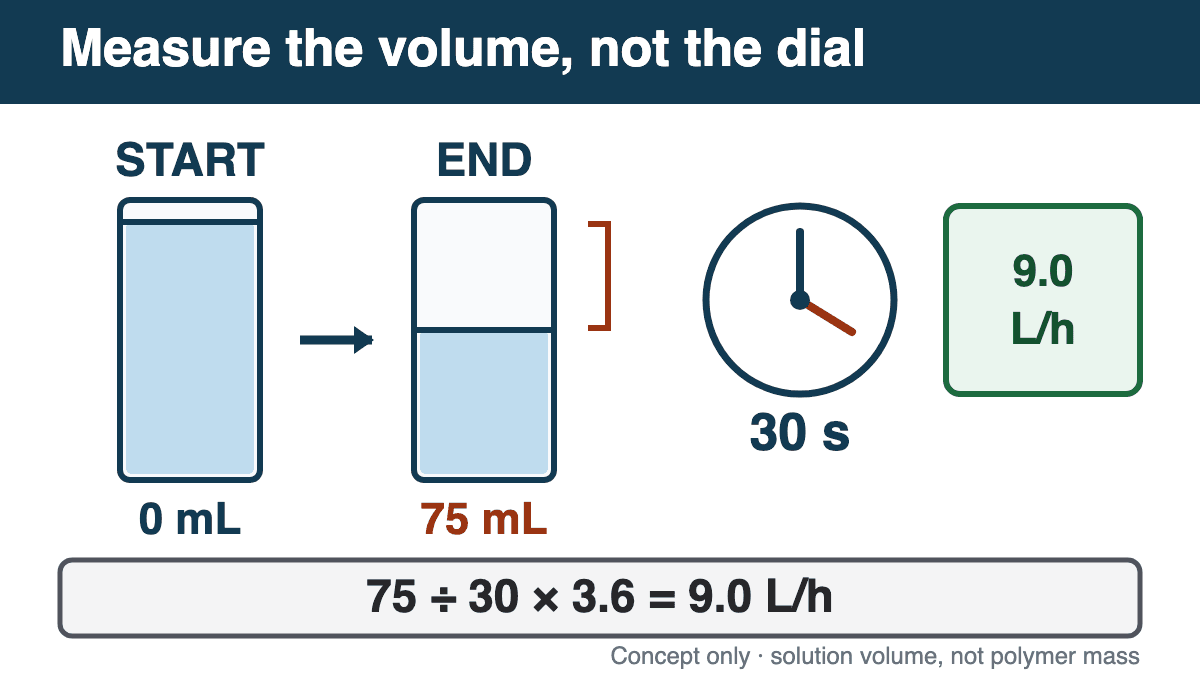
Before you change polymer dose, change grade, or tell a supplier their product underperformed, find out how much solution the pump is actually moving. A dial position, a stroke setting and a controller percentage are commands, not measurements. A timed drawdown measures the volume a pump withdraws from a graduated column over a known interval, which gives you a number you can record and compare against the same measurement next month.
Scope. This article covers what the measurement establishes and how to convert the reading into a flow rate. It is not an operating procedure and contains no valve sequence or pressurisation steps. Calibration hardware differs between installations, so follow your own equipment manual and your site's procedures and permits, with a trained operator and the correct PPE for the chemical in the line.
What a drawdown establishes, and what it does not
A positive-displacement metering pump's delivered volume depends on conditions, not only on its control input. Discharge pressure, suction conditions, fluid viscosity, valve and diaphragm wear, entrained air and tubing condition all move real output away from nominal.
A pump manufacturer's technical bulletin on drawdown calibration makes the same point from the manufacturer's side: many application variables affect a pump's actual output, so calculating from the adjustment-knob setting gives an approximate output and a starting point, and determining precise output calls for a calibration column (Pulsafeeder, Draw Down Pump Calibration, technical bulletin rev 1.0).
So a pump can be in good order and still not deliver what its dial claims. The drawdown closes that gap for one operating point.
The column measures offtake, not arrival
This boundary is the one most worth being strict about. What the test gives you is the volume withdrawn from the column during the timed interval, at the conditions in force at that moment. In the common arrangement the column sits on the suction side.
One accessories manual installs its calibration cylinder in the suction line to the chemical metering pump, with the top of the cylinder vented back to the storage tank or to drain, and notes a maximum cylinder pressure of 15 psi (Flomotion Systems, chemical feed pump accessories manual, June 2019, section 4.0).
A suction-side measurement is what the pump took in. It is not independent proof of what reached the injection point. If the system has a bleed or calibration return, a relief valve returning chemical to the source container, an open bypass, a leaking fitting, or a failed injection quill or check valve, the volume that left the column and the volume that entered the process are not the same number. Treat the two as separate questions: measure the offtake here, then account for any return or bypass path and confirm the delivery point is actually passing flow. Only after that does the figure describe what the process received.
The measurement also says nothing about whether that flow is the right dose, whether the polymer suits the duty, whether the solution was made down correctly, or what the pump will deliver at a different setting or discharge pressure.
Measure at the operating point you care about
The reading is only valid for the conditions it was taken under, so the pump should be working against its normal system pressure with the feed line in its normal state. A reading taken against an open drain tells you little about delivery into a pressurised line.
The hardware and its sequence are equipment-specific, which is why this article does not give generic steps. The two manuals cited here differ in a way that matters: one puts the cylinder in the suction line and caps it at 15 psi, the other describes a column kit arrangement in which the pump is first brought up to system pressure before the draw is observed. Those are different installations with different limits. Use the procedure for the hardware actually fitted at your plant, and if nobody can produce that manual, get it before opening anything.
Turning the reading into a flow rate
The arithmetic is a unit conversion you can derive rather than take on trust. You have a volume in millilitres over a time in seconds and you want litres per hour. Divide millilitres by 1,000 for litres, divide seconds by 3,600 for hours, and divide one by the other; the two divisions collapse into a single factor of 3.6.
flow (L/h) = volume withdrawn (mL) ÷ draw time (s) × 3.6
Both manufacturer documents cited above give the same relationship for converting a millilitre reading to litres per hour, which is a useful check that the factor is not one house's convention.
Worked example
A 30-second interval is common because it is long enough to average individual pump strokes and short enough to stay within a small column. Take 75 mL withdrawn in 30 seconds:
- 75 mL ÷ 30 s = 2.5 mL/s
- 2.5 mL/s × 3.6 = 9.0 L/h
The long way round gives the same answer: 75 mL is 0.075 L, 30 s is 0.008333 h, and 0.075 ÷ 0.008333 = 9.0 L/h. Both manuals also note that the column's printed scale reads directly in US gallons per hour. Read such a scale only for the interval it was graduated for; a scale printed for a 30-second draw gives a meaningless number if you time 20 seconds.
A flow rate is not a process dose
9.0 L/h is a pump output. It is not a dose in mg/L of treated flow, and not a dose in kg per tonne of dry solids. Converting to either needs the treated flow or sludge load and the concentration in the line, which the drawdown does not measure. Two separate steps, and they are easy to collapse by accident.
The mass step needs the concentration of what the pump was moving. Suppose, purely as a hypothetical to show the arithmetic, that the line carries solution made down to 0.25% w/w on a commercial-product basis, meaning 0.25 kg of product as supplied per 100 kg of prepared solution, and that the dilute solution's density is close enough to water to take as 1.0 kg/L. Then:
- 9.0 L/h × 1.0 kg/L = 9.0 kg/h of solution
- 9.0 kg/h × 0.0025 = 0.0225 kg/h of product as supplied, which is 22.5 g/h
- If that product were, again hypothetically, 50% active, 0.0225 × 0.50 = 0.01125 kg/h active polymer, which is 11.25 g/h
Neither the 0.25% nor the 50% is a specification, a typical value, or a ChinaPAM figure; both are placeholders for numbers you take from your own make-down record and the product data sheet. The point of writing it out is that solution, product as supplied, and active polymer are three different answers, and mixing them up is how a dose record becomes unusable. Our PAM dosage calculation guide works through the dose side, and PAM emulsion vs powder covers why the product-versus-active gap is larger for emulsions.
The density shortcut applies to dilute solutions only. If the pump is moving neat emulsion rather than made-down solution, use the product's actual density and stop treating litres and kilograms as interchangeable.
A field log worth keeping
A drawdown is only useful if the next person can tell what it meant. These fields are a suggested record rather than a published method; every one of them changes the result, so a number logged without them cannot be compared to anything later. The example column shows the format, not measurements taken by us at any plant.
| Record | Example format | Why it matters later |
|---|---|---|
| Start and end graduation | 0 mL to 75 mL on the column scale | The difference between two graduations is the measurement, not one reading |
| Column graduation interval | Smallest division on that cylinder | Sets how precisely the volume can be read at all |
| Elapsed time | 30 s, timed | The conversion is tied to the interval you actually timed |
| Computed flow | 9.0 L/h | The output of the check, to compare against the setting |
| Pump settings as found | Stroke length and rate, or controller output % | Ties the flow to one operating point, the only point it is valid for |
| Fluid and concentration | Working solution, % w/w and basis, batch reference | Without it, litres per hour cannot become a mass figure |
| Conditions | Discharge pressure, suction arrangement, temperature | The same pump gives a different flow against a different pressure |
| Return or bypass paths checked | Bleed line, relief return, bypass state | Decides whether offtake can stand for delivered volume |
| Repeat readings | Three draws logged separately, for example graduations read as 74, 75 and 76 mL | One draw is an anecdote; agreement between draws is the evidence |
| Who, when, method | Operator, date and time, manual and revision followed | Makes the record auditable and repeatable by someone else |
The 74, 75 and 76 mL figures above are illustrative graduation readings to show how a repeat set is logged. They are not field measurements made by ChinaPAM.
Repeating the draw is part of the manufacturer's own method rather than an optional refinement: the bulletin states that repeating the process ensures the results obtained are consistent.
When to hold and retest instead of changing grade
Judging whether repeat draws agree is a site decision, not a number this article can supply. Compare the spread between your draws against the tolerance your plant has approved for that duty, and against what the cylinder's graduations can actually resolve: a 1 mL spread means something different on a column graduated in 1 mL than on one graduated in 10 mL. If the spread is wider than your approved tolerance, or measured flow differs materially from the setting, you have an equipment or measurement question rather than a chemistry question. The usual candidates are air in the suction line, a sticking or worn check valve, a tired diaphragm, collapsed or hardened tubing, a changed discharge pressure, or a scale read for the wrong draw interval.
Hold the polymer decision until the measured flow is stable and repeatable. Changing grade while delivered volume is unknown means you cannot attribute the outcome to anything: if performance improves, you will not know whether the new product or the restored flow did it. The opposite error is a plant dosing far more polymer than it needs and reading the symptoms as a product fault, which our guide to PAM overdosing signs and fixes covers. This measurement helps you work out which situation you are in; on its own it will not diagnose the product or the supplier.
Frequently asked questions
How often should I run a drawdown check?
There is no universal interval and we will not invent one. Set it from the consequences of being wrong at your plant and from your own history: a pump feeding a tightly controlled process, or one that has drifted before, earns more frequent checks than a lightly loaded one. The useful habits are to check at a fixed operating point, after any work on the pump, tubing or valves, after a change in discharge pressure or solution strength, and before you blame a product; and to record every check the same way so drift becomes visible.
Can I skip the column and time how long the tank level drops instead?
A tank-level drop over a long interval is a legitimate cross-check on total consumption and sometimes the only option available. It is a weaker measurement: tank geometry, level-gauge resolution, agitation, temperature and any other draw-off all enter the result, and a long interval hides short-term instability. If you use it, record it as what it is, an average consumption rate over that period rather than the pump's output at a defined operating point.
Does a correct flow rate mean the dose is correct?
No, and that is the most common misreading of a good calibration result. A drawdown tells you the pump moved the volume you asked for. Whether that volume is the right dose for the sludge or water is a separate question, answered by jar testing and plant performance. A correct dose command delivered by a pump running well below setting is a wrong dose, and a perfectly calibrated pump delivering a badly chosen dose is still a badly chosen dose.
Flow measured, still not getting the result you expect?
Send us the measured flow, the solution concentration and make-down method, the product form, and what you are treating. We will work in the units you measured and say plainly whether the numbers point at dose, at make-down, or at product selection, and what would need a plant trial to settle.
Request a quote or a technical discussion — include your drawdown record and we will read it with you.