
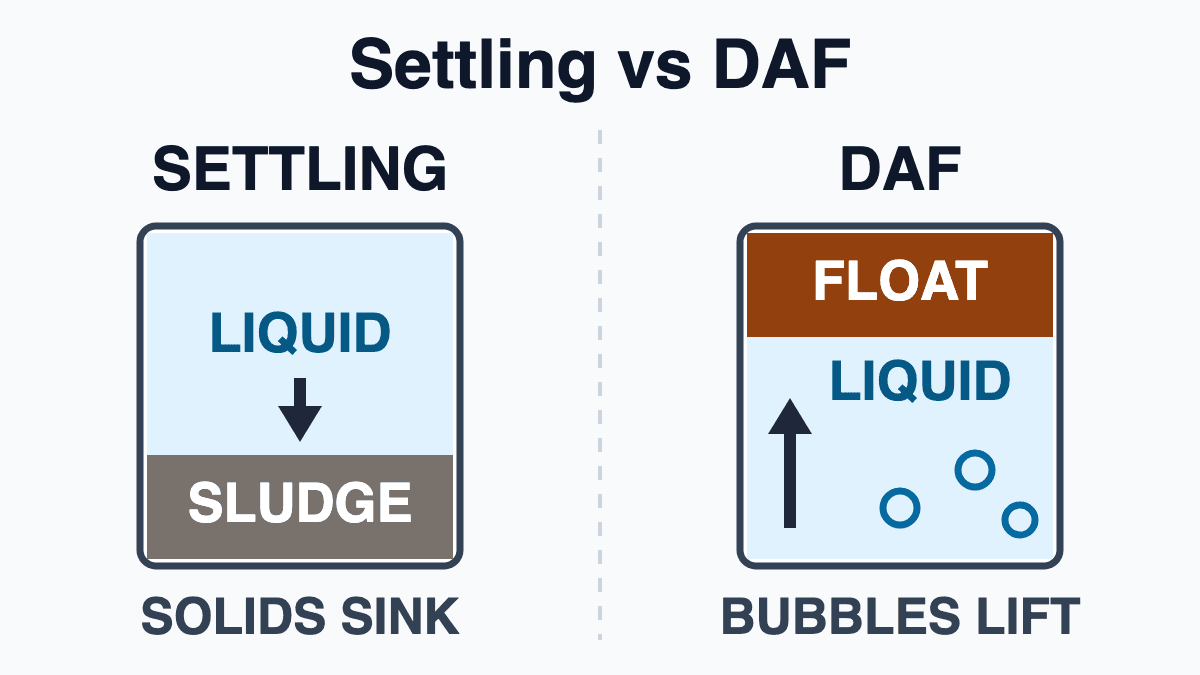
A settling jar test is a sound way to screen coagulant and polymer conditioning, but on its own it cannot show that dissolved air flotation will work on your water: the separation direction is reversed and the variables that drive flotation are absent from the jar. Screen the chemistry that way if you like. Before committing to a DAF unit or changing flocculant on an existing one, run a bench flotation test as well, or require whoever runs the work to report one in a form you can compare.
What each test actually measures
Flotation separates by lifting, not by sinking. A Western Australian asset-owner design guideline describes air-supersaturated water being let down to atmospheric pressure, so very fine bubbles come out of solution and lift suspended particles (Water Corporation DS211, Ver 1 Rev 0, 2022, Introduction). A settling jar has none of that: no air-saturated water, no controlled let-down, no bubbles competing with gravity. Whatever it shows you is a sedimentation result.
That gap matters most for exactly the waters DAF gets chosen for. The same guideline notes settling works less well on low-density or highly organic solids, which is a reason flotation is specified instead. A disappointing settling result therefore does not rule DAF out, and a clean one does not prove conditioned solids will attach to bubbles, rise and hold together as a float.
Equipment built for bench flotation reflects that difference. One current Australian bench DAF accessories package is described as preparing pressurised saturated water, feeding it to jar assemblies, letting it down under controlled test conditions, then comparing the float and the liquid beneath it. Its listed assessment areas include the recycle rate, the saturator pressure, float cohesion and subnatant quality (Platypus Analytics, DAF test accessories; no publication date given). A settling jar has no air side to set or vary, so it cannot produce those readings.
Side-by-side: what you can and cannot conclude
| Aspect | Settling jar test | Bench DAF test |
|---|---|---|
| Endpoint you read | Sludge at the bottom, supernatant above it | Float layer at the top, subnatant drawn from below it |
| Conditioning variables | Coagulant and polymer type, dose basis, mixing sequence | The same, plus how conditioning interacts with the released air |
| Air-side variables | None exist | Saturated water preparation, controlled release, volume of recycle added |
| Question it answers | Can these solids be aggregated, and will the aggregates sink? | Do the aggregates rise, stay cohesive, and leave acceptable liquid below? |
| What the result cannot prove | Flotation suitability, float solids content, float cohesion | Full-scale loading, detention, float removal or plant-scale capture |
A record sheet that makes two tests comparable
Most arguments about bench flotation data come from missing context, not the numbers. The fields below are our own suggested record sheet, not a published method. Pressure, recycle volume and dose are controlled inputs in each run: you set them deliberately and write them down. What this article will not give you is a recommended value for any of them — a suitable setting or range for your water is a conclusion drawn after comparing runs under a defined method.
- Sample identity: source point, collection time, temperature and pH at test time, and how long it stood first. An aged or warmed sample is a different sample.
- Conditioning: coagulant and polymer products, make-down concentration, order of addition, mixing speed and duration at each stage.
- Dose basis: whether dose is stated as product or as active polymer. This is where comparisons quietly break.
- Air side: how the saturated water was prepared, the release conditions, and the recycle volume added per jar.
- Denominator and final volume: recycle dilutes the jar, so record raw sample volume, recycle added and final test volume, then state which one dose per litre refers to.
- Method identity: the equipment method and edition followed, and its definitions of pressure, recycle and timing.
The dilution point is worth labouring. If one run reports dose against the raw sample and the next against raw sample plus recycle, the second looks more efficient on paper while nothing has improved. Different reporting conventions are not the problem in themselves: once the volumes and definitions are recorded, two known bases can be converted onto one common basis and then compared. The problem is ranking runs whose denominators were never reconciled, or never written down to begin with.
What to observe, and when
A flotation endpoint has to be defined before the first jar is run, or every jar gets read at whatever moment looked best. Our working checklist:
- Fix the endpoint by the clock, not by eye: a stated time after release, applied identically to every jar.
- Sample the subnatant at the same depth and time in each jar, well below the float, so you are not measuring how steadily someone held a pipette.
- Describe float formation and cohesion: how fast a layer forms, whether it holds, whether it breaks up when disturbed. A float that collapses is a different problem from one that never formed.
- Judge the subnatant against the actual duty. DS211 treats thickening and clarification as different design problems: for thickening, what matters is how concentrated the floated layer is; for clarification, what matters is the liquid withdrawn beneath it (DS211, application differences). One jar can pass one duty and fail the other.
- Do not trade measurands. Turbidity and suspended solids are measured differently and are not interchangeable, and neither demonstrates removal of a dissolved contaminant. Float solids content is a third measurement again.
Conceptual comparison—not a plant or laboratory test result. In the settling jar the solids collect at the bottom and the liquid above is the supernatant; in the DAF jar the bubble-borne solids collect as a float and the liquid withdrawn beneath it is the subnatant. The air side — saturated water preparation, let-down conditions and recycle volume — exists only in the DAF case.
How far a bench result transfers
A bench flotation test ranks candidates and tells you whether flotation is a plausible route. It does not predict what a full-scale unit will do, and the distinction is worth being precise about. Saturator pressure, recycle rate and conditioning dose are all set and recorded in each bench run, which is why a bench rig is useful at all. What a jar does not reproduce is the continuous side of a plant: sustained hydraulic and solids loading, detention in a flowing tank, the float removal mechanism, the unit's configuration, and feed that changes through the day and the season.
Those same plant variables appear in an Australian vocational training assessment for operating DAF processes — release 1, document generated 2018 — which lists air loading, recycle flow rates, saturated pressure, detention time, float removal frequency and intended plant configuration among an operator's adjustments (NWPTRT033 assessment requirements, release 1). It describes operator competency in one national training system, not a current universal standard.
The point for a buyer is the direction of inference: a value that worked in a jar does not prescribe the plant setting, and a bench ranking is not a performance guarantee.
So treat a bench ranking as a shortlist, then confirm it with paired plant data over comparable periods with machine conditions recorded, or a chemistry change gets credited for a throughput change. And be wary of one photograph of a clear jar: a single reading, taken once by one person, characterises that moment and nothing more. Ask for the record sheet.
On the chemistry side, our jar test procedure guide covers conditioning and mixing, the polyacrylamide in DAF guide covers grade direction and troubleshooting, and PAM versus PAC, alum and ferric covers the coagulant choice upstream of either test.
Asking a laboratory or supplier for comparable evidence
Send the duty (thickening or clarification), the water and its variability, the measurands and methods you will accept, and the blank record sheet above. Ask for completed fields and the defined endpoint, not a conclusion. If you want conditioning options screened against your own sample on that basis, you can tell us what you are treating.
FAQs
Is an ordinary settling jar test ever enough on its own?
It gives you real information about conditioning chemistry, and it is a reasonable place to start. It is not enough to demonstrate flotation, because the jar has no air-saturated water, no let-down and therefore no bubbles. Be careful about the reverse inference too: a candidate that produces little visible settling or no large settleable flocs has not thereby been shown to fail. Flocs can be too light to settle well and still float perfectly, which is one of the situations flotation is chosen for. If you want to exclude a candidate for a flotation duty, exclude it on flotation evidence gathered under a defined method, not on a settling endpoint.
What records should I request with bench DAF results?
Sample identity and condition, conditioning sequence and dose basis, how the saturated water was prepared and released, recycle volume and final test volume, the denominator used for dose, the defined endpoint and sampling depth, the method and edition followed, and each measurand with its laboratory method. Any of these missing makes two runs hard to compare.
If the subnatant looks clear in the jar, is the plant result guaranteed?
No — and a clear-looking jar does not even establish the bench result on its own. Appearance is a visual observation. A bench conclusion needs the defined method and treatment objective, the measured endpoint at a stated time and sampling position, the float behaviour alongside the subnatant, and a comparison against the other runs. Only then is there a bench finding to transfer, and transferring it still requires paired plant data, because sustained loading, detention, float removal, configuration and feed variation are not reproduced in a jar.