
A rotary press dewaters sludge differently from a belt press or a decanter centrifuge, so the grade that performs on your current machine is a candidate on the new one rather than a known quantity. Feed pressure, residence time and the shear the floc passes through all change, and those are the conditions a flocculant responds to. The practical question before bulk polymer is committed is narrow: which grade, at what dose, under the conditions the press will actually run.
If you are specifying a press now, the polymer comparison is worth planning before the order rather than after commissioning. Send us the grade you run today and the change you are making, and we will say which candidates belong in the comparison and what we would need to quote for that duty. Your current grade name alone is enough to start; feed and throughput figures can follow.
Why the question is live
Rotary press dewatering is being examined at operating utilities. South West Water reports hosting a trial of a Fournier rotary press at its Newham Sludge Treatment Centre in Truro, Cornwall, in October, run over five days, with full results stated to be under review ( South West Water, latest news; no publication date stated in the page we read). We cite it to show the equipment question is current, and draw no performance conclusion from it: results under review are not a design basis, and one site’s sludge streams do not transfer to yours.
What changes for the polymer
Fournier describes sludge entering a low-pressure channel between rotating filter surfaces. Water drains through these surfaces, while solids move toward a restricted outlet and are discharged as cake ( Fournier Industries, Rotary Press).
For a buyer, this suggests checking drainage and floc stability on the proposed machine. Record operating settings beside each dose result so an equipment adjustment is not mistaken for a polymer improvement.
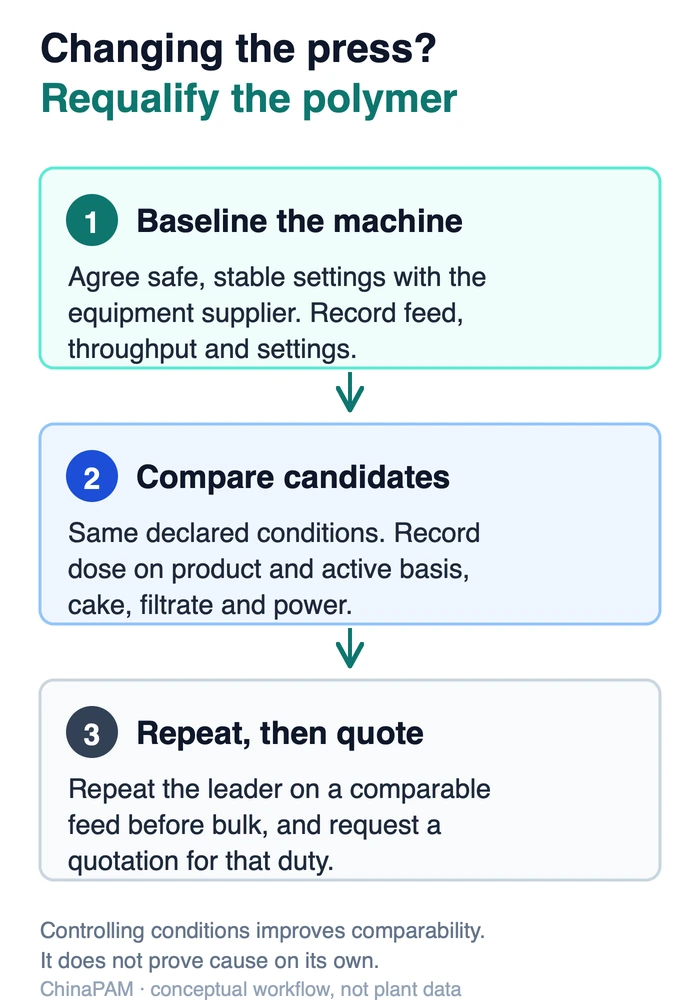
A proposed sequence, not a standard. Holding conditions steady makes two runs more comparable; it does not on its own prove what caused a difference.
Step 1: Agree a baseline with the equipment supplier
This step is a conversation with your press supplier or integrator rather than with us. The aim is a safe, stable operating point on your actual feed, with your current polymer as the reference, recorded well enough that a later comparison has something to be measured against. Worth writing down:
- Feed identity — primary, waste activated, mixed or digested; indigenous versus imported, with proportions if you blend, plus the seasonal or upstream variation you already know about.
- Feed solids and throughput — feed total solids and solids throughput in t DS/h. Volumetric flow alone misleads as soon as feed solids drift.
- Machine configuration — channels in service, feed pressure, rotation speed, restriction-valve setting, polymer injection point and the mixing arrangement ahead of the channel.
- Current grade and dose — full designation including suffix, and dose on both commercial product and active basis.
- Baseline outcome — cake dry solids, filtrate quality, and whatever capture or carry-over measure your works already monitors.
The make-down system belongs in this picture rather than alongside it. US EPA guidance on centrifuge thickening and dewatering notes that a poorly designed polymer system can raise polymer costs and reduce efficiency, that polymer systems need sufficient mixing and aging capacity, and that polymer should be blended with the solids feed under laminar rather than turbulent conditions, because turbulence shears floc and reduces effectiveness ( EPA 832-F-00-053, September 2000). That document is historical and written about centrifuges, so treat it as rationale for why make-down matters, not as rotary-press settings or a current standard. If make-down, aging or injection are wrong, you will measure the make-up system and attribute it to the polymer.
Step 2: Compare candidates under declared conditions
With conditions declared and held as steady as the plant allows, candidates can be compared on the measures that appear in your cost base. One caution on fairness: settings optimised around your current grade may not suit a different chemistry. To give a candidate its best showing, run the like-for-like comparison first, then document a separate optimised run at comparable throughput and report both rather than merging them.
| Measure | Record it as | Easy to get wrong |
|---|---|---|
| Cake dry solids | % DS at comparable solids throughput, with the valve setting noted and the sampling point stated | Compared across runs where throughput or settings moved, so the polymer is credited with a machine change |
| Dose | Both side by side: kg commercial product per t DS and kg active polymer per t DS | One basis quoted for one candidate and the other for the next, which hides the active-content difference between an emulsion and a powder |
| Filtrate / return load | Filtrate solids concentration, and the solids load it returns to the works | Treated as percent capture. Concentration and load are not capture — a balanced capture figure needs compatible feed, cake and filtrate dry-solids rates |
| Power | State which auxiliaries are included: press drive, feed pump, polymer make-up, wash water, ventilation | Taken from the drive motor only, omitting auxiliaries that differ between dewatering routes |
| Disposal cost | Per wet tonne, stating the scope: haulage, gate fee, or both | Two candidates compared on different cost scopes, which can reverse the ranking by itself |
| Operability | Make-down time, solution handling, dose stability as feed drifts | Left out, so a grade that wins on paper turns out to need constant attention |
The capture row is the one most often misread. A drier cake achieved by sending solids back around the works is not an improvement, and filtrate concentration alone cannot tell you that has happened. For closing a proper balance, our guide to centrifuge solids capture versus cake dryness sets out the streams, the declared basis and the arithmetic, so it is not repeated here.
The same EPA fact sheet advises confirming manufacturer design and performance data against other operating installations or through pilot testing, and evaluating equipment on capital and operating costs including polymer, electricity, wash water, ventilation and odour control. One run on one feed state is also one data point, so repeat the leading candidate on a comparable feed before bulk: feed variation, make-down and sampling remain sources of difference even when settings are fixed.
Worksheet: one row per run
A suggested record, not a form we need from you. Its job is to keep a comparison readable months later:
- Run reference, date, and which step it belongs to.
- Feed identity, blend proportions, and anything unusual upstream that day.
- Feed total solids and solids throughput in t DS/h.
- Machine settings: channels in service, feed pressure, rotation speed, restriction-valve setting.
- Polymer identity: full grade with suffix, form, lot number, and the stated active content with its basis.
- Make-down: solution strength, water quality and temperature, aging time, mixing arrangement.
- Dose on both bases, product and active.
- Cake result, with the sampling point and method.
- Filtrate solids and the return load implied.
- Power, stating which auxiliaries are in the figure.
- Disposal cost basis and scope.
- Deviations from the declared conditions, recorded without assigning a cause.
The last line earns its place. An unrecorded deviation is usually the one that unsettles a comparison later, when the person who ran it is no longer available. If you are writing this into a tender rather than an internal trial, our emulsion polymer tender checklist covers how one municipal buyer fixed the rig and published a threshold before bids opened.
Who answers for what
Agreeing this early keeps a disappointing number from becoming a dispute about scope:
- Equipment supplier — machine scope, commissioning and throughput. A cake figure in an equipment proposal is a machine claim under its own stated conditions.
- Polymer supplier — grade identity with full suffix, the stated active basis, the documents available for that grade and batch, and price for the quantity and destination quoted.
- You — the acceptance criteria, the measurement method and the sign-off, since only your works can measure the result.
Where a performance commitment is wanted, it can be written conditionally — tied to a declared feed, throughput, sampling method and agreed acceptance basis. What makes such a clause workable is that those conditions are stated, not that someone is willing to promise a number.
What we can do at this stage
Discuss cationic polyacrylamide options for your new dewatering duty with ChinaPAM. Useful things we can do before you commit: look at your current grade and the duty you are moving to and say which candidates belong in a comparison and why; flag where a powder-to-emulsion change alters make-down and dosing; confirm which forms and documents are available for the grades in question; and quote against the duty, quantity and destination so the commercial picture is visible early. Sample options and available documents we confirm per enquiry rather than promise in advance.
Changing dewatering equipment? Let us look at the polymer side
Send your current grade or the equipment change you are planning. We will come back on which grades belong in your comparison, the dose basis to record, and what we can quote for that duty, quantity and destination.
Quotation based on grade, quantity and destination · info@chinapolyacrylamide.com · WhatsApp +86 187-3759-0940
Frequently asked questions
Will our current polymer work on the new press?
Possibly, and that is worth testing rather than assuming in either direction. The data sheet cannot answer it, because the conditions the floc passes through have changed. Keep the incumbent in the comparison as the reference rather than replacing it on principle: if it holds up, you have avoided a changeover, and if it does not, you will know on which measure and by how much.
How do we set a meaningful cake target for the trial?
Tie it to conditions rather than to a number in isolation. A target is testable when it names the feed it applies to, the solids throughput, the sampling point and method, how many runs count, and what happens to an outlier. Agree the acceptance basis with whoever is making the commitment before the trial runs, and record the achieved result against those same conditions. A figure defined that way can support a conditional performance clause; the same figure quoted without its conditions cannot be tested at all.
How much material do we need for a meaningful comparison?
It follows from your throughput and how long a run you consider representative, so it is a calculation rather than a standard quantity: solids throughput in t DS/h, a working dose assumption in kg active per t DS, and the run duration. Tell us the throughput and run length you have in mind and we will work the quantity through with you, including what an active-content difference means if you are comparing a powder against an emulsion.