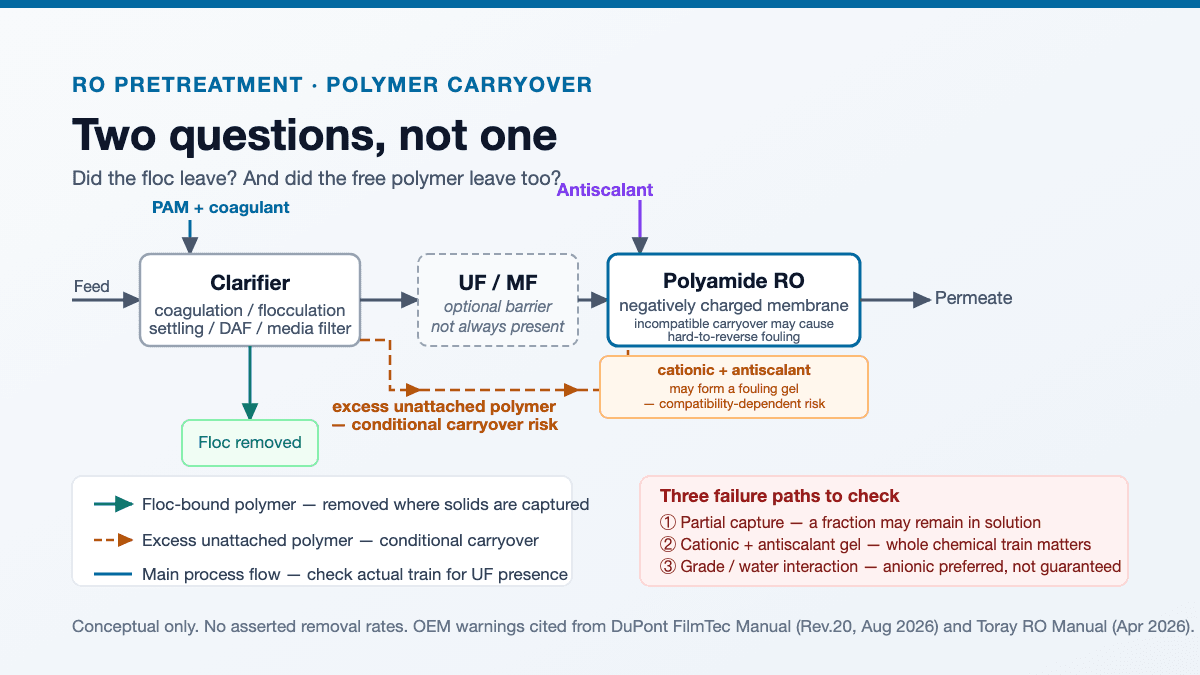
Short answer: polyacrylamide can do useful work upstream of a reverse osmosis train, but a clear clarifier outlet is not the evidence an RO owner needs. Two questions are in play. The separation question asks whether the polymer captured the solids and left with them. The chemistry question asks what happens to any polymer that did not leave: whether it meets a negatively charged antiscalant, and whether it reaches a polyamide membrane. Accept a pretreatment polymer change on evidence for both, agreed with whoever owns the membranes.
Where the polymer actually sits in the train
Before discussing risk, draw the real flowsheet: the dosing point, the separation step that follows it, every filter or membrane barrier between that step and the RO, and where the antiscalant is injected. Sequence is part of the picture, but so are chemical identity, water conditions, dose, and how much polymer the separation step actually captures — these factors operate together, and order of addition alone is not the complete cause of the risks below.
A typical arrangement is coagulant dosed and mixed, PAM dosed as a flocculant, solids separated by settling, flotation or filtration, sometimes an ultrafiltration barrier, then antiscalant injection, then the RO membranes. DuPont’s RO/NF technical manual describes exactly this role for high molecular weight polyacrylamides — strengthening microflocs and bridging colloidal particles so they can be removed — and states that these pretreatment chemicals need to be incorporated into the agglomerates and removed with them, because they can become a source of fouling if they are not. [1] That requirement is the whole topic of this article. “Leaves with the solids” is a separation outcome, and a dose that looked right in a jar does not guarantee it.
Three ways a good-looking clarifier can still deliver a problem
1. Incomplete capture
A portion of the dosed polymer can attach to and be incorporated into flocs that the next separation step removes. A fraction may remain unattached or only partially bound and persist in the water. The size of that residual fraction depends on dose level, mixing conditions, floc characteristics and the separation configuration — it is not a fixed material balance. DuPont notes that channelling in a media filter can let flocs pass through and deposit on the membrane, and that precipitates can form when treated feedwater is concentrated in the RO stage. [1] Toray makes the dose-side point: the optimum dose is set by jar test or another laboratory-scale procedure, and only enough chemical to maximise floc formation should be added, because more is not better. In the aluminium-coagulant and cationic-substance context that guidance addresses, chemical dosed beyond what the available particles can take up has nothing further to attach to, and a portion of it can therefore persist in the treated water. [2]
2. Reaction with the downstream chemical
This is the failure that surprises people. Antiscalants carry a negative charge almost without exception, which puts them chemically at odds with a cationic coagulant or flocculant sharing the same water; DuPont describes that pairing as reactive and reports having found heavily fouled membranes at several RO plants where the product of such a reaction had formed a gel. [1] The possibility of such an interaction exists even when neither chemical has separately shown membrane incompatibility; the outcome depends on the specific combination, the water chemistry and the operating conditions, not on individual product acceptability. DuPont’s compatibility section gives the governing rule: a chemical compatible with the membrane material can still be incompatible with another chemical in the system, so the whole chemical addition system has to be considered together. [3]
3. Grade- and water-dependent interaction
The third path is the least tidy, and it is where honest uncertainty belongs. DuPont distinguishes indirect interference, where a compound forms a precipitate that deposits on the membrane, from direct interference, where the compound itself causes flux loss, and notes that water ionic strength can affect it — a brackish-water result may differ from a seawater one. In that context the manual prefers anionic or nonionic flocculants over cationic ones and warns against overdosing. [1] Toray adds the counterweight: nonionic substances also carry a fouling risk through hydrophobic interaction with the membrane. [2] Charge family narrows the risk without removing it, and it does not replace testing the actual grade in the actual water.
Does an ultrafiltration barrier settle the question?
Not by itself, and the distinction is easy to overclaim in both directions. Toray’s warning on this point is scoped to aluminium coagulants and cationic substances dosed in excess of what the water can bind. Material of that kind, left unattached in solution, falls below the size an MF or UF stage is able to reject, so the manual expects it to carry forward into the RO system, where a negatively charged polyamide surface is a likely place for it to deposit. Removing a deposit of that origin without putting the membrane at risk may prove difficult or impossible. [2]
Read that for what it says: it is a warning scoped to excess unattached cationic material, not a claim that every polyacrylamide grade or charge type passes through a UF barrier without reduction. Polymer carried within floc and free unattached chemical in solution have different fates. A UF stage can contribute to removing floc-associated material where the solids are actually captured, but the presence of that stage does not by itself demonstrate adequate removal of the particular unattached residual fraction — what it achieves depends on the polymer in question, its size distribution in that water, and how the barrier is specified and operated. Controlling the dose so there is little surplus to begin with remains the first line. Aggregate organic measurements do not close the gap either: Toray notes that TOC and COD values do not identify organic composition or establish fouling potential on their own, and that specialist or pilot evidence may be needed. [2]
A hold-or-proceed checklist for a pretreatment polymer change
The table below is our own procurement checklist, built from the manufacturer concerns cited above. It is not a manufacturer-prescribed test standard, and it contains no threshold values — the criteria belong to your project and to the membrane manufacturer’s applicable requirements for your membrane specification.
| Checkpoint | Evidence to request or record | Hold condition and next action |
|---|---|---|
| Chemistry identity | Exact PAM grade, form and charge family; the coagulant and antiscalant actually in use; the membrane specification. | If the incumbent product or a downstream chemical is only known by family, resolve identity before dosing anything new. |
| Dosing point and barriers | The real flowsheet from the PAM injection point through settling, flotation, filtration and any UF stage to the RO, with the antiscalant injection point marked. | If a barrier or capture step is assumed rather than mapped, or the only evidence is a clear-water sample, map the process and sample the actual outlet. |
| Chemical interaction | A compatibility screen of the actual combination, at the real water, dilution and sequence conditions, agreed with the chemical suppliers involved. | Any new precipitate or gel, or an unresolved compatibility question, holds the change. Do not mix concentrates in a drum as an informal test. |
| Pretreatment capture | Feed and post-separation water quality under representative conditions, the fouling indicators your system uses, and a validated residual test if one is required. | A single clarity, turbidity or TOC figure is not sufficient. Add the endpoints relevant to the membrane manufacturer’s feedwater guidance. |
| Controlled comparison | Incumbent or no-polymer reference where appropriate, with feed quality, coagulant dose and solution make-up basis held constant, compared at the true dosing point. | If several variables moved together, the result cannot be attributed to the PAM grade. Repeat with one change at a time. |
| RO trial acceptance | A pilot or evaluation protocol approved by the membrane owner, the recorded operating basis, and normalised permeate flow, salt passage and differential pressure trends. | Exceeding the agreed project or manufacturer criteria, or any unexplained deterioration, holds commercial acceptance pending diagnosis. |
The dossier that gets a change approved
An RO owner is being asked to accept a risk to expensive elements on someone else’s assurance. A dossier answers that properly, and most of it is facts you already hold.
- Identities. The exact grade, form and charge family of the proposed polymer; the coagulant; the antiscalant; the membrane type and specification.
- Dosing points. Where each chemical enters, in what order, at what solution strength, and with what mixing.
- Representative feed. Feed analysis with its range, including the upsets the plant actually sees, not just the design case.
- Existing baseline. Current pretreatment performance and current normalised RO performance before anything changes. Without it, a later trend has nothing to compare against.
- Staged comparison. Bench screening, then pretreatment-only evaluation at the real outlet, then membrane-side evaluation under the protocol the membrane owner approved. Do not jump to full-scale exposure to save a week.
- Normalised trends. Permeate flow, salt passage and differential pressure normalised against the operating basis, with the basis recorded alongside.
- Named acceptance owner. Who may accept the change, against which written criteria, over how many comparable operating periods.
Point 6 is where arguments happen, so it is worth one line. Toray’s manual asks operators to log operating data at defined intervals and to normalise current data against start-up values, noting that permeate flow and quality should stay essentially constant when feed quality and operating parameters are constant, and recommending a graph of normalised data to detect trends early. [4] Without that discipline, an unrelated temperature or recovery change reads as a chemical problem, or a real chemical problem hides inside normal variation.
For method detail, use our jar test procedure guide at the bench stage and the COA, TDS and SDS review guide to check what supplied documents prove. For what each treatment stage must achieve before water is reused, start from our industrial water reuse pretreatment selection guide; this article is the membrane-specific layer above it.
Frequently Asked Questions
Does ultrafiltration guarantee that pretreatment PAM cannot reach the RO?
No, and it is worth being precise about why. The Toray guidance behind this question concerns aluminium coagulants and cationic substances dosed past the point the water can bind them; material of that description, still unattached, is small enough to get through an MF or UF stage and reach a negatively charged polyamide membrane. That is a scoped warning, not a finding that polyacrylamide of any charge type or binding state behaves the same way, and it does not establish how much floc-associated polymer a given barrier retains. Treat the stage as one layer whose contribution depends on your polymer, your feed and how it is operated; control the dose to limit free surplus, and ask what the barrier is specified to achieve for your water.
If I switch from a cationic to an anionic or nonionic grade, is the membrane protected?
It is a sensible starting point for screening, not a conclusion. In its RO pretreatment context, DuPont prefers anionic or nonionic flocculants over cationic ones to minimise both direct interference with the membrane and indirect interference through reaction with downstream chemicals. Cationic polymer reacting with negatively charged antiscalants is one important pathway; DuPont also identifies direct membrane interactions and notes that water ionic strength can affect the outcome, so a brackish-water result may differ from a seawater one. That preference is not an approval of any particular commercial grade. Toray separately identifies a hydrophobic fouling risk for nonionic substances. Charge family narrows the risk without removing it, and it does not replace evaluating the exact grade, the downstream chemicals and the real water together.
Will the membrane manufacturer test my polymer and certify it?
Do not assume so. Toray’s stated policy on chemical compatibility testing is that it does not accept compatibility test inquiries, since this falls outside an RO membrane manufacturer’s scope; it will disclose a recommended test method only as a reference, and the evaluation and conclusions remain the customer’s responsibility. Compatibility also changes with chemical composition and membrane specification. In practice that means the trial protocol is agreed between you, the chemical suppliers and the membrane owner, and the acceptance decision sits with the project — not with a certificate from the membrane manufacturer or from us.
What to send us for an RO-pretreatment shortlist
ChinaPAM supplies named anionic and cationic polyacrylamide grades, plus a nonionic grade, listed in our product catalogue. Which technical and safety documents we can issue for a particular grade, and what batch documentation accompanies a delivered lot, is confirmed for your specific grade and order rather than assumed from the catalogue listing — ask us for the exact grade you intend to screen and we will tell you what we can provide for it. We are comfortable being screened this way: a buyer who asks these questions is easier to supply than one who does not. Send the RO membrane type and specification, the real treatment train with dosing points, a feed analysis with its range, the current PAM, coagulant and antiscalant identities, and your project acceptance criteria. We will propose candidate grades to screen and say what the trial has to show. We will not claim a membrane manufacturer approval, a measured residual figure, a removal percentage or a guaranteed outcome, because none of those can come from a catalogue. Under the OEM guidance cited above, anionic grades may be considered as an initial screen for this pretreatment context, subject to the evaluation route described here; request a quotation with the train description attached.
Sources
- DuPont FilmTec Reverse Osmosis and Nanofiltration Technical Manual (Form 45-D01504-en, Rev. 20, August 2026), sections 2.5.1 and 2.5.4, pages 56 and 60. Covers the role of flocculants in pretreatment, the requirement that pretreatment chemicals be removed with the agglomerates, direct and indirect interference, the reaction between cationic polymers and negatively charged antiscalants, and the stated preference for anionic or nonionic flocculants in this context. The preference is manufacturer guidance for RO pretreatment, not an approval of any commercial product.
- Toray Reverse Osmosis Membrane Element Operation, Maintenance and Handling Manual (06-G-MB1-260430, April 2026), section TMM-800 RO Feed Water Guidelines, pages 83–84, and section TMM-700 Policy for Chemical Compatibility Test, page 81. Covers dose optimisation by jar test, the behaviour of excess unattached cationic substances, nonionic fouling risk, and the limits of aggregate TOC and COD values (TMM-800 §6–7, PDF page 84), and the manufacturer’s compatibility-testing policy (page 81).
- DuPont FilmTec Technical Manual, section 9.11 Testing Chemical Compatibilities, pages 188 and 191. Establishes that compatibility assessment must consider the total chemical addition system, that a membrane-compatible chemical may be incompatible with another process chemical, and that field observations are the most reliable indication of compatibility. The numeric limits in that section’s cleaning-chemical test procedures apply to cleaning chemical compatibility and are not polyacrylamide acceptance criteria.
- Toray RO Handling Manual, section TMM-230 Operation Monitoring, pages 26–28. Covers data logging intervals, normalisation of current performance against start-up values (p27), and graphing normalised data to detect trends early. Follow your own project and manufacturer logging requirements; no universal acceptance percentage is implied here.
- ChinaPAM’s current verified 26-row powder grade catalogue. It is cited here only to establish that named anionic and cationic grades, plus a nonionic grade, exist and can be put forward for screening. The catalogue is not evidence of what documentation accompanies any particular grade or shipment: technical, safety and batch document availability is confirmed for the specific grade and order on request. Suitability for any RO-pretreatment duty depends on the trial and acceptance route described above.