
Settling went off-spec during the backwash return window, so the polymer is the first thing to get blamed and the first thing people want to change. Before you switch grade or place a different order, it is worth separating two things that happened at the same time: the polymer you were dosing, and the pattern in which the spent filter backwash came back. They are not the same variable, and a trial that confuses them tells you very little. If you are weighing a polymer for spent-backwash duty right now, tell us which duty you are trying to cover and what you run today — a grade name or one line about the process is enough to start, and we will come back on what belongs in the comparison and what a quotation covers.
Three different jobs, often quoted as one
Buyers ask for "a polymer for filter backwash" and mean one of several things. Getting the duty right before the enquiry saves a round of mismatched quotations.
The first job is treating the spent backwash itself: dosing a polymer into the backwash stream so solids separate in a holding tank, clarifier or plate settler, and a clearer supernatant comes off the top. The second is a separate downstream check: once the treated return rejoins the raw water, you are looking at how your existing coagulation handles the blended influent — a different question, sitting after the backwash treatment step, and what it shows still depends on the character of the returned stream and how it was treated upstream. The third is handling the residual sludge that collects underneath, which is a thickening and dewatering duty with its own grade logic.
Two further things get mixed in and should not be. Make-down water quality is about preparing polymer solution, not about treating a stream; it is covered separately in how to dissolve polyacrylamide properly. And recycle in a dissolved-air flotation context is a pressurised-water loop, a different mechanism with a different purpose. One enquiry naming one of the three jobs above is far more useful to us than a general request for a backwash polymer.
Same volume, different average flow
Here is the arithmetic that makes the point, with numbers chosen for illustration only. They are not recommended settings and not drawn from any plant.
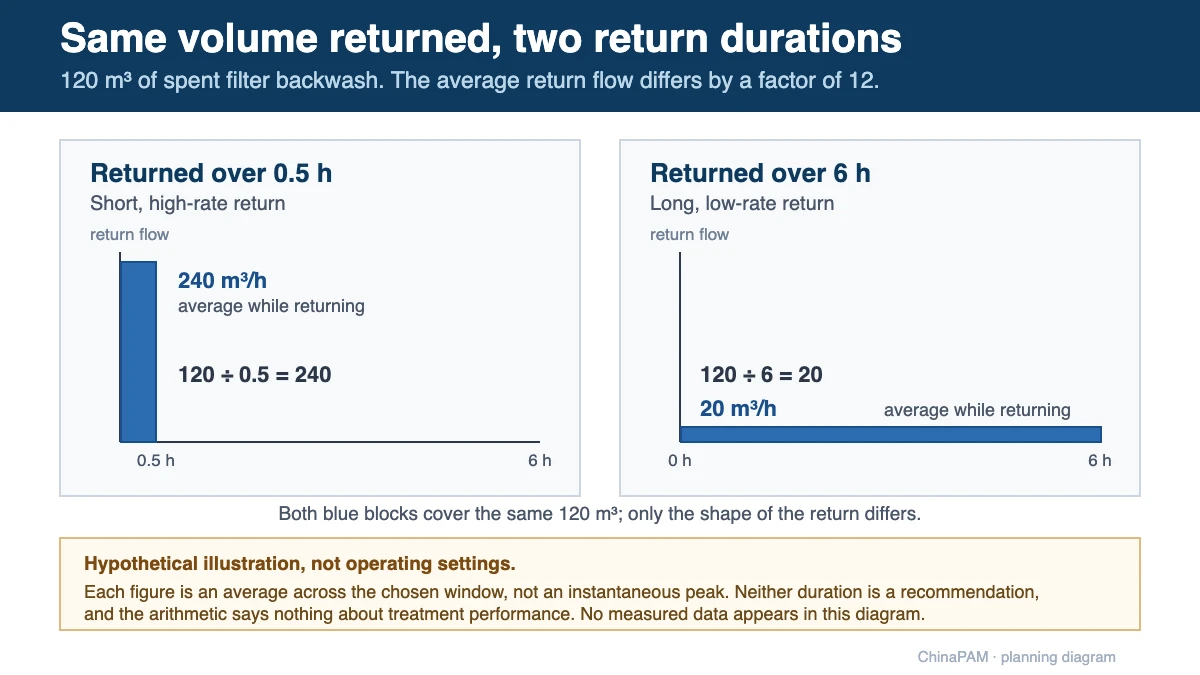
Take 120 m³ of spent backwash going back to the head of the works. Returned over half an hour, the average return flow is 120 ÷ 0.5 = 240 m³/h. Returned over six hours, the same 120 m³ averages 120 ÷ 6 = 20 m³/h. Identical volume, twelve-fold difference in average flow. A monthly total, or even a daily volume figure, cannot distinguish those two cases — and if your trial log records only the volume, neither can you.
Two cautions on reading those figures. Each is an average across the window you chose, so it is not the instantaneous peak; a return that arrives in bursts will exceed its own average. And neither duration is a recommendation here. The point is narrower and more useful: a volume in a report does not tell you what the return flow was doing while your polymer trial was running.
Why that matters for a purchase decision. Published engineering guidance on filter backwash recycle treats a sharp rise in return flow as something to be managed rather than ignored, and describes holding the stream and releasing it at a controlled rate as how plants moderate it. The same guidance says chemical feed decisions during recycle events have to be settled by testing at the particular site, which is why no supplier can hand you a universal grade and dose for this duty (US EPA, FBRR Technical Guidance Manual, December 2002). That is guidance written in 2002 for one regulatory context, not current worldwide law.
Record the event, then the trial means something
A short event record makes the comparison useful when you choose your next order. The list below is our own suggested planning aid for your trial log — not a regulatory protocol, not a validated standard, and not a condition of buying anything from us. Its only purpose is that two polymer runs can be told apart afterwards.
| Record this | Why it changes the reading |
|---|---|
| What is in the stream, and whether anything is blended with it | Spent backwash alone, basin blowdown or thickener decant are different feeds; a blend that changed between runs changes the duty |
| Event start and end times, per filter | Without both, duration is unknown and no average flow can be derived |
| Volume, and how it was obtained | A metered figure and a rate-times-time estimate are different grades of evidence |
| Return start, end and duration, logged separately from the backwash | The return can be delayed or spread out, so the backwash clock is not the return clock |
| The division written out, and whether the return was steady | Makes the average auditable and keeps it distinct from a peak a steady return would not produce |
| Sample point and the clock time of each sample | A shift-wide composite can mask a short event; state the sampling window and location, and match them to the event you are trying to read |
| Polymer in use and the basis of its dose: product or active | Mixed bases make two dose figures incomparable even when both numbers look right |
| The settling endpoint you agreed to judge on, fixed before the run | An endpoint chosen after the fact can be read to favour either product |
Two habits from other trial work carry over here rather than being restated: confirm the feed pump is actually delivering what the dial claims, in timed drawdown pump calibration, and treat a bench or sample result as a step toward a bulk order rather than a verdict, in qualifying a sample before you buy in bulk.
Two comparisons, run separately
Run the polymer comparison separately from the downstream recycle-impact check.
The first is a polymer comparison for treating the spent backwash: candidate products against each other on the same backwash sample, judged on how the solids separate and how clear the supernatant comes off. The second is a recycle-impact check: take the already-treated return, blend it into raw water at the proportions you are considering, and run it under your existing coagulation regime to see what the blended influent does there. Different sample, different question, different thing you are holding constant.
That separation is not something we invented. In 2005 CH2M HILL set out a proposed bench protocol for Northern Kentucky Water District that screened nonionic, cationic and anionic high-molecular-weight polymers for settling spent backwash, then used a separate later jar test on the treated process water made up with raw water and run under the plant's current coagulation regime (appended to a 2007 case filing). It is a proposed design, not a set of results, and in the pilot phase the treated water was planned to go to sewer. We cite the arrangement of the testing, not any number in it.
Before you reorder or switch grade
Pulling it together into something you can act on this week. Four questions, in order.
What actually changed? If the polymer, the return pattern and the raw water all moved between the good week and the bad one, the polymer has not been tested — it has only been accused. What is being held comparable? Same feed, same sample point and window, same dose basis, same agreed endpoint, or the two runs do not speak to each other. What belongs with your own staff? Return rate, equalization and where the stream rejoins the train are plant design and operating decisions. And what is the supplier question, properly narrowed? Which product type suits this separation duty, what the documentation covers, how it is supplied and at what price.
That last one is ours, and it is the one worth sending over. Tell us which of the three jobs you are covering, the polymer type or grade you run now, and anything you have on the stream — what it is, roughly how much comes back and over what period. We will come back on which polyacrylamide types belong in the comparison, what our documentation covers for that duty, and what a quotation looks like. Potable-water projects require grade-specific documentation and acceptance for the intended use under applicable local requirements, so say early if that is where this is going. Send what you have and we will take it from there.
If your interest is the raw-water clarification side rather than the return stream, raw water and drinking-water treatment is the better place to start.
Common questions
Does the speed of the backwash return change what my polymer trial shows?
It changes what the trial is measuring. The same 120 m³ returned over half an hour averages 240 m³/h; over six hours it averages 20 m³/h. If the return pattern differed between your two runs, more than the polymer changed, and the comparison cannot be read as a product verdict.
How much spent backwash can I recycle?
That depends on your plant, your water and the conditions in your own operating consent, so the answer comes from your regulator and your design engineer rather than from a polymer datasheet. What we can discuss is the product side: which polyacrylamide type suits the separation duty you are describing and what our documentation covers.
Can ChinaPAM supply a polymer for spent filter backwash treatment?
Yes — we supply polyacrylamide for solid-liquid separation and sludge dewatering. We can discuss product types, documentation and a quotation for the backwash or residual-sludge duty you describe. Tell us the duty and the grade you use now; one line is enough to begin, and no trial data or technical report is a prerequisite for getting in touch.