
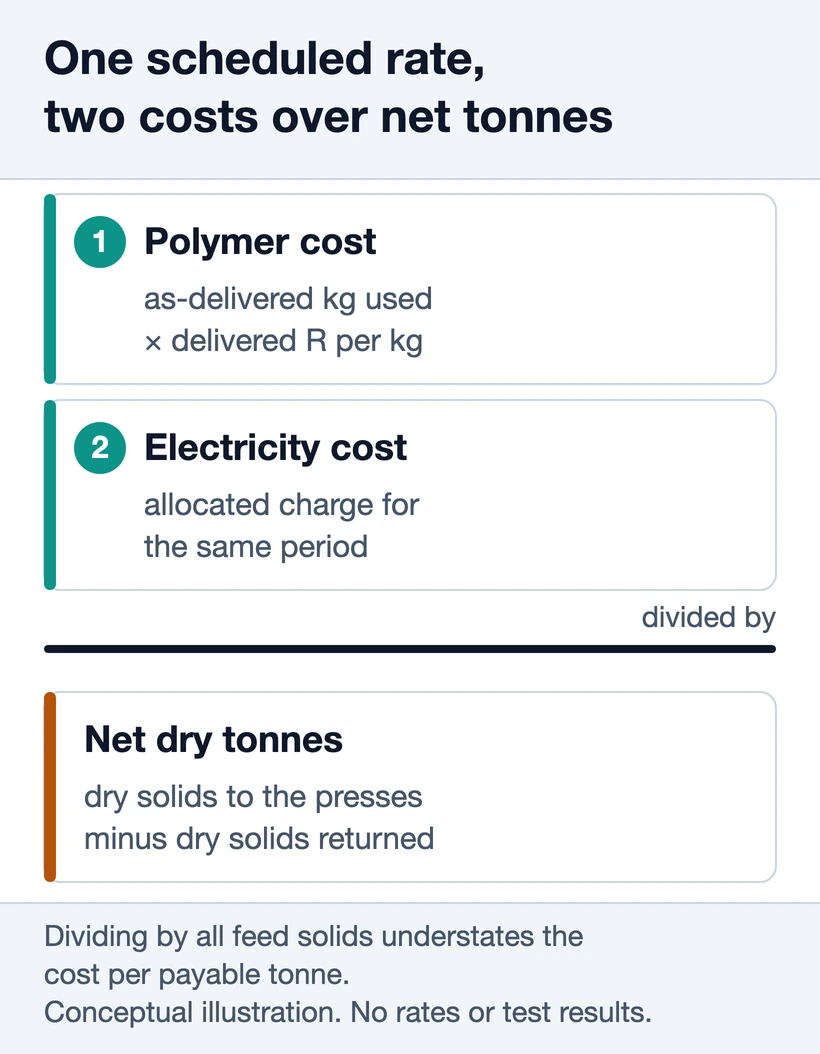
You are pricing a municipal dewatering service, and the schedule wants a rate per dry tonne for polymer and another for electricity. The number you enter decides whether the contract earns or bleeds for years, and the quickest way to get it wrong is to divide real costs by a tonnage you never get paid for. A cheap quote per kilogram and a generous dry-tonne denominator can sit together in the same bid and still leave you short on every payable tonne.
Tell us which sludge stream you are pricing. We will quote delivered polymer on an as-supplied basis you can put straight into the chemical line, and send a sample if you want to test first.
Ask ChinaPAM for a delivered polymer quoteThis worksheet is for the moment before you commit a figure: you have a pricing schedule in front of you, you know roughly what your presses do, and you need the chemical and power lines to be defensible. It is useful whether you are bidding an operations contract or rebuilding an internal cost model. It is not a dosage guide and it does not tell you what to charge.
Read the costing unit before you cost anything
Municipal operations schedules can be more specific than a general cost model expects. A 2026 City of Cape Town procurement for the Zandvliet Wastewater Treatment Works, advertised on 9 October 2026 and published through the National Treasury eTenders portal, asks for polymer and electricity as separate fixed-rate entries, priced in Rand per net tonne of 1 000 kg of sludge dewatered on a dry basis, and then summed (tender 088S/2026/27, pages 44–45 and 162–163).
What matters for your estimate is the shape of it. That document splits the sludge stream by material and by electricity season, so the same plant carries four separate variable rates rather than one blended number:
| Stream | Season | Polymer, R per net dry t | Electricity, R per net dry t | Sum |
|---|---|---|---|---|
| Primary sludge | Low season | |||
| Primary sludge | High season | |||
| Waste activated sludge | Low season | |||
| Waste activated sludge | High season |
Fill this in with your own figures. The cells are deliberately blank: no rate here is published, assumed or implied.
Four entries in total, one for each stream-and-season combination, rather than one blended figure. Primary solids and waste activated sludge can have different conditioning requirements, and the two tariff seasons are billed differently, so a single rate entered four times is unlikely to represent all four. Work each entry with its own polymer figure and its own period of electricity.
Treat that document as one worked purchasing example rather than a national rule. It shows how a large municipal buyer chose to define the unit; another plant can define its boundary differently, and your own schedule governs your bid. Nothing here speaks to the status of that procurement, and the rate cells in it are blank, so no price can be read off it.
Define the denominator the way the contract does
This is where most cost models leak. The unit is not feed solids, not wet cake and not press nameplate capacity. In that Cape Town schedule, “nett” is defined explicitly: the dry solids transferred to the dewatering belt presses, minus the dry solids returned to the reactors through belt washings and similar streams (pages 162–163).
So solids that go round again add no billable tonnage. The polymer and the power they consumed are still real costs, and the only place you can recover them is the rate you quote per net tonne. That makes the return stream the single most valuable number in this worksheet, and the one least likely to be in your spreadsheet already.
Three practical rules keep the denominator honest:
- Align the stream. Primary tonnes belong in the primary rows and WAS tonnes in the WAS rows. A combined dry-solids figure cannot price either row.
- Align the period. The polymer consumed, the electricity charged and the tonnes dewatered must all come from the same window. Mismatched periods produce a rate that describes nothing.
- Align the boundary. Measure at the same points the contract names: solids to the presses, and solids coming back.
If the return stream is not metered, do not quietly treat it as zero. Zero is a claim that nothing comes back, and it inflates your denominator in a way that lands entirely on you. Say what is unknown and pick one of these: establish the returned dry mass over a representative run, read the recycle from your existing mass balance, or agree an allocation method with the client in writing before the rate is fixed. An agreed, stated method beats a confident guess, and it is defensible later.
A concentration on its own will not give you that mass. You need both terms: the representative volume of each returning stream multiplied by its own measured dry-solids concentration, or flow integrated against concentration across the same period. Identify which streams actually return to the reactors at your plant, and count each one once, so a stream is neither missed nor counted twice.
The polymer line: as-delivered mass, delivered price
The chemical figure is one division, and both inputs have to be on the same basis:
Polymer R per net dry t = (as-delivered kg consumed × delivered R per kg) ÷ net dry tonnes
Two disciplines make that arithmetic trustworthy.
Price what arrives, not what leaves the factory. Comparing one supplier’s ex-works price against another’s delivered price ranks the shipping terms, not the polymer. Two quotes can also both say “delivered” and still cover different things. Ask every bidder for the same delivery point and the same as-delivered kilogram basis, and ask each to state which charges are included and which will be added on top: freight, import duty, clearance, packaging, pallets. Then the column is comparable.
Keep product form and active content straight. Powder and emulsion are supplied differently, and the kilogram you buy is not the kilogram of active polymer in it. If your consumption data is recorded as active mass, do not convert it with a guessed fraction: ask for the confirmed mass fraction for that specific grade and convert with that, or stay in as-supplied kilograms on both sides. One kg per tonne of dry solids is the same quantity as one gram per kilogram of dry solids, but as-supplied and active bases are not interchangeable numbers, and mixing them silently moves your rate.
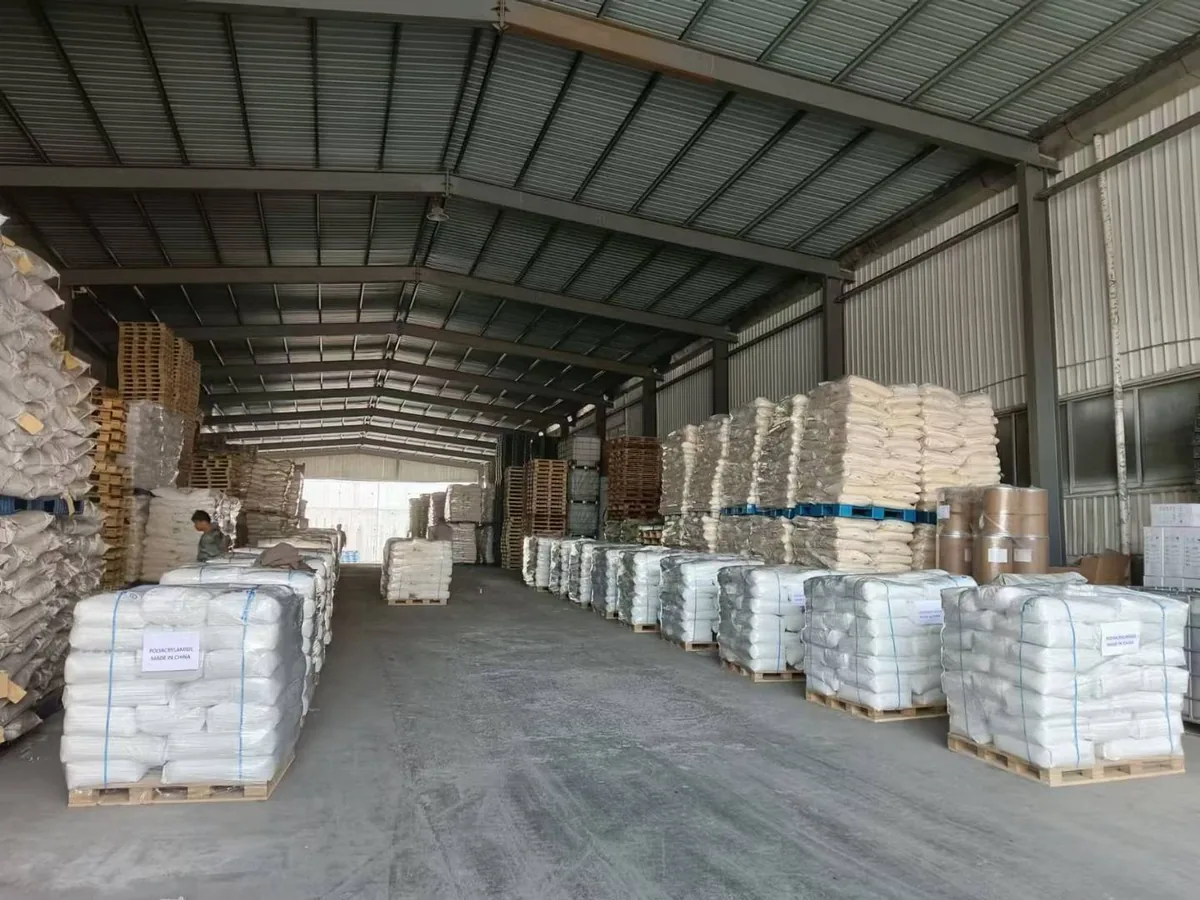
Palletised bags of bulk material. Polymer is bought and invoiced by the kilogram supplied, which is the mass your chemical line should use.
One caution on tools, including ours. Our sludge dewatering polymer cost calculator works from wet volume, feed dry solids and a dose you enter, and returns a chemical cost per tonne of dry solids. That is a useful chemical-side cross-check, and it is deliberately polymer-only. Its denominator is feed dry solids, not the contract’s net payable tonnes, so do not carry its output into the bid unchanged. Use it to sanity-check consumption, then do the division above against net tonnes yourself.
The electricity line: allocate, then divide
The power figure follows the same discipline with a different input. Take the electricity charge properly allocated to that dewatering stream for the same period, and divide it by the same net dry tonnes.
Three things decide whether the allocation holds up:
- Time bands and fixed charges. The Zandvliet schedule describes a tariff with peak, standard and off-peak rates and two seasons, with high-season rates per kWh significantly higher than low season, and its price-adjustment provisions treat the fixed charge and each time-of-use rate separately. If your plant runs presses mostly in one band, an averaged cost per kWh will not represent what you are billed.
- Shared meters. If you share a meter and the figure is apportioned from a works-level bill, write down the apportionment basis and get it agreed. An unstated split is the first thing to be challenged when the invoices start.
- Season alignment. High and low season rows need electricity from their own season. Averaging across the year defeats the reason the schedule has four rows.
Two boundaries worth stating plainly. This sub-schedule sum is the specified variable component: polymer plus electricity, not your whole operating cost. Labour, maintenance, disposal and the rest sit in their own schedule items. And do not build an assumed tariff into the rate. Published tariffs change, the contract carries its own escalation provisions for exactly that reason, and a rate propped up on a guessed cost per kWh is a rate you cannot defend. Use your own billed figures for the period, and read your contract’s adjustment terms rather than reproducing anyone else’s formula.
One worked example, with invented numbers
Every figure below is made up for the arithmetic. They are not our prices, not a tariff, not a bid rate and not a field result. The point is the shape of the calculation and the size of the denominator error.
Take one primary sludge stream over one period, one boundary throughout. Ten dry tonnes go to the presses. One dry tonne returns to the reactors in belt washings. Net payable: 9.0 dry tonnes. Over the same period the line consumed 45 kg of as-delivered polymer at an illustrative R40 per kg, so R1 800 of chemical, and the allocated electricity charge for that same period was an illustrative R900.
| Line | Working | Result |
|---|---|---|
| Net dry tonnes | 10.0 t to presses − 1.0 t returned | 9.0 t |
| Polymer | 45 kg × R40/kg = R1 800, ÷ 9.0 t | R200 per net dry t |
| Electricity | R900 allocated, same period, ÷ 9.0 t | R100 per net dry t |
| Sub-schedule sum | R200 + R100 | R300 per net dry t |
Hypothetical inputs for illustration only. Not a quotation, tariff, dose or measured plant result.
Now make the common mistake. Divide the same R2 700 by the 10.0 tonnes that entered the presses instead of the 9.0 that are billable, and the rate reads R270 rather than R300. The costs did not change. Only the denominator did. In this hypothetical period that is 10% below the figure the same costs support, and nothing in the bid would look wrong.
That is the whole argument for pinning the return stream down before the rate is fixed. How far the gap opens at your plant depends on your own measured returned dry-solids fraction, which is why it is worth measuring rather than assuming.
Get the chemical figure on a basis you can defend
Of the two inputs in the polymer line, you control the consumption data and your supplier controls the price. The part worth sorting before you enter a number is that the price you are given is comparable: delivered to your gate, for a stated product form, quoted per kilogram as supplied.
That is a short conversation, and it is worth having before the rate is locked rather than after. For municipal sludge dewatering our cationic polyacrylamide range is the relevant one, and we will quote a suitable candidate grade on a delivered as-supplied basis, at a stated delivery point, with the product form stated and the included and excluded charges spelled out. Where the active mass fraction for the grade quoted is needed to reconcile your consumption data, ask us for it with the quote. If you would rather test before you cost, ask for a sample.
You do not need a full technical pack to start. Tell us which stream you are pricing, primary or WAS, and we can begin. If you have a current grade, a test sheet or a dose in hand, send it and the quote comes back closer to what you will actually run. Where something is still unknown, we will say so rather than fill it in for you.
Pricing a dewatering bid this month?
Send one line: “Pricing primary sludge dewatering, need a delivered polymer price per kg as supplied.” That is enough. We will come back with a comparable delivered quote, and a sample if you want to test first.
Request a delivered quote or sampleOr read how we approach polyacrylamide for municipal sludge dewatering.
Frequently asked questions
Can I price per wet tonne of cake instead?
Not if the schedule asks for a dry basis. Wet cake tonnage moves with cake solids, so a rate built on it describes a different quantity and converts into a different price. Where the costing unit says net tonne on a dry basis, that is the unit your division has to use.
We do not meter solids returned from belt washings. What do we enter?
Not zero. Establish the returned dry mass over a representative run, taking each returning stream’s volume with its own matching dry-solids concentration, or flow integrated against concentration over the same period. A concentration alone is not enough. Alternatively derive it from your existing mass balance, or agree an allocation method with the client and record it. Any of those is defensible. Assuming nothing returns inflates your denominator and understates every rate you quote.
Why four rates instead of one blended figure?
Because that Cape Town schedule separates primary sludge from waste activated sludge and low season from high season, which gives four entries in total, one per combination. Conditioning requirements can differ between the two materials and the seasons are billed differently, so a single average may misprice part of the year. Your own schedule may be structured differently; price whatever entries it actually asks for.
Can I use your calculator output as the polymer rate?
Not unchanged. It is a polymer-only estimate against feed dry solids, and it excludes freight, duty, labour, equipment and disposal by design. The bid rate needs net payable tonnes as the denominator. Use the calculator to check your consumption arithmetic, then divide by net tonnes for the schedule.
Do you quote the electricity line too?
No. Only you have your billed charges, your time-of-use pattern and your allocation basis for that plant. We quote the delivered polymer price that feeds the chemical line; the power line comes from your own invoices for the matching period.