
Your sludge changed, and now the polymer you have bought for years looks like the problem. Cake comes off wetter, or the dose creeps up to hold the same result. Before you authorise more product or replace the grade, it is worth separating two questions: has the product changed, or has the feed? They lead to different purchases, and a comparison built on old logbook numbers cannot tell them apart.
Tell us what changed on your feed and which grade you run. We will talk through grade direction for the new material and quote the candidates worth comparing.
Talk to ChinaPAM about your feed changeA changed blend is a changed material
Primary and biological solids are not interchangeable feedstocks that happen to arrive in the same pipe. Supplier process literature treats them as distinct sludge types with distinct conditioning consequences, and names sludge origin among the influences on dewaterability (SNF Floerger, Sludge Dewatering, 2003).
That is the mechanism behind the complaint. If the proportion arriving from each source moves, the material presented to your polymer is not the material the grade was selected against. Nothing has to go wrong with the product for the result to move.
The machine side points the same way. An EPA centrifuge fact sheet reports that cake solids for a primary/WAS blend vary with the proportion of each type, with a higher WAS share tending toward the lower end of its range and needing polymer to reach the higher end (EPA 832-F-00-053, 2000).
Read both as direction rather than numbers for your plant. Neither tells you how far your own cake will move, and the blend sits alongside machine settings and conditioning as something a trial has to pin down on site. That is why a feed change is worth a structured comparison rather than a dose increase.
First, write down what actually changed
Most of the diagnostic value here is free, and it makes the trial that follows worth running. Capture the change as an event rather than an impression, because “the sludge got worse” is hard for anyone to act on. None of it has to be complete before you talk to a supplier; it is what makes the comparison interpretable once you run one.
- Which sources are feeding dewatering now, and which were before. If you do not meter the split, record the sources you can observe and say the proportion is unknown. Write down what you see; do not invent a ratio to fill the field.
- Measured feed dry solids per run, not a design figure. That handbook references dosage to a dry solids analysis. A feed number carried over from a datasheet quietly converts into a dose error.
- Holding and timing. It samples just before the polymer injection point and tests promptly, since sludge condition may change over time. If material now sits longer before dewatering, that is a change in its own right.
- Everything upstream that moved in the same window. Thickening, digestion, a new trade discharge, a return stream managed differently. All of it belongs in the log beside the blend.
- Machine and chemistry settings. Throughput, speeds, injection point, make-down concentration, polymer batch and lot. If any of these moved, the polymer must not be credited or blamed for them.
If that log shows several things moved at once, you have not yet isolated a polymer problem. You have a list of candidate causes, and the comparison below is how you narrow it.
Three comparisons, and what each one is worth
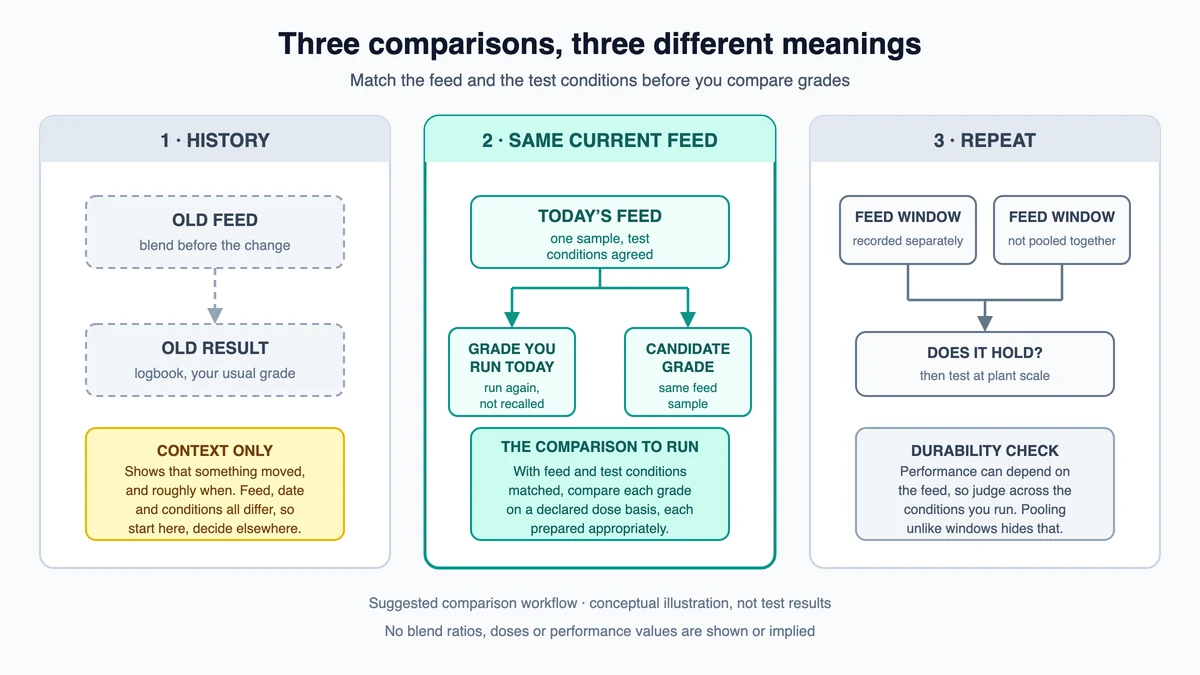
This is the part that decides whether your trial produces an answer or an argument. The three comparisons in the diagram above look similar on a results sheet and mean very different things.
| Comparison | What is being held constant | What it can tell you | What it cannot |
|---|---|---|---|
| Old history vs today | Nothing. Feed, date and test conditions all differ. | That the process result moved, and roughly when. | What is responsible for the move. It cannot rank two grades. |
| Same current feed, incumbent vs candidate | The feed sample and the agreed comparison conditions: test method, endpoint and declared dose basis, with each grade’s preparation recorded. | How the two products, as prepared and dosed on your declared basis, compare on the material you have now. | Whether that ordering holds on a different feed window, or at plant scale. |
| Repeat across feed windows | The products and the comparison conditions, across separately recorded feed windows. | Whether the result holds across the conditions you actually run, or belonged to one window. | Full-scale behaviour, which only a plant trial under recorded conditions can show. |
The trap is comparing last quarter’s logbook result for your usual grade against a candidate run on this week’s feed. Product, feed and conditions all changed between those two numbers, so whatever difference appears cannot be assigned to any one of them. Keep the history: it is good evidence that something moved, and it tells you when to look. Just do not use it as the control.
The control is your own grade, run again, now, on the same feed sample as the candidate. Re-running the incumbent feels redundant and is the single step that makes the rest interpretable. Match and record the comparison conditions across the pairing: the same feed sample, test method, endpoint and declared dose basis. Each grade is prepared appropriately for what it is, and those differences in preparation are documented, so what you are comparing is each tested grade together with its preparation under the declared basis.
One discipline on the dose column: state what the number refers to. Product as supplied and active polymer content are different bases, and dry solids of the feed is a third quantity. Mixing them silently produces comparisons that cannot be reproduced. We have set out that arithmetic separately in our dosage calculation guide; the point here is only that the basis is declared and kept the same down the column.
Sampling, so the comparison means anything
A controlled comparison on an unrepresentative sample is still a wasted trial. Hold the sampling points from your change log steady across every run in the comparison: that consistency, not the paperwork, is what makes one run readable against the next.
None of this asks you to interfere with your process. You are sampling the blend as it currently arrives, not adjusting the blend to suit a trial. Deliberately changing what feeds dewatering in order to test a polymer is an operations decision with its own consequences, and it is not what this workflow asks for.
Laboratory workspace with glassware and testing equipment.
Reading the outcome without overclaiming
Once you have the incumbent and the candidate on the same current feed, across representative feed windows recorded separately, the result tends to fall into one of a few patterns. Each points somewhere different, and the conclusion stays conditional on the feed and conditions you tested.
| What you observe | Reasonable reading | Sensible next step |
|---|---|---|
| Both grades are worse than your historical result, and close to each other | A change shared by both runs, in the feed, upstream process or preparation, is one explanation worth checking. This comparison does not identify the dominant cause, and it does not rule out other grades being better suited. | Check upstream and machine conditions; discuss whether a different chemistry direction suits the new material before buying more of anything. |
| Candidate is clearly better across the windows tested, incumbent run alongside it | A difference between the two tested grades, as prepared and dosed, on your current feed at bench scale. | Take it to a plant trial on your own equipment before committing to bulk. |
| Candidate wins on one window but not another | Performance here can depend on the feed, so the advantage may be specific to those conditions rather than general. | Keep the windows separate, add runs, and weigh the result across the operating conditions you need it to work in, not one window alone. |
| Incumbent holds up once the dose basis is corrected | Part of the apparent decline may be a dose-basis or feed-strength artefact rather than a product failure. | Correct the dosing reference and recheck before changing supplier. |
Two cautions on pooling. If feed windows are substantially different, averaging them produces a number that describes neither, and it can bury exactly the sensitivity you were trying to detect. And keep the final step in view: in the same handbook, an industrial trial confirms a laboratory selection, run with effluent quality and flow as typical as possible. A bench result is a shortlist, not a purchase decision.
Where your dewatering equipment has two product outlets, a wetter or drier cake is also only half the result. We work through reading cake dryness alongside solids loss in our centrifuge solids capture guide. And when a candidate does win and you move to an order, the step that keeps the tested material connected to the delivered material is covered in our sample-to-bulk qualification guide.
Bring the change to us before you pick the next grade
If your feed has moved, the useful conversation is not “send a stronger polymer”. It is which chemistry direction suits the material you now have, and what a comparison on your own feed should hold constant. We supply cationic, anionic and non-ionic polyacrylamide, and we are glad to work through grade direction against your changed feed and your equipment, then quote the grades worth putting in a trial.
Start with whatever you have. The grade you run today and a description of what changed is enough to open a useful conversation; measurements can follow, and where something is still unknown we will say so and suggest how to pin it down. Expect a grade direction, candidate grades and a quotation you can act on.
Changed feed, unexpected polymer behaviour?
Describe the change and the grade you run today. We will talk through grade direction for the new feed and quote the candidates worth comparing.
Contact ChinaPAMOr browse our cationic polyacrylamide range for sludge dewatering grades.
Frequently asked questions
Can I just raise the dose until the cake comes back?
Sometimes a dosing correction is genuinely what is needed, particularly if your dose reference is out of date. Any adjustment belongs inside your own approved dose and operating plan, and we are not setting a dosage here. The reason to compare first is that an increase applied blind cannot distinguish a dosing artefact from a feed change or a product mismatch, so you may end up buying more of something that is no longer the right fit. Measured feed and a declared dose basis are what make the comparison readable.
We do not know our primary and WAS split. Can we still do this?
Yes. The comparison needs the feed as it currently arrives, not a known ratio. Note the sources you can observe and mark the split as unknown. An honest unknown is usable; an invented percentage is not, and it will mislead whoever reads the trial later.
Does a changed blend mean we need a different polymer?
Not automatically. It means the grade was selected against material that no longer arrives, so the selection is worth rechecking. The sources cited above are directional and neither settles it for your plant. Whether your specific grade still suits your specific feed is decided by the comparison, not by either document.
How many feed windows should we test?
Enough to represent the conditions you need the polymer to work in. There is no universal number of windows, runs or hours, and we are not going to invent one for your plant. The practical test is whether the result holds on representative current feed; if windows disagree, that is itself a finding worth acting on. A plant trial then shows how a shortlisted grade behaves under its own recorded conditions, which is more than a bench result can offer, though it speaks for those conditions rather than settling the question for good.