
Could reclaimed water lower your polymer make-down water bill? Test the switch against your current supply before committing to a bulk order. The buyer's question is narrower than "will it work": how do I find out, on my own water and my own process, before I commit to a bulk order? This guide sets out a comparison that answers that question on its own terms, the water characteristics worth putting on the list, and how far a bench result can be pushed. If you are weighing a reclaimed source now, tell us your process and the water you want to use and we will talk through which polyacrylamide types belong in the comparison and what a quotation looks like. A grade name or a sentence about your process is enough to start; no complete water analysis needed.
Make-down water and process feed are separate questions
Worth separating these at the outset. The water you use to wet and dissolve polymer has one job: let the chains open up fully so the product can do its work downstream. The stream you are treating has a different one. A reclaimed source can be a sound choice for one and not the other, in either direction, so a decision about treating reclaimed water does not carry over to preparing polymer in it.
This also means a general clarity or turbidity figure does not settle the make-down question, and neither does the name of the stream. RO reject, filter backwash, treated effluent and cooling blowdown each describe where water came from rather than what is in it on the day you use it. The useful move is to compare your two candidate waters directly, with your own proven supply as the yardstick.
What to put on the list
You do not need a full characterisation to start. You do need a short list of plausible suspects so the checks have a direction.
Published work on flocculant dissolution is specific about several. A high level of dissolved solids, or certain bivalent ions, can work against dissolution and lengthen the time it needs. Suspended solids arriving with the make-up water are flocculated inside the preparation tank itself, where they create skins and can block pumps or pipes. Residual oxidiser and some divalent metal ions can lead to free-radical formation that degrades polymer chains. That work covers powder flocculant in mining tailings service (Bonnier et al., Paste 2025).
An activation-equipment manufacturer's polymer FAQ reaches a similar list from the operating side, answering plainly that dilution water quality matters and naming hardness, chlorine residual, solids concentration and temperature as characteristics that can all affect activation. It flags particulates in dilution water as a cause of plugged solenoid valve pilots and gauges, and its instruction on mixing is to match the initial wetting step and the handling that follows to the product and the equipment in use (Cleanwater1 polymer FAQs).
Two practical consequences for your own list. First, the characteristics that matter are not the ones you can see, so get hardness and any disinfection residual as numbers for both waters from your own lab or your utility. Second, confirm the water acceptance and activation requirements for the specific grade you intend to buy with whoever supplies it, since those sit with the product rather than with general guidance.
That gives you something to watch for in each case, and a next step when you see it. The mechanisms behind the first column are the ones cited above; what follows is how we would act on each.
| On the list | What you would notice | Next check |
|---|---|---|
| Dissolved solids, divalent ions | Solution slower to come up; material still undissolved at your usual transfer time | Compare preparation behaviour in both waters at the same strength and age before touching dose |
| Suspended solids | Film or deposit in the tank, falling transfer rates, small instrument lines fouling | Check what filtration sits ahead of the make-down skid; inspect the tank after a few batches |
| Oxidiser residual | Solution that looks correctly made but underperforms, or thins while standing | Establish whether the reclaimed line carries a residual, and whether it moves by shift or season |
| Hardness | Preparation behaving differently from your reference water at the same settings | Get the figure for both sources and send us the two values with your grade |
| Temperature | Different temperatures in the two supplies; changes by season or shift | Log make-down temperature for both waters on the day you compare, not from memory |
| How much the source moves | A result you cannot reproduce later with nothing apparently changed | Sample the proposed source more than once, under different upstream conditions |
Deliberately no limit values here. Published figures sit with a particular product family, equipment set and duty, so the number that governs your purchase is the one your grade's supplier will confirm for that grade. Your own reference water is the more useful yardstick anyway, because your polymer is already proven in it.
A comparison you can still read afterwards
Here is the design we suggest. The priority is to keep the water question separable from everything else, because a trial that moves two variables at once leaves you deciding on judgement rather than on your own data.
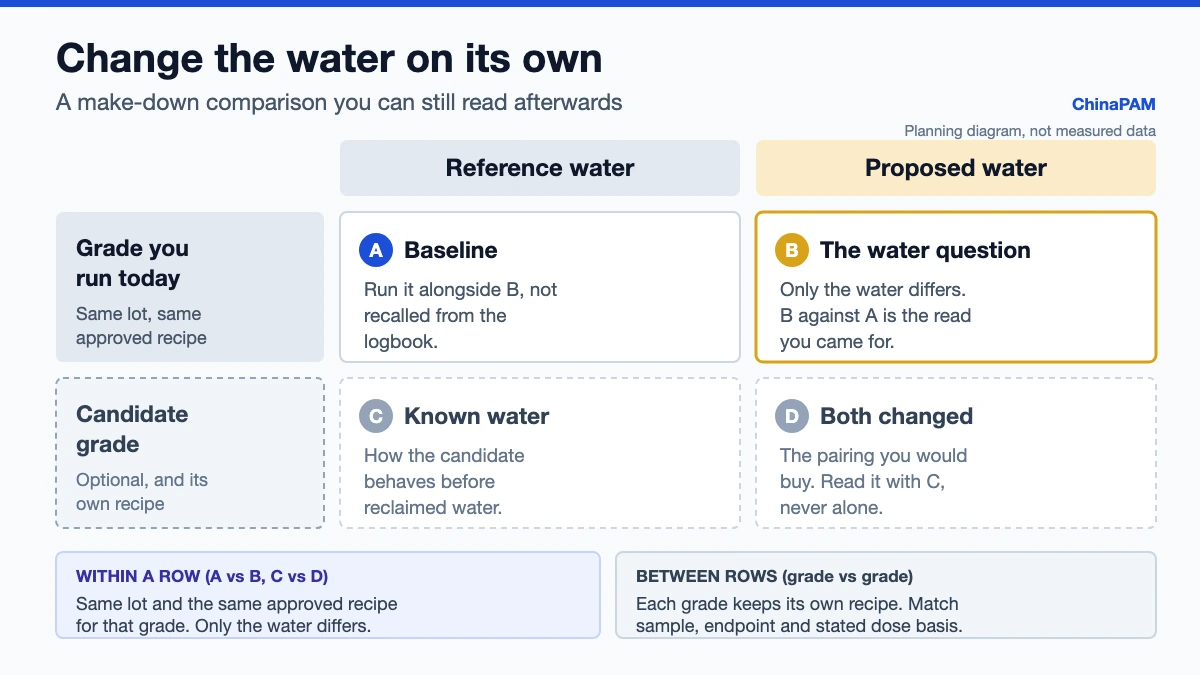
Start with two cells. Take the polymer lot you run today — the same bag or drum, not a fresh delivery — and prepare it twice to its own approved recipe: once in the water your plant already uses successfully, once in the reclaimed water you are proposing. Run both against the same process sample to the same test endpoint. That is cell A and cell B, and B read against A is the comparison you came for.
If you also want to screen a different grade, give it its own row rather than folding it into those two cells. Run the candidate in both waters as well, which gives you the full four. That tells you something two cells cannot: whether a candidate looks better in general, or specifically in the proposed water. Those lead to different purchasing decisions.
Within a row, and between rows
This distinction keeps the water comparison separate from the grade comparison.
Within a row — A against B, or C against D — hold the product and its preparation fixed. Same lot, same weighed mass, same solution strength, same age at use, same mixing and the same wetting method, all to that grade's own approved recipe. Only the water differs. This is where a weighed-mass match belongs, because you are preparing one product twice.
Between rows — your incumbent against a candidate — each grade keeps its own recipe. Powder, emulsion and solution products have different approved activation routines, and a dry powder and an emulsion do not share a wetting method, a mixing energy or a standing time. Forcing one recipe across both forms can disadvantage a product whose preparation requirements differ. So take each grade's preparation from its own supplier instructions and your equipment documentation, record the recipe you used for each, and keep three other things matched instead: the same process sample, the same test endpoint, and a dose basis you state explicitly for both. Because products differ in active fraction, equal weighed mass is not equal dose between rows — name the basis, active polymer or as-supplied, and convert before you compare.
Beyond that, hold the handling steady: same settling or filtration routine, same timing, same operator, same glassware. Our guide to dissolving polyacrylamide correctly covers the preparation steps themselves; here the requirement is that each grade gets its proper recipe and that you apply it the same way in both waters.
Two further notes. Run cell A alongside B rather than quoting a figure from the logbook, so both sides of the water comparison come from the same day and the same feed. And if you measure solution viscosity, report it with its conditions and read it as one indicator rather than a verdict — see what a viscosity specification actually needs. It tells you about the solution, not about how the stream will separate.
What to do with each outcome
Read the result as a decision about where to look next, and repeat the pair before you act on either outcome — a single run of a reclaimed source tells you about that sample of it.
| What you see | Where to look first | What to do |
|---|---|---|
| B below A, same grade and recipe | The proposed water and how the polymer is prepared in it — the question you set out to answer | Repeat the pair to confirm, then work through your list for that water and review preparation and pre-filtration before concluding you need a different product |
| A and B both below what you expect | Dose, feed point, preparation routine or a changed process stream. Note that this pattern does not rule out a water contribution as well — it means the baseline is not currently a reliable reference | Restore a baseline you trust first, then re-run the water pair against it |
| B comparable to A | Encouraging for that sample of the proposed water under those conditions | Repeat with samples taken under different upstream conditions before planning a changeover |
| Candidate ahead in both waters | A shortlist result, separate from the water question — check your dose basis conversion before reading it as a product difference | Take it into a plant trial on your own equipment |
| Candidate ahead only in the proposed water | A possible fit between that grade and that water, worth pursuing on its own merits | Confirm with repeats, then trial it on the water you actually intend to run |
Keep the strength of the claim proportionate. A bench difference tells you where to investigate; it is a screening signal rather than a demonstrated cause, since a jar is not your tank, your shear, your residence time or your dewatering equipment. Two products landing close on the bench means they were close under one set of conditions on one sample, which is useful for shortlisting and is not an equivalence between them.
Treat the exercise as what earns a plant trial, and run that trial before a bulk changeover. Our sample-to-bulk qualification guide sets out the gates from first jar to released bulk batch, including what to retain and record.
One boundary, since the topics get conflated: this article is about preparing polymer in reclaimed water. Treating reclaimed water so it can be reused downstream is a different job with its own selection logic, covered in choosing PAM for industrial water reuse pretreatment.
Costing it properly
The business case is water cost, and it is a real one. It just needs both sides of the ledger, compared at the same treatment duty. If the reclaimed version leaves you with wetter cake or more carryover, the cost has moved rather than disappeared, and it will not show up on the chemical invoice.
Line the two options up only once both are meeting the same outcome, then count:
- Water cost avoided — your delivered cost for the clean supply being displaced, at the volume make-down genuinely consumes.
- Polymer consumption, on one basis named explicitly, active or as-supplied, converted consistently if you are comparing product forms.
- Conditioning needed to make the reclaimed line usable: filtration ahead of the skid, temperature correction, storage, plus the labour and power behind them.
- Cleaning and maintenance, if solids in the make-up water mean more tank cleaning, strainer changes or instrument work.
- Throughput, capture and cake dryness where your process has them, priced as whatever they cost you in disposal, haulage or lost capacity.
The percentage this comes to depends on your water tariff, your duty and your equipment, which is why the useful thing we can offer is help setting the comparison up so the number you calculate holds together for whoever signs the order.
Where we come in
We supply polyacrylamide, and a short conversation before the trial usually beats one after it. Send us your process and the water source you are considering.
Useful to mention, in whatever detail you have: what you are treating, whether you are on powder or emulsion, the grade or type you run now, and roughly what the proposed water is. Hardness or a disinfection residual figure sharpens the discussion if you have them.
What comes back: a view on which polyacrylamide types belong in your comparison, the characteristics of your specific water we would look at first, and a quotation for the grades worth putting in the trial. If your incumbent is the right product and the issue sits in preparation, we will say so.
Common questions
Can I use reclaimed water to make up polymer?
It can be workable; suitability depends on that source, your product and your make-down equipment, so confirm it with the comparison below. Hardness, oxidiser residual, suspended solids and temperature are the characteristics to put on the list, and the acceptance requirements for your specific grade are the ones to confirm with its supplier. The practical route is the matched comparison above: your current lot on its own recipe in your proven water, against the same lot on the same recipe in the proposed water. That answers the question for your plant rather than in general.
Our reclaimed water looks clear. Is that enough?
Appearance does not cover dissolved ions, a disinfection residual carried over from upstream, or fine solids below the point where water turns cloudy. Clear water is a reasonable starting condition rather than a qualification, so run the comparison.
Should I change polymer grade at the same time as the water?
Not inside the same pair of cells. If both change together, the result cannot be attributed to either. Give the candidate its own row instead: run it in both waters, on its own approved recipe, alongside your incumbent in both waters on its recipe, with the process sample, test endpoint and stated dose basis matched across all four. Four cells, one readable answer.
What do I need ready before contacting you?
Less than you might think. A description of your process and the water source you are considering is enough to start — a grade name, or just "we dewater municipal sludge and want to stop using potable water for make-down". Hardness figures, a residual reading or your current consumption make it sharper, and none of them are a prerequisite. Start with what you have.