Auditing a polyacrylamide supplier is not a factory tour. It is six evidence chains you either close or leave open: the legal entity that will sign your contract, the site that will actually make the product, the production scope for your product form, the certificates with their issuer and their stated scope, the sample lot traced back to a release document, and the capacity and packaging evidence tied to your specific order rather than to a headline number. This checklist gives you the questions, the document each question should produce, and a pass/hold/fail scorecard you can run before you release a purchase order.

Site overview of the Henan Jinghua manufacturing location behind the ChinaPAM brand. A site photograph is an orientation aid, not audit evidence — the documents described below are what close an audit finding.
Who this checklist is for, and what it decides
Use this if you are qualifying a polyacrylamide supplier you have not bought from before, re-qualifying one after a quality incident, or building the supplier-approval file your own quality system will be audited against. It is written for the person who has to put a name on an approved-vendor list and defend that decision later.
The checklist answers one question: can every claim in the offer be tied to a document that names the right entity, the right site, the right product and the right date? It does not rank suppliers, and it does not replace technical trials. Identity and document evidence tell you whether a supplier is real, traceable and accountable. Only a jar test and a plant trial on your own feed tell you whether a grade works. Running the audit first stops you from spending a full qualification cycle trialling material from a supplier who cannot ship it compliantly.
The structure follows standard procurement-control logic rather than anything invented for this page. ISO 9001 auditing guidance for external providers expects an organisation to keep a list of approved providers, to place orders only with providers satisfying defined criteria, to monitor provider performance, and to carry out the activities necessary for ensuring that specified requirements have been met. It also expects the depth of control to be set by the degree of risk associated with the purchased item. That is the backbone of this checklist: defined criteria up front, evidence that requirements are met, and a depth of checking proportional to what failure would cost you.
Set the risk level before you start, because it decides how deep to go. A small bench-trial quantity for an initial bench programme is a low-risk purchase where document review is usually enough. A polymer feeding a municipal sludge line under a discharge consent, or a mine thickener where an upset costs a shift of production, is high-risk: there you want lot-level traceability and an order-specific delivery commitment in writing, not a general capability statement.
1. Legal entity and factory address
Start here, because every later document is only as good as the entity it names. Three names can legitimately differ in a China PAM transaction and you need all three on the table: the export brand or trading name you found in search, the registered legal entity that will sign the contract and issue the invoice, and the manufacturing site where the product is made.
Ask for them explicitly and in writing:
- Full registered legal name in the local language plus its English rendering, and the business licence showing it. On our side, the brand is ChinaPAM (also written CNPAM) and the registered entity is Henan Jinghua New Material Technology Co., Ltd. — the current business licence is published on our certifications and compliance page rather than described in words.
- Unified social credit code or equivalent registration number, so the entity can be looked up independently rather than taken on trust.
- Registered address and manufacturing address. These are frequently different and that is normal; what matters is that both are disclosed and that the manufacturing address is the one your product documents will reference.
- Relationship between brand and factory. If the seller is a trading company, ask it to state that plainly and name the producing plant. A trading company is a legitimate counterparty; an undisclosed one is a traceability gap, because you cannot audit a factory whose identity you do not have.
- Export entitlement. Confirm which entity holds the export right and will appear on the shipping documents, since that name must match your import paperwork.
The failure this prevents is mundane and expensive: you qualify a supplier under one name, the proforma invoice arrives under a second name, the certificate of origin shows a third, and your customs broker or your own quality auditor stops the file. Resolve name mismatches before the first order, not at the port.
2. Production scope and product form
“We manufacture polyacrylamide” is not a scope statement. Polyacrylamide is a family, and the lines that make each member are different pieces of equipment. A plant with a dry powder line cannot make an emulsion product without an emulsion line, no matter how much powder capacity it has.
Pin the scope down on four axes before you accept a quotation:
- Ionic family. Anionic (APAM), cationic (CPAM), nonionic (NPAM) or hydrolysed PHPA for oilfield duty. Ask which families are made in-house at the named site and which, if any, are sourced. A supplier who makes three families and buys in the fourth is not disqualified — but you need to know, because the fourth one has a different traceability chain.
- Product form. Dry powder, emulsion or solution. This is the axis buyers most often leave implicit, and it determines your dissolution equipment, your storage, your freight cost per kilogram of active polymer and your document set.
- Grade range within the family. Molecular weight band and charge density band, since “cationic powder” spans a very wide range of products with different duties. Our own range and the bands it covers are set out on the polyacrylamide product page.
- Packaging formats actually run on the line. 25 kg bags, bulk bags, drums or IBCs for liquids, and whether OEM or neutral labelling is available. A packaging format that exists “on request” is a different lead time from one that runs routinely.
Then ask the question that separates a scope claim from a scope fact: which line, at which site, would make my grade in my form? A supplier with a real answer will name the production route without hesitation. A supplier who only restates the catalogue is telling you the capability sits somewhere other than where you were told.
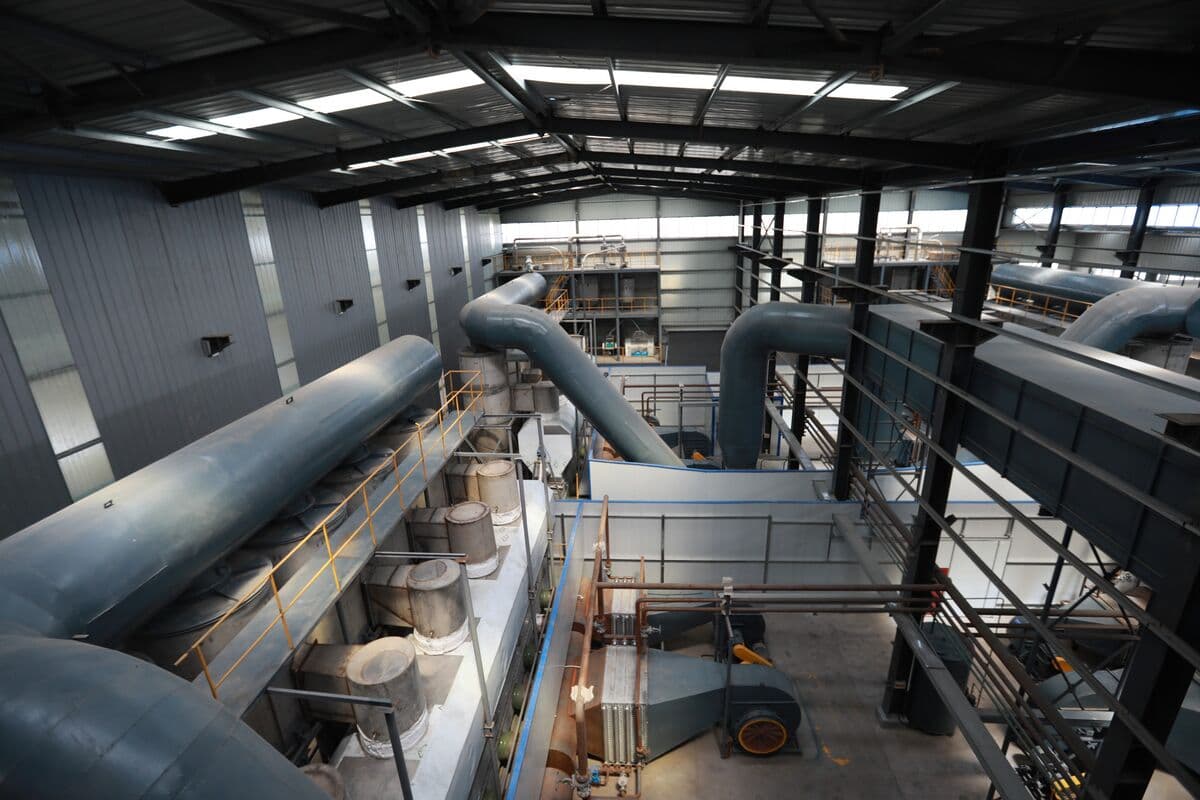
Production hall at the Henan Jinghua site. A scope review asks which line runs your ionic family and product form — not how large the building is.
3. Certificate issuer, scope and validity
This is where most desk audits go wrong, and the error is almost always the same: treating a certificate image as a yes/no credential instead of reading what it actually covers.
Two structural facts make the difference. First, ISO does not certify companies. ISO develops and publishes the standards; certification against them is performed by independent certification bodies. So “ISO certified” is never a complete statement — the meaningful version names the standard, the certification body, the certificate number and the validity period. Second, a conformity attestation is designed to identify a defined set of things: what object was assessed, against which specified requirements, by what method or evidence, with what result, issued by whom and on what date. If any of those are missing from the document in front of you, the document cannot be tied to your purchase.
So read every certificate against five fields:
- Legal entity named on the certificate. It must be the entity you are contracting with, or the relationship must be explained. A certificate for a parent, affiliate or former name is not automatically your supplier’s certificate.
- Site or sites covered. A multi-site group can hold a certificate that covers one plant and not another.
- Scope of activity. A quality-management certificate covers activities — production of specified product types at specified sites — and a product approval covers named products. Neither one silently extends to everything in the catalogue.
- Certificate number and issuing body, so you can verify directly with that body rather than relying on the PDF you were sent.
- Current validity. Check the expiry date, and for a management-system certificate remember that surveillance audits can suspend or withdraw it between issue and expiry.
A worked example from our own file, so the scope point is concrete rather than abstract. Our drinking-water hygiene safety approval, number (豫)卫水字(2024)第0053号, carries validity to 2028-08-11 — and it applies only to the Shuangnuo-brand anionic polyacrylamide listed in that approval. It does not cover our cationic grades, and we state that limit on the certificate card itself rather than letting the approval be read as site-wide. That is exactly the reading you should apply to any supplier’s product approval, including ours: the scope line is the claim, not the logo.
Our management-system certificates are published the same way, with issuer reference numbers and validity dates visible — ISO 9001 under ZBF25Q0620R1S, ISO 14001 under ZBF25E0465R1S and ISO 45001 under ZBF25S0432R1S, all valid to 2029-01-08. Open the originals on the certifications page and check those fields yourself; that is what the page is for. If any supplier, us included, sends you a certificate image with the number or the scope cropped out, ask for the complete document before you record a pass.
4. Sample and batch traceability
A sample is only useful as audit evidence if you can tie it back to a production lot and forward to the material you eventually receive. An unlabelled bag of white powder proves nothing, and it is the single most common weak link in a PAM qualification file.
Require four things with every sample:
- Lot or batch number on the sample packaging, not just on the covering email.
- A certificate of analysis for that specific lot, with the lot number printed on it. A COA that carries only a grade name and typical values is a datasheet in disguise.
- Production date, so you can judge the sample against the shelf-life position of material you would actually receive. Storage history changes behaviour; our shelf life and storage guide covers what degrades and how it shows up.
- A statement of whether the sample came from routine production or was made specially. This matters more than it sounds. A hand-prepared sample can outperform routine output, and if the trial result was obtained on a special batch, your plant will not reproduce it.
Then test the chain in both directions. Backwards: ask the supplier to show which production record the sample lot came from. Forwards: ask what the lot number on your first commercial delivery will look like and whether its COA will carry the same tested parameters as the sample COA. If the sample COA lists five parameters and the delivery COA lists two, you have lost the ability to compare them, and that is a finding to resolve now rather than after the container lands.
One more practical point. Keep a retained portion of every sample you test, stored in a sealed container with the lot number and your own test date. If a commercial batch later underperforms, a retained reference sample is the difference between a documented claim and an argument.
5. Laboratory capability and release documents
Behind every COA is a laboratory and a release decision. Both are auditable without visiting the plant.

Quality-control laboratory at the Henan Jinghua site. The audit question is which parameters are tested in-house, by which method, and who signs the release.
Ask for the test method behind each released parameter, because the method changes the number. For polyacrylamide the parameters that matter most to a buyer are solid content or moisture, degree of hydrolysis or charge density depending on family, molecular weight or its practical proxy, residual free monomer, insolubles, particle size distribution for powders, and dissolution time. Of these, three deserve specific attention during an audit:
- Viscosity or molecular weight. A viscosity figure is meaningless without concentration, solvent or brine composition, temperature, spindle or geometry and shear rate. If a COA states a viscosity with no conditions, you cannot reproduce or dispute it. Our viscosity guide sets out the five conditions a usable viscosity spec needs.
- Residual free monomer. Ask whether it is tested per lot or periodically, and by what method. For any regulated or food-contact-adjacent duty this moves from nice-to-have to mandatory, and periodic testing is not the same evidence as lot testing.
- Insolubles and dissolution behaviour. These predict the operational problems that actually generate complaints — blocked screens, fish-eyes, gel lumps on the make-up system. The mechanism and the handling errors that cause it are covered in our guide on why PAM lumps.
Then ask the release questions, which are about control rather than equipment: who authorises release of a batch, what happens to a batch that fails a parameter, how non-conforming material is segregated, and how long retained samples and test records are kept. A supplier that can answer those four has a release process; one that answers only “our QC checks everything” has a slogan. For parameters sent to an external laboratory, ask which laboratory and ask to see one report in full, including its scope and date.
6. Capacity, packaging and lead-time evidence
Capacity claims are the most freely made and least supported numbers in the PAM trade. The documented 100,000 t/year annual capacity is a useful site-level fact — it tells you the factory is operating at a meaningful scale. An order decision also needs the product form and line behind that number, the packaging slot in the production schedule, and an order-specific delivery commitment for your quantity and window. A headline figure confirms scale; it does not confirm what the factory can ship to you, in your product form, in your required window, without disrupting its other commitments.
Ask for evidence at four levels:
- Production line allocation. Which line runs your grade and form? What is its monthly output for that product class, and how much of that is already committed to other customers? A supplier who cannot give you a committed monthly volume for your grade is not yet in a position to make a reliable delivery promise.
- Packaging run confirmation. If you need 25 kg bags, confirm that 25 kg bagging runs on the named line and is not a special diversion. If you need bulk bags or drums, confirm the filling station and the available slot in the production schedule. Packaging constraints have held up orders that cleared every technical hurdle.
- Recent lot traceability. Ask to see a redacted recent dispatch record or lot-traceability document for a comparable product form and quantity, with all customer-identifying information and commercial terms removed. This shows the factory has executed what it says it can do for an order similar to yours — without exposing another customer’s confidential data.
- Order-specific delivery schedule. For any order above your organisation’s own low-risk threshold, require a written delivery commitment tied to your order, your quantity and your required window — not a general lead-time range. General lead times are averages across all orders; your order has a specific slot.
Export paperwork readiness also belongs in this section. Confirm which entity handles the export declaration, that it holds the export right, and that the required documents — commercial invoice, packing list, COO, COA, SDS, and any product-specific approval — are generated routinely and not on special request. A supplier who treats the document set as optional is a risk to your import clearance, even if the product itself is fine.
7. Red-flag and failure-mode diagnostics
Two failure modes account for the majority of post-PO problems in PAM sourcing. Understanding the trigger, the symptom and the correct check for each prevents them from reaching a shipping document.
| Failure mode | Trigger | Symptom | Correct check |
|---|---|---|---|
| Certificate covers a different entity, site, activity or period | Buyer checks only the certificate logo or headline | Document cannot be tied to the quoted factory or the specific product; fails a compliance audit | Verify legal entity, site address, scope, certificate number, issuing body and current validity; confirm directly with the certification body if required |
| Capacity accepted from marketing copy without order evidence | Audit relies on headline annual-capacity number only | Lead time or batch availability changes after PO; partial or late shipment | Request product-form production line allocation, a redacted recent dispatch or lot-traceability record for a comparable form and quantity, packaging plan and written order-specific delivery schedule |
| Sample was not from routine production | Supplier sends a hand-prepared or specially monitored batch as the qualification sample | Plant trial succeeds, commercial shipment underperforms; no retained reference to compare | Ask explicitly whether the sample came from routine production; require a lot number in the production records; retain a sealed reference portion |
| Entity mismatch between quotation and shipping documents | Trading company quotes but an unnamed factory ships; names differ between invoice and packing list | Customs stop; certificate of origin does not match invoice; approved-vendor entry cannot be validated | Require the full entity chain in writing before PO: brand, legal trading counterparty, manufacturing plant and export right holder |
| Viscosity or molecular weight reported without test conditions | COA carries a viscosity number with no concentration, temperature, solvent or instrument specification | In-house test gives a different result; no basis for dispute or comparison across batches | Require concentration, solvent or brine composition, temperature, spindle/geometry and shear rate on every viscosity entry; reject COAs that list only a single number |
8. Audit scorecard: pass, hold and fail
The table below is a structured scorecard to work through before you record an approve, hold or reject decision on your supplier file. Run it once per supplier, once per significant change (new product form, new manufacturing site, post-incident re-qualification), and once per year for high-risk suppliers.
| Audit item | Document or evidence required | Pass ✓ | Hold ⚠ | Fail ✗ |
|---|---|---|---|---|
| Legal entity name and registration | Business licence with registration number | Entity on licence matches contract counterparty | Minor name variation; clarification sought | No licence or entity cannot be verified |
| Manufacturing site address | Site address in writing; matches certificate scope | Site confirmed and matches all documents | Site identified but not confirmed in certificate | Site unknown or supplier refuses to confirm |
| Production scope for your ionic family and form | Written scope of what is made in-house at named site | Your form confirmed in-house at confirmed site | Form sourced or sub-contracted; supplier states plainly | Cannot confirm which forms are made in-house |
| Certificate entity, site and scope | Full certificate with number, issuer, scope, validity | All five fields present, entity and site match, validity current | Certificate present but scope ambiguous; follow-up needed | No certificate, expired, or entity/site mismatch |
| Sample lot number and COA | Sample packaging label plus lot-specific COA | Lot number on packaging matches COA lot number | COA present but lot number not on packaging | Sample has no lot number or COA is grade-typical only |
| Viscosity or MW with full test conditions | COA entry with concentration, temperature, instrument, conditions | All conditions stated; result reproducible in-house | Some conditions missing; supplier provides on request | Number only; cannot be reproduced or disputed |
| Release process description | Written answers: release authority, hold triggers, NC segregation | All four release questions answered specifically | Partial answers; follow-up meeting scheduled | Generic statement only; no specific controls |
| Order-specific capacity evidence | Redacted recent dispatch or lot-traceability record (comparable form, comparable quantity); written order commitment | Delivery record provided; written commitment issued | Verbal commitment only; evidence promised | Capacity from marketing copy only; no specific evidence |
Pass: evidence is complete and consistent — record and date it. Hold: a specific follow-up is needed; set a deadline and do not release a PO until it resolves. Fail: the item is unresolved or contradictory; escalate or disqualify before proceeding.
9. Qualification evidence request
The table below lists the exact document set to request before a qualification is complete and before a purchase order is released. The column “when required” reflects risk-proportionate depth of control: items marked “all orders” should be closed for every transaction, while items marked “high-risk” apply when the polymer is feeding a regulated, safety-critical or production-uptime-critical application.
| Required document or evidence | What to check | When required |
|---|---|---|
| Business licence (export counterparty) | Legal entity name, registration number, registered address, validity | All orders |
| Manufacturing site confirmation (written) | Site address matches certificate; relationship to trading counterparty stated | All orders |
| Management-system certificate(s) with full text | Five fields: entity, site, scope, issuer with number, validity | All orders |
| Product approval applicable to your duty | Named product, grade, issuing authority, approval number, validity | Where regulated |
| Sample with lot number on packaging | Lot number on bag or drum matches COA lot number | All orders |
| Lot-specific COA for sample | Lot number, grade, key parameters with test conditions, release signature | All orders |
| Safety data sheet (SDS) current revision | Issue date, grade match, hazard classification, handling and storage | All orders |
| Statement: sample from routine production | Confirmation that sample is from routine production, not a special batch | Qualification orders |
| Production line and packaging confirmation | Named line, in-house or subcontracted, standard packaging formats and lead time | All orders |
| Redacted recent dispatch or lot-traceability record (comparable product form, comparable quantity) | Record is available, redacted and covers a comparable order; confirms execution history without disclosing another customer’s data | High-risk |
| Written order-specific delivery commitment | Your order, your quantity, your required window — in writing | High-risk |
ChinaPAM can return a qualification pack covering this full evidence set once you supply six inputs: the quoted legal entity you need to qualify, the manufacturing site, your product form and grade or application, the certificates you require, the sample lot and COA you want traced, and your packaging format and target delivery window. Send the application, annual demand, target delivery window and required documents using the quotation form, and we will return a traceable qualification and quotation pack. For background on MOQ, export terms, quality documents and factory details, the supplier profile page is the right starting point. Our certificates are published with issuer references and full scope on the certifications and compliance page, and company background is on the About page.
Frequently asked questions
Does a management-system certificate cover all products the factory makes?
No. A management-system certificate covers the activities carried out at the certified site under the quality or environmental management system. It does not certify individual products. Product-specific claims — such as a drinking-water hygiene approval — are product approvals, each naming the specific product, grade and issuing authority. Read the scope line of every certificate rather than treating the logo as a blanket yes/no.
Can a trading company supply a complete supplier audit file?
Yes, provided the relationship between the trading company and the manufacturing plant is stated explicitly in writing. A file that names only the trading company does not demonstrate the manufacturing capability or the certificate scope of the plant that will make your product. Require the full entity chain: trading counterparty, manufacturing plant and export right holder.
How do I verify a Chinese certificate without visiting the factory?
Contact the certification body named on the certificate directly, using the body’s own published contact details rather than those provided by the supplier. Give the certificate number and ask to confirm current status, scope and named entity. For China-specific product approvals, the issuing authority publishes an online register; check the approval number against that register independently.
What is the minimum document set for a low-risk trial order?
For a non-regulated bench trial: business licence, management-system certificate with full text, lot-specific COA for the sample, and SDS. A statement that the sample came from routine production and a brief production-scope confirmation add very little workload and significantly improve your ability to compare trial results to future commercial batches.
Sources
- ISO 9001 Auditing Practices Group — Guidance on External Providers (ISO/TC 176 APG). PDF. Supports: defined supplier criteria, performance monitoring, verification that purchase requirements are met, risk-based depth of control. Limits: auditing guidance for ISO 9001 procurement controls; does not certify ChinaPAM or prescribe PAM performance.
- ISO — Certification overview. iso.org/certification.html. Supports: ISO develops standards but does not itself issue certificates; independent certification bodies perform certification. Limits: use only to explain how buyers should verify the named certification body and scope.
- ISO CASCO — Attestations of conformity. ISO CASCO page. Supports: a conformity statement should identify the object, applicable requirements, evidence/result, issuer and date; attestations are evidence snapshots, not permanent proof for unrelated batches. Limits: general conformity-assessment guidance; not a ChinaPAM certificate.