
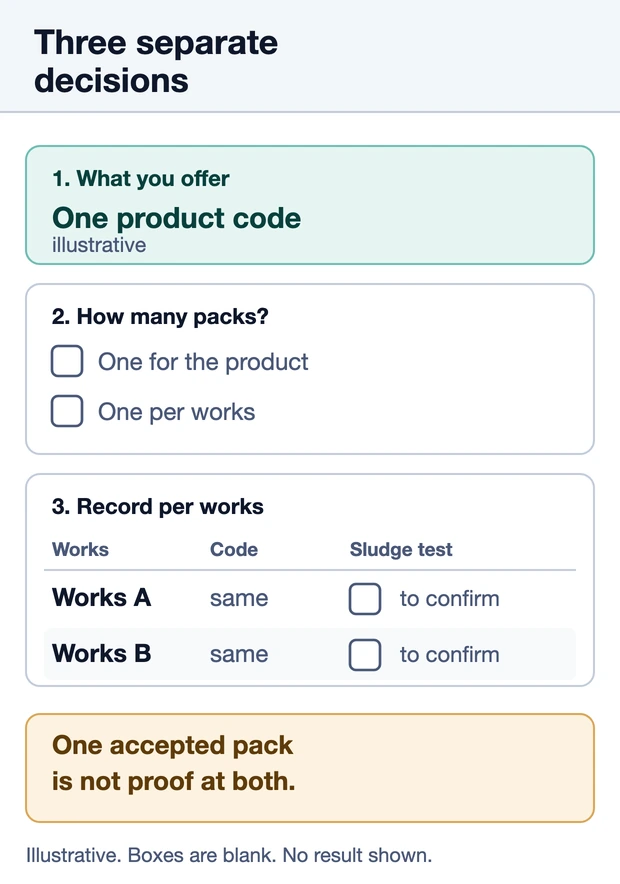
You are bidding sludge flocculant for four or five wastewater works, and you need to decide what actually goes in the box. One grade for the lot, or a different grade per plant? How many physical specimens, and what has to be written on each one? Send too many and you have paid to courier duplicate packs nobody asked for. Get the labelling wrong and a specimen can be set aside unevaluated, or a grade can carry a result from one works that was never tested on the sludge at the next one.
The answer comes from reading your own instruction rather than from a rule of thumb. Keep three things apart: the grade you propose, the number of physical specimens the invitation asks for, and the works for which the product is proposed and assessed. They are set separately, and conflating them is what causes both the over-ordering and the gap in evidence.
Buying for several works at once? Tell us how many plants you are covering and one sludge or equipment type you already know. We will come back with candidate cationic grades, the identifiers you need on a sample label, and a comparable quote.
Ask ChinaPAM about a multi-plant quoteThe three decisions, before you pack anything
Your tender instruction can settle most of this today, without a single phone call. Read it for three separate answers:
- How many grades are you offering? Where the bid permits it, you may propose one code for several works. Whether that is open to you is the invitation’s call, not a general entitlement, and offering one code is not a basis for assuming one product suits every sludge.
- How many physical specimens does the invitation ask for, and on what basis? Read what the count is keyed to. It may be keyed to each product offered, or to each product and physical form, and the quantity per specimen may be specified as well.
- Which works is the product proposed for, and how is performance assessed? These are separate from the specimen count. The instruction tells you what has to be declared on the container and what the testing is run against.
The two contracts below are both South African municipal flocculant purchases, and they handled specimens and site identification in their own ways. That is the reason to read your own document rather than copy a previous submission.
One product, one specimen: Johannesburg Water
Johannesburg Water’s bid for cationic polyelectrolyte flocculants, JW OPS 039/23 carries a scheduled closing date of 7 March 2024 on its cover page, and covered sewage sludge dewatering across several of the city’s wastewater treatment works. On the specimen count it is explicit: a tenderer submitting only one type of product needed only one sample, with no requirement to submit for each works (page 43).
That is a real saving, and worth checking for before you courier five identical packs. It is also written as an exception, which is why it is worth quoting rather than assuming. In that tender the specimen request went to the shortlisted tenderer, at one 0.5 kg sample per product offered, delivered to the city’s own laboratory (pages 41–42). Both numbers belong to that bid and that stage. They are not a standing sample size and not ours.
What the single specimen did not do is flatten the per-works paperwork. The same document still required technical data sheets as annexures for the product offered, for the wastewater treatment plant being tendered for (page 42). One specimen, still a works-scoped submission.
One more clause from that tender is worth naming precisely because it does not travel. Johannesburg Water had bulk integrated silos at several works and specified micro-bead form on that basis, excluding emulsions and powders (page 40). That is a statement about one buyer’s installed handling equipment, not a general preference and not a comment on what any other municipality should accept. Read your own specification for form before you assume anything about it.
Name the works on the container: City of Tshwane
The City of Tshwane’s water and sanitation chemicals bid, WSBU 04-2025/26 carries a scheduled closing date of 22 October 2025 on its cover page. It keys the specimen count to the product rather than to the works, and then puts the weight on identification.
On quantity, the sludge side of that bid asked for one 500 g sample of each powder product offered and one 500 ml sample of each emulsion product, in sealed containers. Powder and emulsion are the two forms its cationic polyacrylamide specification covers for sewage sludge conditioning. The separate one-litre cationic polyelectrolyte sample belonged to the same document’s potable-water arm, a blended liquid coagulant for drinking water rather than a sludge product, so do not read it as a third sludge specimen (pages 13 and 22). The sludge count there followed the products and forms offered, not the number of plants in the contract.
Identification is where the works came in. Each sample had to be packed and labelled with the tenderer’s name, the contents as product information and identification, the document’s reference number, and the site or works the product was recommended for (page 22).
That fourth item carried a hard consequence in that bid. Samples giving no indication of the site they were recommended for were not evaluated and were discarded, and samples were only tested for the sites indicated on their containers (page 22). A missing line on a label was not a correctable omission there; it removed the specimen from evaluation. Whether any other invitation treats it that way is a question for that document.
Testing followed the same logic. Tshwane’s bench-scale work used sludge from the wastewater treatment works per site, and the best-performing sample per plant meeting the stated criteria would be considered (pages 22–23). Performance was weighed plant by plant.
Put the two together and the shape of the decision is clear. Neither document ties the number of containers to the number of plants. Johannesburg Water said one specimen could stand for one offered product across works; Tshwane counted its sludge specimens by product and form. What Tshwane did require was that every works you propose the product for is named on the container, and that is what scopes the testing you get.
Two boundaries on the Tshwane document. It covers both potable water and wastewater, with raw-water jar tests and turbidity thresholds belonging to the drinking-water arm, so do not carry those numbers across to a sludge dewatering acceptance. And nothing in the labelling requirement says one grade cannot be recommended for several works. It says each recommendation has to be declared, and each declared site is then tested on its own sludge.
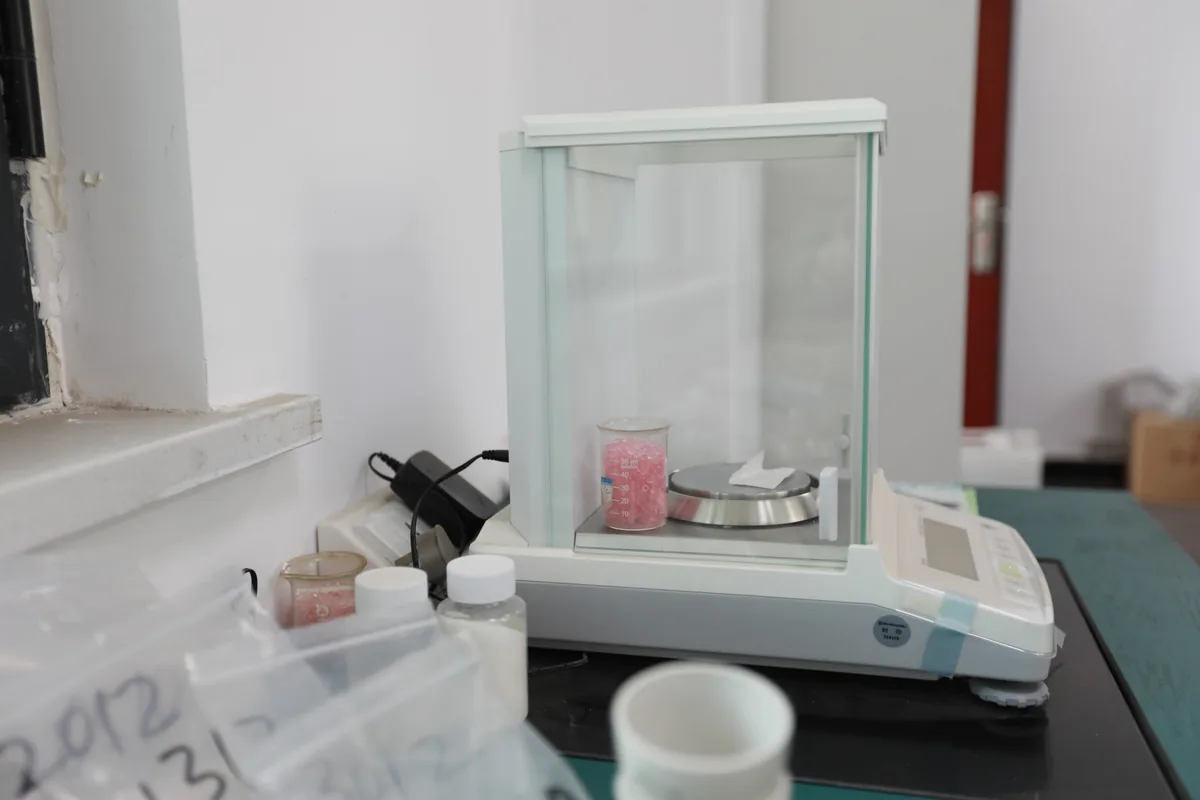
Laboratory balance and sample containers.
Your own sample register
Keep one line per works, not one line per specimen. That is the distinction that stops a result from one plant from quietly becoming your evidence at four. Identifiers do the matching, and more than one party holds them: your own register, what you wrote on the container, and whatever the buyer records on receipt. Tshwane, for instance, issued a letter as proof of submission and had the bidder complete and sign a submission register (page 22). Five columns cover your side, and on a phone the table scrolls sideways rather than collapsing:
| Works | Product code offered | Pack reference sent | Site sludge test record | Next action |
|---|---|---|---|---|
| Works A | Code 1 | to be confirmed | ||
| Works B | Code 1 | to be confirmed |
Illustrative rows. “Code 1” is a placeholder, not a grade we are proposing, and no test has been performed or implied here. Leave a cell blank or mark it to be confirmed rather than carrying a value across from another row.
The same code appears on both rows because proposing one grade for two works is a legitimate position where the bid allows it. What does not follow is copying the fourth column across. A test record belongs to the sludge it was run on. If Works A has a result and Works B does not, Works B’s cell stays empty, and that empty cell is the honest state of your evidence.
Two habits make the register worth keeping. Record the specimen reference you actually sent, so that when a result comes back you can say which container it refers to, and keep any receipt or acknowledgement the buyer gives you alongside it. And separate what the buyer has accepted from what you have proposed: a grade recommended for a works is your submission, while a test record and an approval are the buyer’s. Keeping those in different columns prevents your own paperwork from reading as an approval you were never given.
Five questions to settle before dispatch
Ask these of the tender document first, and of the receiving authority where the document is silent. All five are answerable before anything is packed.
- Which works are you proposing the product for? Name them on the container where the instruction asks for it. In the Tshwane bid a specimen with no recommended site was discarded, and testing covered only the sites named.
- How many specimens, keyed to what? Read what the count follows: each product offered, or each product and physical form, and the quantity per container. Neither document above counted by plant, but only your own invitation settles yours, including whether it asks for separate containers per site.
- What must appear on the label? Typically your name and contact, the product identification, the tender reference and the recommended works. Confirm the list rather than reusing a label from a previous bid.
- What documents travel with each pack? Safety data sheets and product data sheets are commonly required with the sample itself, and a missing one can remove a specimen from testing independently of the product.
- Who receives it, and how is each works’ result recorded? Get the delivery point and, where one is offered, the submission acknowledgement or signed register. Then ask how results are reported per plant, so your record matches theirs.
Where your document is silent on any of these, ask the buyer rather than deciding for them. A short written question before dispatch costs nothing; a specimen set aside for a missing label costs you the evaluation.
Sort the product side before you pack
The packing and labelling decisions are yours and the buyer’s. The part we can take off your desk is the product side: which candidate grades are worth putting in front of several works, what identification you will be able to put on a label, and a quote you can compare across sites.
For municipal sewage sludge dewatering our cationic polyacrylamide range for municipal sludge dewatering is the relevant one, and we will put forward candidate grades with their product identification, so that the code you write on a label and the code on your paperwork are the same thing. If the submission runs across several works, say so and we will quote on a basis you can compare site by site.
Two things are not ours to give, so we will not pretend otherwise. Whether one grade suits every works depends on each plant’s sludge and equipment, and the buyer’s own testing settles it. Your tender’s compliance requirements are between you and the municipality.
You do not need the full picture to start. The number of plants and one sludge or equipment detail is enough for a useful first reply. If you have a current grade, a dose or a dewatering equipment type at any one of the works, send that too and the answer comes back closer to what you will actually run.
Packing a multi-works submission?
Send one line: “Bidding sludge flocculant for three wastewater works, need candidate cationic grades and a comparable quote.” That is enough to start. Tell us one sludge or equipment type you already know and the reply gets more specific.
Request a quote or sample discussionOr read how we approach municipal wastewater treatment.
Frequently asked questions
Can I propose the same grade for every works?
Where the bid permits it, yes, and neither tender above forbids recommending one product for more than one site. Read your own invitation for whether it is open to you. Whether that grade performs at each works is a separate question, answered by that plant’s own sludge testing rather than by the fact that you proposed it once.
Do I need a separate container for each works?
Not in either document above. Johannesburg Water required only one sample where a tenderer submitted a single type of product, with no need to submit for each works. Tshwane keyed its sludge specimens to each product and physical form offered, at a stated quantity per container. If your invitation asks for separate containers per site, that is its own requirement and you should take it from the text rather than from these examples.
If one specimen covers several works, do I still complete paperwork per plant?
In the Johannesburg Water bid, yes. One specimen was enough for a single product offered, and the technical data sheet annexures were still completed for the plant being tendered for. Specimen count and documentation scope were set separately there, and that is the pattern worth checking for in your own document.
What happens if I leave the works off a sample label?
In the Tshwane bid, samples with no indication of the recommended site were not evaluated and were discarded, and testing only covered the sites named on the container. Where your instruction asks for the recommended works, treat it as a mandatory field rather than a convenience.
A grade passed at one plant. Does that carry to the next?
Not on its own. Tshwane tested with sludge from the works per site and considered the best-performing sample per plant against its criteria. A result describes the sludge it was run on. Leave the second plant’s record open until it has its own.
Can I use a raw-water jar test result as evidence for sludge dewatering?
No. Those are different duties with different criteria, and a bid covering both water and wastewater keeps them apart for that reason. A turbidity threshold from a potable-water test says nothing about dewatering performance on sludge.
Do you decide whether my submission is acceptable?
No. Acceptance is the buyer’s, and so is the testing behind it. We supply the product, its identification and a quote; you and the municipality control what is submitted and what is approved.