
Two retention aids, two reports, and one of them shows more ash in the finished sheet. That looks like the answer on its own, and it is not. Finished sheet ash is the mass fraction of residue left after an ignition test on the dry sheet, so the figure moves with the sample, the denominator and the furnace setting as well as with the polymer. Before you pay for machine time, it is worth five minutes checking whether the two numbers were ever comparable.
Send us one report heading, or just the grade of paper you make. We will help you work out whether the two figures can be compared, and quote a retention aid worth putting in a trial.
Ask ChinaPAM about your two offersA higher ash figure is not a ranking
Put the two offers side by side and the problem shows up in the headings, before you reach any value. Supplier reports in this area carry labels that look interchangeable and are not:
- “Ash content of the sheet, % w/w” — the residue left after an ignition test on a piece of the dry sheet, as a fraction of that piece.
- “First-pass ash retention, %” — a comparison of two process streams on the machine, not a property of the sheet.
- “Filler retention, normalised” — a bench ratio against a run with no polymer in it.
Those three answer different questions. One describes residue in the product you ship, one describes what the wire held on a single pass, and one describes a laboratory comparison against a blank. Ranking two suppliers across a mixture of them is not a close call; it is an arithmetic error.
What each figure actually answers
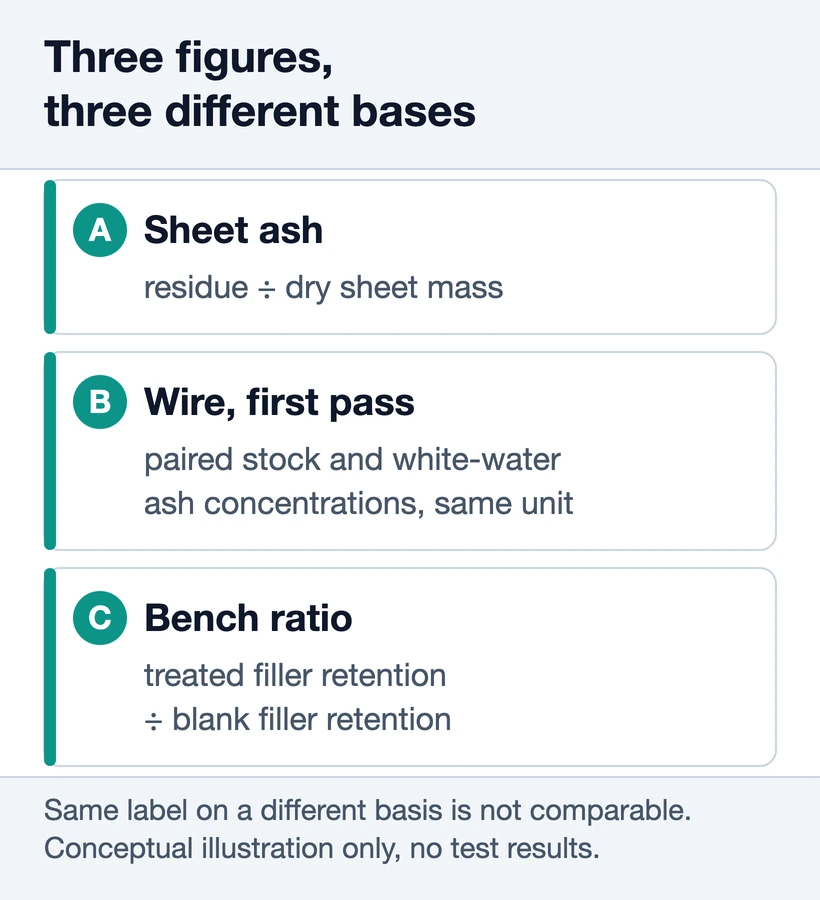
The figure at the top of this page pairs each of the three with what it is divided by. Work through them before you look at any value, because the useful question for each is not “is it high?” but “what was sampled, and what was it divided by?”
| Figure | What is sampled | What it is divided by | What it will not tell you |
|---|---|---|---|
| Ash in the finished sheet | Residue from a piece of the finished dry sheet, after the stated ignition test. | The dry mass of that same piece. | How much the wire retained on one pass, or how much mineral was fed to the furnish. |
| First-pass ash retention | Headbox stock and the white water it drained to, as a matched pair of whole suspensions. | The headbox ash mass concentration, with both streams measured in the same unit. | What the sheet you ship contains, or what happens over a shift. |
| Bench ratio against a blank | A bench furnish on bench equipment, not your machine. | Filler retention measured in its own matched no-polymer blank. | Absolute filler retention, sheet ash, or what the wire held. It is a relative ratio throughout. |
The middle row is the one worth being precise about, because its pairing is easy to lose. A published patent example that measures both quantities takes a headbox sample and the white water drained from that same stock, then works out total retention from the two suspension consistencies and ash retention from the two ash consistencies (EP4159769A1, published 2023, paragraphs 0132–0134). Note what that structure requires of a report: a named sampling point for each stream, and an ash mass concentration for both, in the same unit. A single ash fraction of dry solids does not supply either stream’s concentration, so a report that gives you one percentage and no sampling points has not given you a first-pass number you can check.
That example is a laboratory protocol from a patent document. It is cited here only for how the two streams pair up, not as a method you should adopt, a result you should expect, or any statement about the polymers in it.
The furnace setting can move the number on its own
This is the part that surprises buyers, and it is the strongest reason to ask for a method before you ask for a price. Burning paper to measure its mineral content is not a single fixed operation. The temperature is a choice, and the choice shows up in the result.
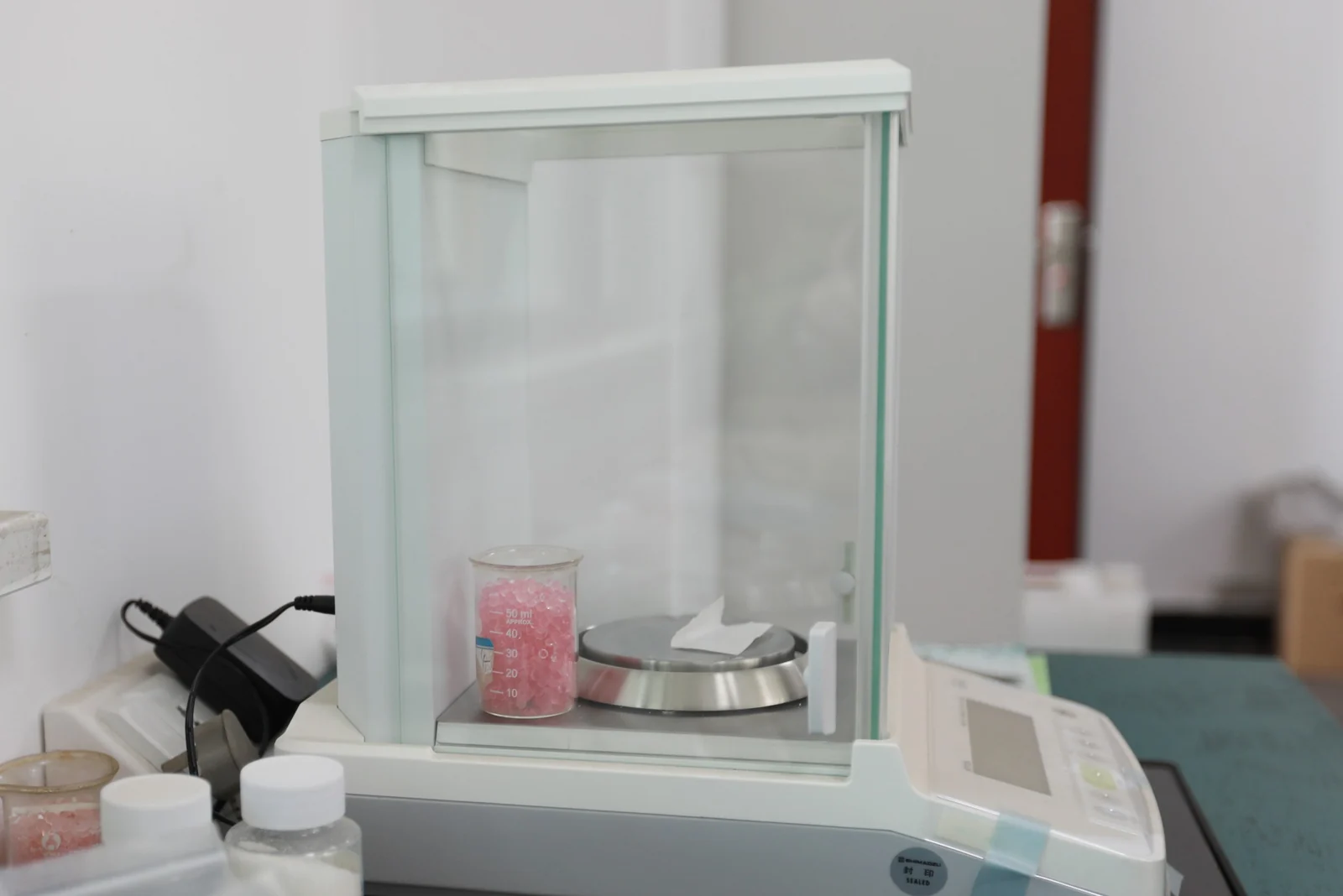
Laboratory balance with a glass draft shield.
A published study on isolating filler from paper makes the size of that effect concrete. Working with one commercial printing and writing paper containing a precipitated calcium carbonate filler, the authors ignited test pieces at several temperatures and weighed the residue each time. As a percentage of the starting paper weight, the ash they recovered was 18.5 at 600 °C and 10.9 at 800 °C (Ferreira et al., TAPPI Journal, November 2005, Table II). Pieces of the same sheet: the measured ash fell by 7.6 percentage points when the ignition temperature changed.
Read those numbers for one purpose only. They are not a standard, not a correction factor you can apply to your own figures, and not a recommended furnace setting for your mill. That study varied the ignition conditions of one sheet; it was not comparing retention aids. Your filler, your furnish and your laboratory’s procedure will behave their own way. What the result does establish is that ignition temperature belongs in any ash report you intend to compare against another one.
The practical point is small and it decides the comparison. If one supplier’s figure came from a different ignition temperature than the other’s, you may be looking at a method gap rather than a polymer difference, and nothing in either report will tell you which. Sample conditioning sits in the same category: a report you can compare states how the sample was dried and held, rather than leaving you to assume it.
Bench retention as a percentage of its blank
The third basis trips people up in the opposite direction, because it looks like the most scientific of the three. The published bench work pins the definition down. One peer-reviewed study ran a bench eucalyptus-fibre and PCC furnish on its own drainage apparatus and reported filler retention normalised to a run with no flocculant in it (Antunes et al., Industrial & Engineering Chemistry Research, 2008). That is the shape of the figure: the filler retention measured in the treated run, divided by the filler retention measured in its own matched blank. It may reach you written as a percentage of baseline, which is a legitimate way to express a ratio, but a relative result is not absolute filler retention, not sheet ash and not what the wire held on a pass. So the question to put to another report is which baseline its percentage was measured against.
Two consequences for a buyer. The ratio cannot be copied into a sheet-ash percentage or into a first-pass retention percentage, because it shares a denominator with neither. And the blank is part of the result, so two laboratories with different blanks are not reporting on the same scale even when both write “normalised”. That study used its own apparatus, its own dilute furnish and experimental polymers, which is a reasonable way to compare polymers against each other under controlled conditions and not a prediction of anything on a running machine.
None of this makes bench data worthless. It makes it a screening tool whose numbers belong on their own axis. If a supplier offers a bench ratio and you want to understand what still has to be proven on the machine, our retention and drainage trial guide sets out how a machine trial is designed and what a bench result can and cannot carry into it.
The check to run on both reports
Go down this list with both documents open. You are not auditing anybody; you are finding out whether the two figures sit on the same scale. Anything you cannot answer from the report is a question worth asking before a trial, not a reason to disqualify a supplier.
- Same product and furnish. One grade, one furnish, the same filler type and the same target loading. A different grade on the other report makes the pair uninformative whatever the method.
- Same starting filler and process conditions. If filler addition, machine speed or wet-end chemistry moved between the two runs, those sit alongside the polymer as candidate explanations.
- For a sheet-ash figure: the method, the basis and the temperature. Ignition temperature, how the sample was conditioned, and whether the percentage is of dry sheet mass. All three, stated.
- For a machine figure: both sampling points and when they were taken. Headbox stock and the white water it drained to, sampled for the same condition, with both ash figures on the same concentration basis.
- For a bench figure: the blank and the apparatus. What the result was normalised against, and on what equipment. A ratio without its blank is not interpretable.
- Dose and how it was fed. What the dose number refers to, product as supplied or active polymer, and where it entered. Two reports on different dose bases cannot be compared at equal cost either.
- How many runs sit behind each number. A single pair of readings and an average over a week are different kinds of evidence.
One warning about matching labels, because it is the failure mode this whole check exists to catch. Two reports both headed “first-pass ash retention, %” can still be built on different sampling points, different ash methods or different denominators. The heading agreeing does not establish that the polymer caused the difference between the values underneath it.
Which of three things to do next
Once you have been through the list, the answer is usually obvious, and it is one of three.
| What you found | What to do |
|---|---|
| Same figure, same sample and denominator, same method, comparable conditions. | Compare as reported. The difference is informative for those conditions. Shortlist and move to a machine trial. |
| Everything lines up except one field that was simply not reported — the ignition temperature, a sampling point or the dose basis is missing. | Ask the lab for that one field. It is a short email. If the figures were in fact measured the same way, the answer makes the pair usable with no new testing. |
| A field is reported and the two differ — different ignition conditions, different sampling, different doses, or a mix of the three bases. | Ask for comparable data, or retest on paired samples before you select a grade. Being told the numbers were measured differently does not repair the comparison; agree the sample, the method and the dose basis with both suppliers first. |
Keep price in its place in that sequence. A quotation only becomes meaningful once a candidate is a credible technical fit, because a lower price against an incomparable performance figure is not a saving you can count on. Work out the technical comparison first, then compare cost on the grades that survive it.
The one line to send your supplier
If you only do one thing from this article, send this. It fits in an email, it asks for method rather than argument, and the reply tells you immediately whether the figure can be compared:
“For the retention figure in your report, please confirm: which figure it is (finished-sheet ash, first-pass ash retention, or a bench result normalised to a blank); what was sampled and what the figure is divided by; for a sheet ash figure, the ignition temperature and how the sample was conditioned; for a machine figure, the two sampling points and when they were taken; the dose and whether it is on a product-as-supplied or active basis; and how many runs sit behind the number.”
Send the same line to both suppliers. Whichever way they answer, you end up with two figures you can either compare or knowingly set aside, which is the whole point of asking.
Bring us the two reports
We supply cationic, anionic and non-ionic polyacrylamide, and our range includes cationic PAM for paper retention and drainage. We are glad to go through a pair of reports with you before anybody books machine time. The useful conversation is which of the three figures you are actually holding, what is missing from each, and which grade is worth a trial on your furnish and filler. If the comparison turns out not to be usable, we will say so rather than talk past it.
Start with whatever you have in front of you. One report heading, or just the grade of paper you make, is enough to open a useful discussion; you do not need to assemble a dataset or attach anything to get an answer. From there we can identify the first missing item, suggest a grade direction for your furnish, and quote the candidates worth testing. For the application background behind these programmes, see our paper-making solutions overview.
Two retention-aid offers, and no way to rank them?
Send one report heading or the paper grade you run. We will go through which figures you are holding, what to ask for first, and quote the retention-aid grades worth a trial on your furnish.
Contact ChinaPAMSources
- Ferreira, Velho, Figueiredo and Mendes, “Effect of thermal treatment on the structure of PCC particles”, TAPPI Journal vol. 4 no. 11, November 2005. Cited for Table II, the ash recovered from pieces of one commercial PCC-filled paper at different ignition temperatures, and for the conditioning described in its method: eq.uc.pt — Paper_16.pdf
- Antunes et al., “Use of New Branched Cationic Polyacrylamides to Improve Retention and Drainage in Papermaking”, Industrial & Engineering Chemistry Research vol. 47 no. 23, 2008. Cited for the practice of reporting bench filler retention normalised to a no-polymer blank: eq.uc.pt — Paper_13.pdf
- EP4159769A1, published 5 April 2023, paragraphs 0132–0134. Cited only for the sample identity in its first-pass comparison, headbox stock against the white water drained from it: data.epo.org — EP4159769A1
The figures quoted from the 2005 study belong to the single commercial sheet tested there. They are not a standard, a correction factor, a recommended furnace setting or a performance result for any product, and nothing above reports a ChinaPAM test, trial or customer outcome. The 2008 study and the patent example are laboratory work on their authors’ own equipment and furnishes. The report check and the three next steps are a comparability framework to use against your own documents, not a specification, a dosage or a promised result.
Frequently asked questions
Both reports quote a percentage. Is that not enough to pick one?
Not on its own, because a percentage is only meaningful with its denominator. Finished-sheet ash is residue divided by the dry mass of that sheet, first-pass ash retention is divided by the headbox ash mass concentration, and a normalised bench figure is treated filler retention divided by the filler retention in its blank. Two percentages built on different denominators are two different measurements that happen to share a symbol, and the higher one is not automatically the better product.
Our supplier will not give the ignition temperature. Is that a red flag?
Not by itself. Ask once and see what comes back. If the temperature turns out to be unavailable, you have not caught anyone out, but you also cannot treat that figure as comparable to one measured elsewhere, so the sensible path is a paired re-test on an agreed method rather than ranking the two numbers anyway.
Can we convert a sheet ash percentage into first-pass ash retention?
No. They are measured on different samples against different denominators, and no general factor connects them. A conversion would also need information neither figure carries, such as what each stream contained at the time of sampling. If you need the machine figure, it has to be measured as a matched pair of samples; there is no arithmetic shortcut from the sheet.