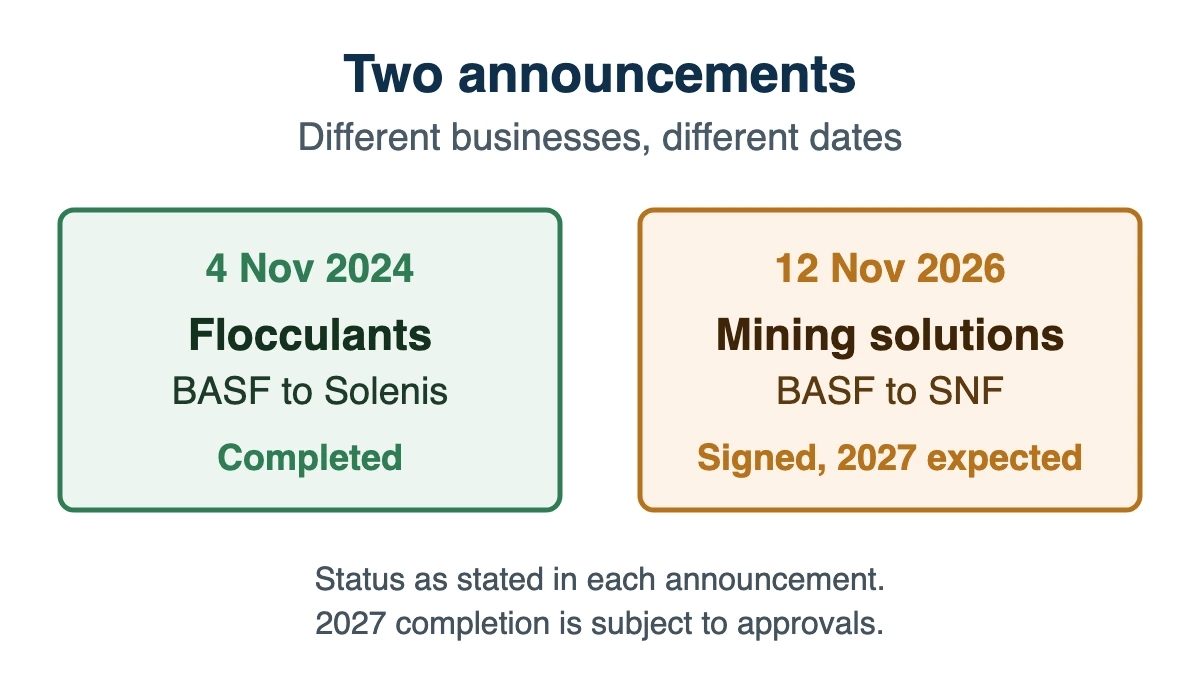
Two BASF announcements are circulating and they describe different businesses on different dates. BASF's release dated 4 November 2024 reported the sale of its mining flocculants business, with Magnafloc and Rheomax among the transferred trademarks, to Solenis as completed on 1 November 2024. A separate release dated 12 November 2026 announced a signed agreement to sell its mining solutions business to SNF; the status it gives is in the table below. Neither announcement tells you who invoices your plant today, so confirm the current seller and the current document revision with whoever quotes you. If you also want an independent polyacrylamide option assessed, send us the grade name or a photo of the bag label — that is enough to start a comparison and a quote discussion.
The two announcements, side by side
| Flocculants announcement | Mining solutions announcement | |
|---|---|---|
| Announcement date | 4 November 2024 | 12 November 2026 |
| Status as announced | Completed 1 November 2024 | Agreement signed; completion expected in 2027, subject to merger clearance and customary conditions |
| Business described | Mining flocculants business; Magnafloc and Rheomax among the trademarks | Mining solutions business; leaching, flotation and solvent extraction reagents |
| Named buyer | Solenis | SNF |
| Source | BASF release P-24-305, with a Solenis release the same day | BASF release P-26-193, mirrored by SNF |
Two things to keep straight when reading either one. The trademark names in the 2024 release are part of a longer list, so a brand's absence from what is quoted anywhere, including here, is not evidence that it sat outside that transaction. And placing the two scopes side by side is our reading of what each announcement says, not an official position of BASF, SNF or Solenis. If a contract or tender depends on it, get it confirmed by the party quoting you.
Where to take your enquiry
You need the branded original. Ask your current supplier, or the party quoting you, which entity sells and warrants that grade now and which revision of the data sheet is current. That is a question only they can answer for your account.
You want an independent polyacrylamide option assessed. This is where we can help, and a period of commercial change is a reasonable moment to look at a second qualified source. Send the grade name or a label photo and we will work through which of our anionic or cationic polyacrylamides is a candidate for your duty, what we can document up front, and what a trial would need to show. Our guide to BASF Zetag and Magnafloc alternatives from China covers grade-level screening, and the Magnafloc 336 alternative page shows how we document one grade.
You are buying a flotation, leaching or solvent extraction reagent. Those sit outside our polyacrylamide range. Send the grade name and we will tell you plainly whether it is something we can quote.
What to have ready before comparing offers
These are our purchasing recommendations, not anyone's official requirement. The first two are the ones worth collecting before you write to anybody; the rest are questions to put to each supplier.
- Record the grade designation exactly as printed, including any suffix, and the supply form. Copy it from the bag or the data sheet rather than from memory. Suffixes and form designations vary between brand families, so an exact transcription is what keeps both sides discussing the same item.
- State the separation duty. Tailings thickening, concentrate dewatering, coal fines recovery and process water clarification are different jobs, and the duty is what determines which polymer family is even a candidate.
- Ask which revision of the data sheet is current, and who issues it now. The revision and the issuing entity are what tell you how current a figure is.
- Ask which legal entity supplies and which warrants. The name on the label and the name on the invoice are not always the same.
- Ask each supplier to state in writing whether the offer is the branded original or an independent alternative. Both are legitimate offers; which one you are holding should never be left to inference.
- Ask for the basis behind any dose or consumption figure — whether it refers to product as supplied or to active polymer. Request it on the same basis from every supplier so the numbers can sit next to each other. For what each document can and cannot establish, see our guide to reading a PAM COA, TDS and SDS.
Agreeing the comparison before anyone tests

A comparison is easier to act on when the conditions and the measure are settled in advance rather than argued about afterwards. Agree what feed the trial runs on, how the solution is made up and dosed, which result you are judging, and that every candidate is assessed the same way. Record those conditions alongside the result so a later repeat means something. Our sample-to-bulk qualification workflow sets out how that progresses from a bench screen to a plant trial to a bulk order.
Send a grade name and we will tell you which of our products is a candidate, what evidence we can provide immediately, and what a trial would need to demonstrate before a bulk commitment. ChinaPAM manufactures polyacrylamide independently and is not connected with BASF, SNF or Solenis.
Start with the grade name
If you hold a specification naming a mining flocculant grade and you want an independent polyacrylamide source assessed against it, that is a short first message. Contact ChinaPAM with the grade designation or a photo of the label. Add the duty and your annual tonnage if they are to hand; if not, send the grade name and we will ask for what we need. You will get a view on whether the duty suits our range, what a comparable specification looks like, and what a quote would be based on.
Common questions
What do you need from me to discuss an alternative?
The grade name, or a photo of the label. That alone lets us say which polymer family is in scope and what we would need to check. Useful additions, whenever you have them, are the separation duty, your current form and dose, and the result you judge performance by. Those can follow in a second message rather than hold up the first.
My data sheet still carries a former owner's branding. Is it out of date?
Not necessarily, and the branding on the header is not what settles it. Check the revision number and date on the document itself, then ask the party quoting you whether that revision is the current one and who issues it today. A sheet can remain an accurate description of a grade, and the only reliable way to know is to confirm the revision rather than judge by the logo.
Can you match a named grade exactly?
We do not offer an exact-equivalence claim, and we would be cautious of anyone who does on paper alone. What we can do is identify a candidate polyacrylamide for the same duty, set out the specification side by side, document what we hold, and agree with you what a trial has to demonstrate. That is the basis a comparable quote should rest on.