Every paper mill we ship CPAM to is chasing the same three numbers: first-pass retention, drainage rate, and white water consistency. Get retention above 85% and the whole wet end relaxes — less filler in the white water, less ash in the broke, fewer deposits on the wire. We run CPAM for paper-making mills in 14 countries, and the pattern is boringly consistent: the mills that treat retention as a system (polymer + micro-particle + DCS control) beat the ones that just throw a single product at it.
This is the working guide we send to paper mill technical managers before they place an order. It covers the four jobs PAM does on a paper machine, the specific CPAM grades we run for each, the dosage math, and the deposit/anionic-trash problems that sink first-time users. If you only care about the spec table, scroll to the first table below.
Our CPAM Grades for Paper Making
| Grade | Use Case | Molecular Weight | Charge Density | Dosage (kg/t paper) |
|---|---|---|---|---|
| CPAM-PM1 | Retention aid, virgin fiber | 12-15M | 20-30% | 0.3-0.6 |
| CPAM-PM2 | Retention, recycled fiber | 10-12M | 40-55% | 0.5-1.2 |
| CPAM-PM3 | Drainage aid | 8-10M | 30-50% | 0.5-2.0 |
| CPAM-PM4 | Dry strength (glyoxylated) | 1-3M | 10-25% | 3-10 |
| CPAM-PM5 | White water / DAF | 8-12M | 50-70% | 2-8 per t DS |
| APAM-PM6 | Mill effluent (post-DAF) | 18-22M | 10-25% | 1-4 per t DS |
MW = viscosity-average. All grades: solid content ≥90%, residual acrylamide monomer ≤0.05%. CPAM-PM4 is glyoxylated and needs to be dosed into the short loop; PM5/6 are the same chemistries we use in municipal sludge dewatering.
1. Retention Aid: Keeping Fines and Filler on the Sheet
In the wet end, fine fibers, fillers (PCC, GCC, kaolin), and fines smaller than the wire opening drop straight through into the white water. Without a retention program, first-pass retention sits at 50-70% — meaning a third or more of your filler loads the short loop and eventually shows up in the broke or the DAF. We have seen mills running at 55% FPR lose roughly $1.80-2.40 per tonne of paper in wasted filler alone.
CPAM works by adsorbing onto anionic fiber and filler surfaces, bridging them into larger aggregates that the sheet captures. Per TAPPI (Technical Association of the Pulp and Paper Industry) retention measurement guidelines, a well-tuned CPAM program at 0.3-1.0 kg/tonne paper pushes FPR to 85-95% and ash retention to 55-75%.
Grade selection depends on furnish. Virgin bleached kraft is clean — PM1 (12-15M, 20-30% charge) gives large flocs and good drainage. Recycled OCC/DIP has heavy anionic trash (DCS) that eats low-charge polymer; use PM2 (10-12M, 40-55% charge) at 0.5-1.2 kg/t. Coated broke furnishes with high ash (30%+) also need the higher-charge PM2.
Dose point matters more than dose rate. Add CPAM after the fan pump and before the pressure screens — long enough to disperse, short enough that shear does not break the flocs. Adding too early gives overflocculation; too late gives poor dispersion.
Dual-Component and Micro-Particle Systems
Modern retention programs often run dual-component (CPAM + bentonite) or micro-particle (CPAM + colloidal silica). The CPAM first forms macroflocs, shear breaks them on the screens, then the bentonite/silica reflocculates the sheared fragments into denser, drainage-friendly microflocs. This adds 3-6% to FPR and 8-15% to drainage versus single-polymer programs.
For these programs we dose our PM2 at 0.4-0.8 kg/t and recommend 1.5-3 kg/t bentonite or 0.3-0.6 kg/t colloidal silica. The polymer cost per tonne paper actually drops because you cut the CPAM dose. If you are planning to put one of these on the machine, our micropolymer retention and drainage trial guide lays out how to structure the mill trial and read the results.
2. Drainage Aid: Faster Dewatering on the Wire
Drainage sets machine speed. If you are water-limited on the wire, production is capped regardless of pulp supply. CPAM improves drainage by flocculating the fines that would otherwise plug the wire, opening drainage channels.
For drainage-limited machines we use PM3 (8-10M, 30-50% charge). The slightly lower MW produces smaller, denser flocs that hold together through the press section rather than large, water-holding flocs that squeeze out poorly. Typical result: 10-20% faster drainage and 5-15% machine-speed upside at the same basis weight.
Quick diagnostic: if your dryness after couch roll is below 18%, you are drainage-limited and a PM3 trial is worth the polymer cost. If you are already above 22%, further drainage gain is marginal and the money is better spent on retention or strength.
3. Dry Strength Agent
Low-MW CPAM (1-3M Da) forms hydrogen and ionic bonds at fiber-fiber contacts, lifting tensile, burst, and ring-crush. Glyoxylated CPAM (PM4) is the standard for recycled-fiber linerboard and fluting where virgin fiber strength is not available.
We typically see 10-20% tensile and 15-25% burst improvement at 3-10 kg/t dosage. For recycled linerboard mills, that is often the difference between meeting the 150 N·m/g ring-crush spec and missing it. PM4 dose point is critical — add into the stock line after the refiner but before the fan pump, so it has dwell time to penetrate the fiber network.
Glyoxylated grades have a shelf life of 4-6 months in solution form and 12 months in powder. We ship powder to avoid the shelf-life problem — mills dissolve on-site and use within the same shift.
4. White Water Treatment (Saveall / DAF)
Even at 90% FPR, the white water still carries 1,000-3,000 mg/L of suspended solids — fibers, fines, fillers, and dissolved organics. Most mills run a DAF or disc filter to reclaim this material, and PAM is the flocculant.
For DAF we use PM5 (8-12M, 50-70% charge) at 2-8 kg per tonne of dry solids recovered. The high charge density handles the heavy anionic load in short-loop white water. Recovered solids go back into the furnish, so the dose essentially pays for itself in filler and fiber reclaim.
For full mill effluent (post-DAF overflow plus other mill streams), we use APAM PM6 at 1-4 kg per tonne DS. The chemistry is the standard anionic sludge-dewatering PAM we cover in our municipal WWTP guide.
Anionic Trash: Why Your Polymer Stops Working
The single most common complaint from recycled-fiber mills: "the polymer worked for three months, then retention crashed." Nine times out of ten, the answer is anionic trash buildup. Dissolved and colloidal substances (DCS) — stickies, hemicellulose fragments, dispersants from coated broke — consume cationic charge before it reaches the fiber.
Measure it: cationic demand titration with polyDADMAC should come back under 1,000 µeq/L for a healthy short loop. Above 2,000 µeq/L, no amount of CPAM will fix retention — you are feeding the DCS. According to Confederation of European Paper Industries (CEPI) wet-end best practice, recycled-fiber mills running closed water systems should monitor cationic demand on a weekly cadence at minimum.
Fixes, in order of cost:
- Add a fixative: polyDADMAC or aluminum chlorohydrate at 0.5-2 kg/t, dosed before the CPAM. This neutralizes the DCS and lets the PAM work as intended.
- Increase CPAM charge density: swap PM1 for PM2, or PM2 for a 60-70% charge grade.
- Reduce white water recirculation: bleed more water to the effluent plant. Cuts DCS but hurts water balance.
- Kidney treatment: install a DAF on the short loop to remove DCS before it builds up.
Need PAM for paper mill retention?
Free sample + jar test report. WhatsApp: +86 187-3759-0940
Jar Testing for a New Mill
Before any trial we run jar tests on the mill's actual stock. Take 500 mL of thick stock (or white water for DAF trials), add CPAM at 0.2, 0.4, 0.6, 0.8, 1.0 kg/t as 0.1% working solution, stir 30 sec at 200 rpm, then measure Britt jar retention or simply observe floc size. The dose where floc size stops improving is your starting point — mill optimization usually lands within ±20% of that number.
For drainage trials, the Schopper-Riegler or CSF measurement on treated stock against untreated gives the drainage improvement directly. Our applications team sends a jar-test kit with every first order.
Worked Example: 180,000 t/y Recycled Linerboard
Modelled, not a delivered project. Take a 180,000 t/y recycled linerboard machine on 100% OCC furnish, running 68% FPR with 24% ash retention, speed capped at 720 m/min by wire dewatering, DAF overflow at 1,500 mg/L TSS. Every one of those numbers is a symptom of the same thing: fines and filler passing through the sheet instead of being retained in it.
A three-part program addresses it — CPAM PM2 (10M, 48% charge) at 0.9 kg/t as the retention aid, polyDADMAC fixative at 0.7 kg/t ahead of the fan pump to handle anionic trash, and PM5 on the DAF at 4 kg/t DS. Allow six weeks of optimisation. Modelled outcome:
- FPR: 68% → 89% (+21 pts)
- Ash retention: 24% → 62%
- Machine speed: 720 → 795 m/min (+10%)
- DAF overflow TSS: 1,500 → 320 mg/L
- Filler savings: $3.40/tonne paper
Note the shape of the economics: the polymer program itself costs roughly $0.90/tonne more, and it is worth it because filler reclaim plus the speed upside is several times that. On 180,000 t/y the net lands in the high six figures annually. Substitute your own filler and polymer prices — the ratio survives, the total will not.
Our Paper-Grade PAM Production
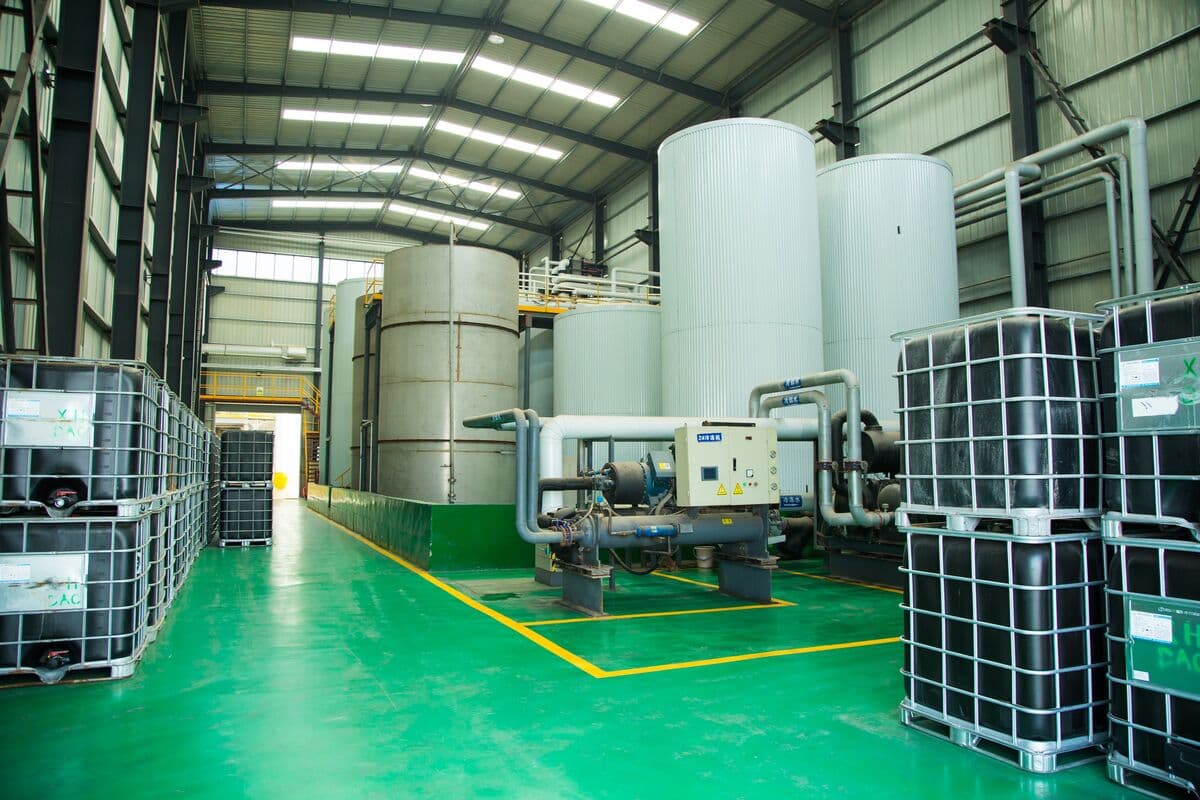
We produce paper-grade CPAM at our Xinxiang factory, with polyacrylamide production since 2009 behind the ChinaPAM export brand. Documented PAM annual capacity is 100,000 tonnes/year; paper-grade availability is confirmed by grade and order schedule.
- Three-stage QC: monomer input, mid-polymerization viscosity, final product (solid content, charge density, residual monomer, dissolution time)
- Spec guarantee: solid content ≥90%, residual acrylamide ≤0.05%, dissolution time ≤90 min at 0.1% in mill water
- Documents: TDS, SDS, batch COA, and buyer-required regulated-use document review for PM4/PM5 grades when applicable
- Export: export orders ship from China through Qingdao or Shanghai ports
For a full breakdown of how CPAM charge density maps to application, see our CPAM bulk wholesale guide, or the molecular weight guide for how MW affects floc size and drainage.
Economics: What Retention PAM Actually Costs vs Saves
Paper mills often compare polymer cost per tonne of paper without accounting for the downstream savings. Here is the real math for a 200,000 t/y packaging paper mill running 30% GCC filler:
- Filler cost: GCC at $80/tonne delivered
- Without retention program: FPR 60%, ash retention 30%. Filler loss to white water: 70% of 30% loading = 21% of sheet weight lost. At 200,000 t/y, that is 42,000 tonnes of filler passing through the system, of which ~12,600 tonnes are lost to effluent/broke = $1,008,000/year in wasted filler
- With CPAM retention program: FPR 88%, ash retention 65%. Filler loss drops to ~10,500 tonnes passing through, ~3,675 tonnes lost = $294,000/year
- Filler savings: $714,000/year
- CPAM cost: 0.7 kg/t × 200,000 t/y = 140 tonnes/year × $1,400/tonne = $196,000/year
- Net savings from filler alone: $518,000/year
- Additional savings: 10% machine speed increase (from better drainage) = 20,000 extra tonnes/year capacity. At $50/tonne margin = $1,000,000 potential revenue
The polymer pays for itself 3-5× on filler savings alone. Add the speed/capacity upside and it is the highest-ROI chemical on the wet end.
Frequently Asked Questions
Can I use anionic PAM as a retention aid?
No. Paper fibers and most fillers carry negative surface charge. Anionic PAM would be repelled, not adsorbed. You need cationic PAM to bridge the negatively charged surfaces. The only exception is in dual-polymer systems where APAM is added after CPAM to create a polyelectrolyte complex — but this is rare and only used in specialty tissue grades.
How do I know if my retention program is working?
Three measurements: (1) First-pass retention via Britt jar or online consistency meter — target 85%+. (2) White water consistency — should be stable at 0.3-0.8% and not trending up. (3) Ash content in broke — if it is climbing, your filler retention is dropping. Check all three weekly; if any trends wrong, run a cationic demand test to check for DCS buildup.
What happens if I overdose CPAM?
Overflocculation. Large, loose flocs that trap water and resist pressing. You will see: (1) formation problems — lumpy sheet, poor uniformity; (2) worse drainage paradoxically — big flocs seal the wire; (3) deposits on forming fabrics. If you see these symptoms, cut dose by 30% and check if formation improves. The optimal dose is always just below the overflocculation threshold.
Powder vs emulsion for paper mills?
Both work. Powder (our standard) is cheaper per active kg and has 24-month shelf life. Emulsion dissolves faster (5-10 min vs 60-90 min for powder) and is preferred by mills without a dedicated make-down system. We supply both forms for all paper grades. See our emulsion vs powder comparison for detailed pros/cons.
Ordering and Trials
MOQ is 500 kg for first orders, flexible for trials. Standard lead time 7-10 days; rush orders 3-5 days out of Qingdao. Sample kits (5 × 1 kg of different grades + jar-test procedure) are free for qualified mills.
Send us your furnish composition, machine type and speed, current retention/drainage numbers, and any existing polymer program — we will recommend a trial plan and ship samples. Most mills run a 2-week parallel trial against their incumbent before committing to a contract.
WhatsApp +86 187-3759-0940 or request a quote. Technical questions go straight to our applications team — not sales.
Get a Quote
Our factory in Xinxiang produces confirmed grade availability across core APAM, CPAM, NPAM, and PHPA products. MOQ 500kg, delivery 7-10 days standard. Contact us for pricing and free sample:
- WhatsApp: +86 187-3759-0940
- Email: info@chinapolyacrylamide.com
Recommended Product Grades
For the application discussed above, these are the polyacrylamide grades we ship most often:
See the full range of pulp and paper mill applications for equipment context and selection criteria across this industry.
For wet-end programme context, see our retention and drainage solution and our starch and fibre recovery solution.
Not sure which is right for you? Try our PAM Selector tool or request a quote.
For a complementary view, see our PAM in paper making applications.